

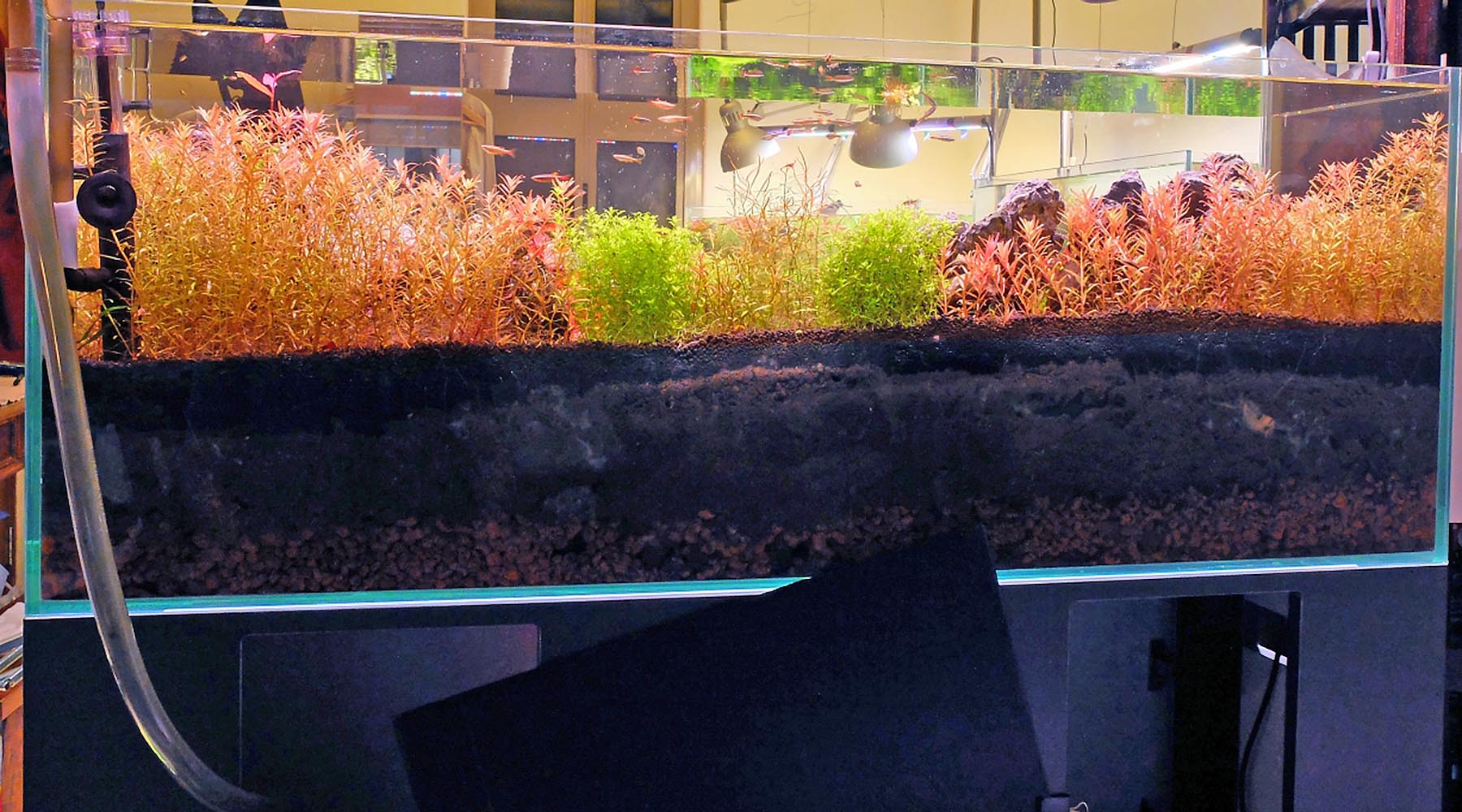
Building up layers with by stacking rocks and hardscape
There are two approaches. The approach used by most competition aquascapers is to create steep slopes by simply layering rock/wood thickly. The rock itself becomes the slope. Lighter rock, such as lava rock, is often used as the base, with more aesthetic rock on the surface. Cosmetic sand/aquasoil is then used to fill in the gaps. This approach uses a lot of rock, but gives the most flexibility in positioning the hardscape.

In this hardscape by Takayuki fukada, the rear rock is elevated using bricks.

In such landscapes, the rock and wood itself is planted with mosses and plants that can grow on the hardscape. Less use is made of rooted plants. Again, this approach offers the most flexibility in terms of hardscape design - you are not restricted to planting in areas with substrate.
Building up layers by having a thicker soil layer at rear
Aquascapers who wish to have large areas of rooted plants use this method. Aquasoil is layered thickly at the rear, with less soil at the front, and hardscape is formed into ridges and used to hold back the slope. Cosmetic sand can also be used. Planting needs to be done carefully at the start; once the plants are rooted they will also hold the soil in place. It is also best to avoid fish, which will disturb the substrate layer and cause the slope to slide.
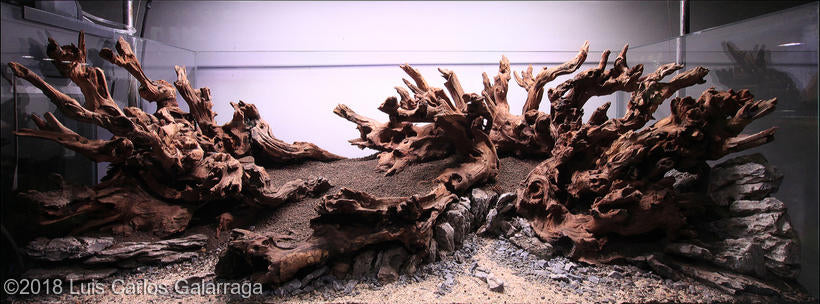

In this example by Luca Galarraga, Aquasoil is used thickly at the rear, while cosmetic sand is used at the front of the planted tank, where there are fewer rooted plants. Hardscape forms ridges that hold back the soil slopes.
Where very deep layers of soil are used to construct slopes, drainage crate/flo-cells can be used to support the soil/hardscape. The deeper layers are then filled with a large porous inert substrate such as small sized lava rock and clay chippings.
This porous inert layer prevents compaction of the deeper soil layers. In general, I would want the topsoil layer to be less than 4 inches or so. This applies mainly to raw soils. Aquasoils, with their large pore spacing due to the granular format, have less problems with compaction even on very deep slopes.




Share:
How deep can I layer soil? Does thick soil always become anaerobic and cause problems?
Which substrate to use for which tank style?