

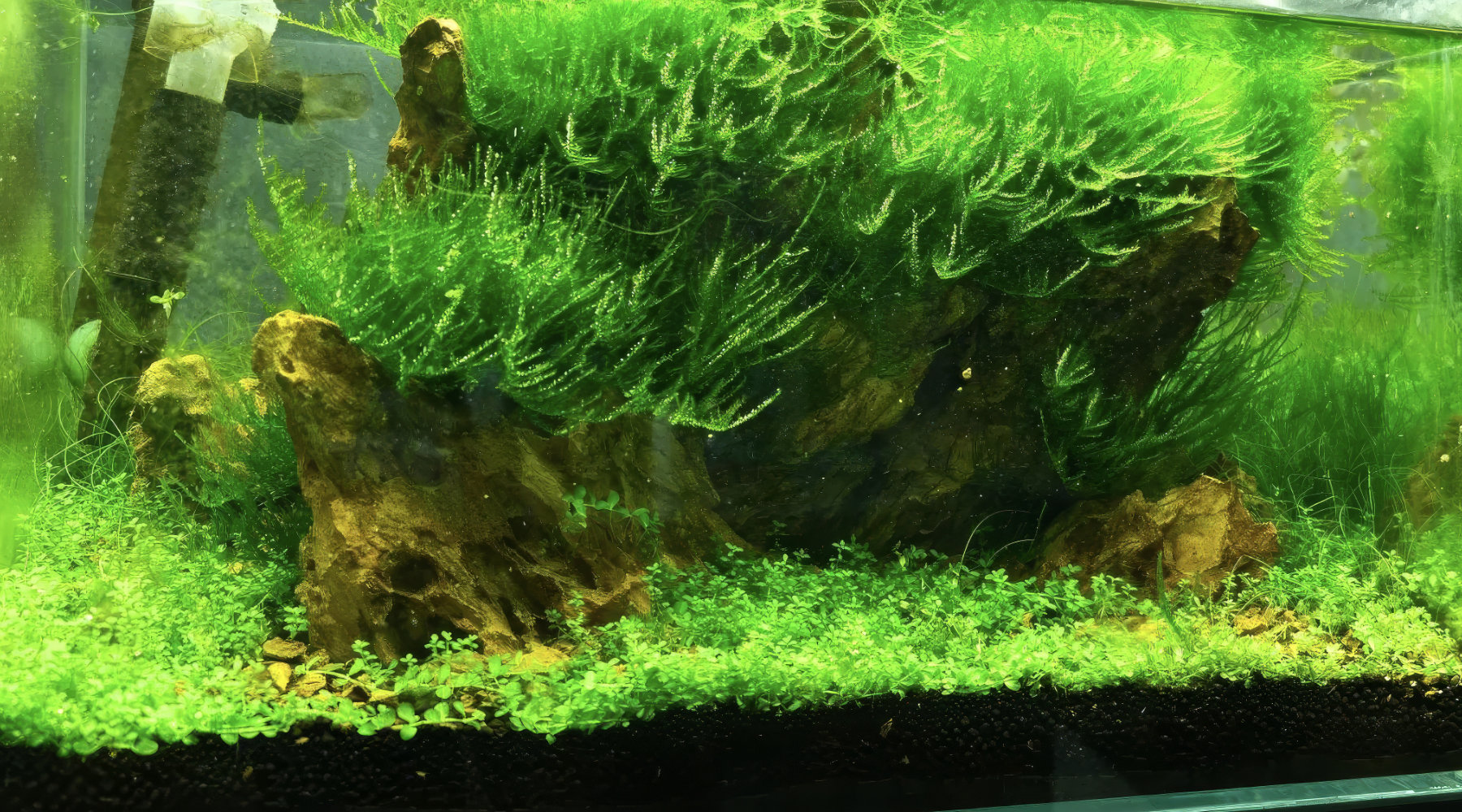
An algae free tank is not about killing every algae species, but about balancing light intensity, CO2, and nutrient levels so healthy plants outcompete visible algae and any algae growth stays modest and easy to wipe from aquarium glass and hard surfaces. A few dots of green spot algae on old plant leaves is perfectly normal; a full-blown algae bloom in the aquarium is your tank telling you something is off. This article will describe the common types of algae that spawn in planted aquariums, and how aquarium hobbyists can combat algae growth.
-
Identify the specific algae type first: green dust algae, green spot algae, black beard algae, brown algae (diatoms), blue green algae (cyanobacteria), green filamentous algae (hair, fuzz, thread), staghorn algae, or green water.
-
Trace the triggers and differentiate whether it is a passing short term issue that one can ride out or a more fundamental flaw in the system that requires substantial adjustments.
-
Short term issues: spike in organic waste levels (such as adding a large amount of fish at one time), CO2 fluctuations due to adjustments, nutrient level adjustments, plant overcrowding, rootzone overcrowding, plants adapting to new aquarium, other passing system shocks.
-
Fundamental problems: These are usually tied to plant health and growth or overall tank stability. Includes unstable/poor CO2 injection methodology, poor nutrient management, excessive light, poor flow/filtration, lack of regular maintenance regime.
-
Short term algae issues can be solved by just algae removal and trimming/replanting plants, and cleaning. Fundamental problems need a change in how one approaches and maintains the aquarium as a whole.
-
Algae removal methods include manual siphoning, dosing with algicides, blackouts, trimming affected plants.
-
Fix the cause, not just the symptoms: Stressed plants attract algae: Trim away old growth, uproot and clear compacted rootzones, replant new growth. Boost growth parameters to improve plant vigor. Clear organic debris on the substrate with large water changes, service filters. Lower light levels if light is excessive.
-
Maintain a plant dominant tank to reduce algae spawning. Healthy plants are naturally algae resistant when plant vigor is strong. Aim to have 70+& of the aquarium planted - an aquarium filled with healthy plants is an algae resistant one.
-
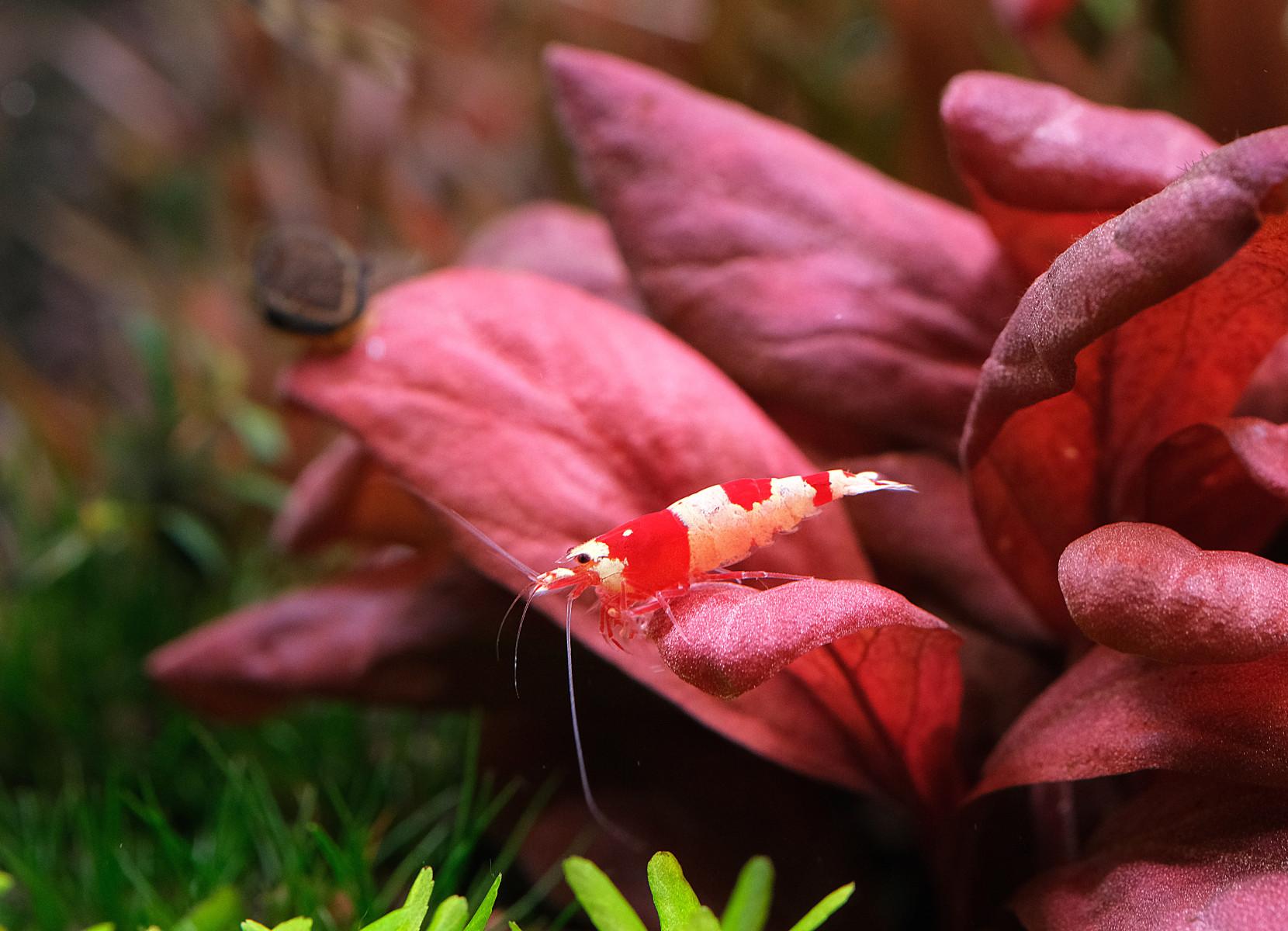
Use algae eaters like dwarf shrimp, Otocinclus catfish and snails to reduce algae before it multiplies.
What Causes Algae Blooms in a Freshwater Planted Tank?
"Excess light" and "Excess nutrients" Algae cells are smaller and simple. Their competitive advantage in nature is to replicates fast when light, space and nutrients are available. Even a standing glass of tap water will grow algae if left standing in open sunlight. Go to any other planted aquarium website and excess light/nutrients are always the first factors to get blamed for algae in the aquarium. If we were running fish-only aquariums, the solution is pretty simple - dimming the lights or black outs stop photosynthesis entirely, and small algae cells with their limited capacity to store starch are quick to die out in extended black outs.
In planted aquariums we have plants to consider. Plants need nutrients and light to grow as well. Though algae replicates fast and need very little to grow, not every lake or river is choked with algae. Similarly, there are planted aquariums with high light, high nutrient availability and hardly a speck of algae visible, and then there are aquariums that have barely any measurable nutrients in the water column with moderate light levels that face continual algae infestation. There are more forces at play than just light and nutrients. Nature has its own balancing forces that keep algae in check

Giant springs, Montana. Photo credits: Tom barr.
Plant competition & deterioration Higher order plants have larger structures that give them a competitive advantage in the long run - plants can grow towards the light, shading out surrounding areas, roots can reach nutrients deep in the substrate, and healthy leaves produce defensive chemicals on their surfaces that deter algae. Plants can also store starch, letting them weather long blackouts that would otherwise kill off algae cells that have limited capacity to store energy. Many aquatic plants can grow emersed, allowing them to access atmospheric oxygen and carbon dioxide.
All these characteristics give plants the long term advantage against algae, but plants need a sustained period of stable growth conditions for this to happen. While algae spores are simple, they 'know' through chemical signals that environments with vigorous plant growth are not conducive to growth, and will avoid spawning on healthy plants leaves. Conversely, stressed plants and deteriorating leaves leave chemical signals that make them a target for algae. There are many factors that causes plant stress such as unstable/insufficient CO2 or nutrient levels, rootzone compaction, overcrowding.
Plant adaptation stress occurs when plants face significant changes in the environment. Plants produce new leaves adapted to the new environment, and these leaves are healthy and well defended by the plant against algae, while old leaves are abandoned and targeted by algae. This is a natural leaf renewal cycle that takes place when the plant adapts to changes in the environment. A more stable growth environment means less adaptation changes, and plants will maintain their older leaves algae free longer.

Ecological Plant dominance When the aquarium is at least 70-80% filled with plant mass, and that plant mass is stable and healthy, it makes the whole aquarium more algae resistant as a whole. The algae deterrence of individual plants combine when the majority of the space in the aquarium is filled by plant mass. We call this having a plant dominant ecosystem.
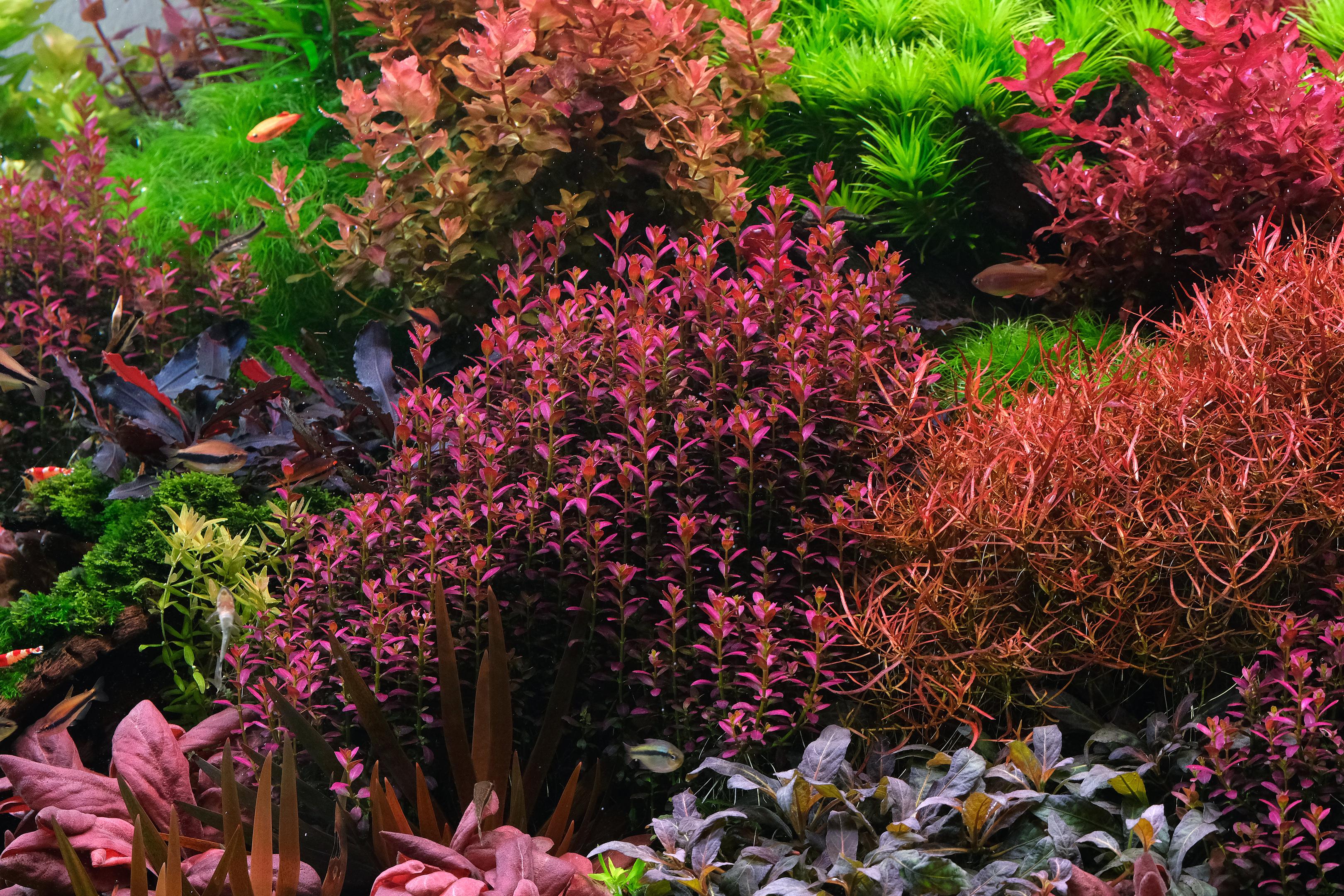
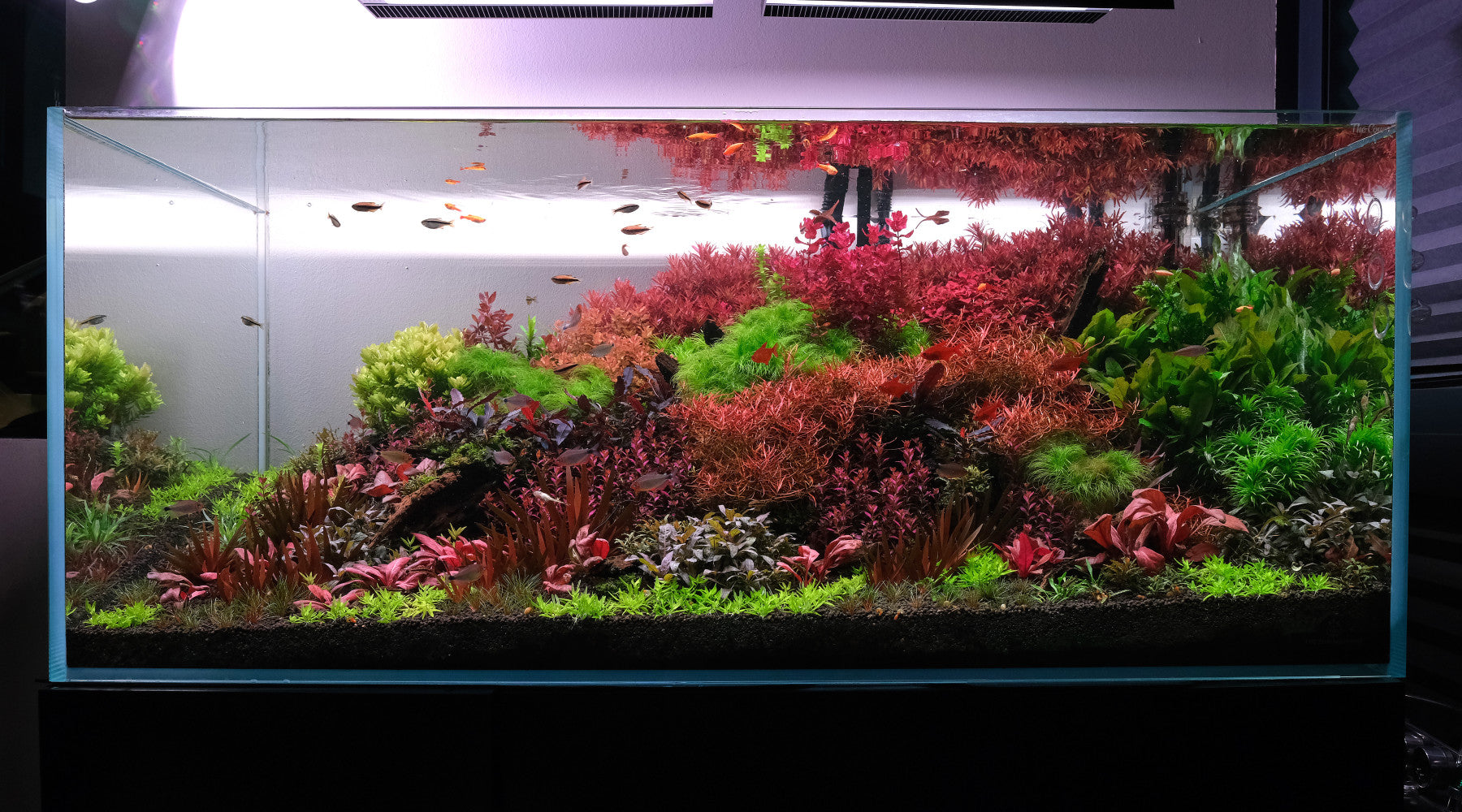
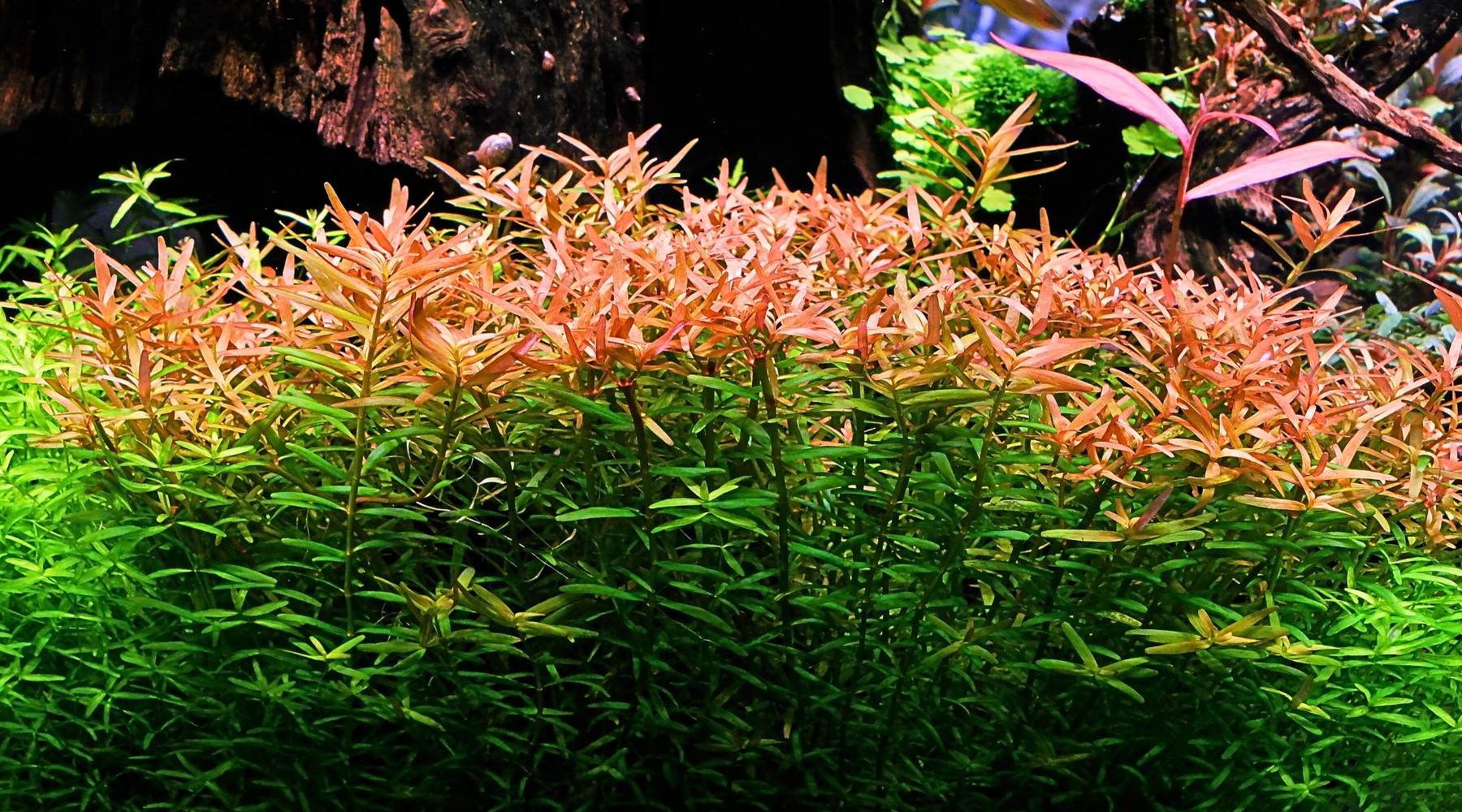
This algae deterrence occurs even when light and nutrient levels are plentiful in the water column, algae spores do not go into full bloom when plant dominance is in effect. It is a common mistake to think that plants out-compete algae for nutrients in such scenarios - they do not. For example in the aquarium below, nitrates levels are maintained at 15ppm (part per million) through daily fertilizer dosing. Nutrients never bottom out at any point of time, and strong light is used to bring out coloration in plants. Nonetheless, the aquarium remains free of visible algae.
In an aquarium with sparse plant mass, and no plant dominance, high nutrient levels combined with high light levels become a free buffet for algae.
Organic waste Stressed plants eject waste metabolites directly on their leaf surfaces, which attracts algae spores to bloom. Large amount of accumulated organic detritus in dead spots or the substrate surface trigger algae spores to bloom in a similar fashion, which can cause even relatively healthy plants nearby to get attacked by algae. Higher light tanks are more sensitive to this, while lower light aquariums are more forgiving.
Biological controls and microbial balance Algae forms the basic food source(phytoplankton) of aquatic systems and are eaten by microbes and other microscopic organisms, which are then eaten by larger predators, forming the backbone of nearly all aquatic ecosystems. In matured aquariums, the presence of such microbes serve as a biological control for algae. These microbes need time and a stable ecological environment to propagate, so new aquariums are especially vulnerable to algae before such microbes populate the environment. Not all algae types are readily eaten by microbes - especially types that grown into larger forms such as Black brush algae or filamentous green algae.
Their ability to consume algae is also not infinite. Heterotrophic microbial populations rise and fall with food availability. When there is a spike in algae, it can take time for the microbial population to catch up. Green water algae and Diatoms blooms only occur when a sustained spike in algae outpaces the rate at which heterotrophic microbes can consume it. This is why diatom blooms are very common in new aquariums, while matured aquariums with similar levels of nutrients, lights and silicates show no visible diatom growth at all. When the microbial community in the aquarium is negatively affected, such as by low oxygen levels, it can also result in algae blooms.
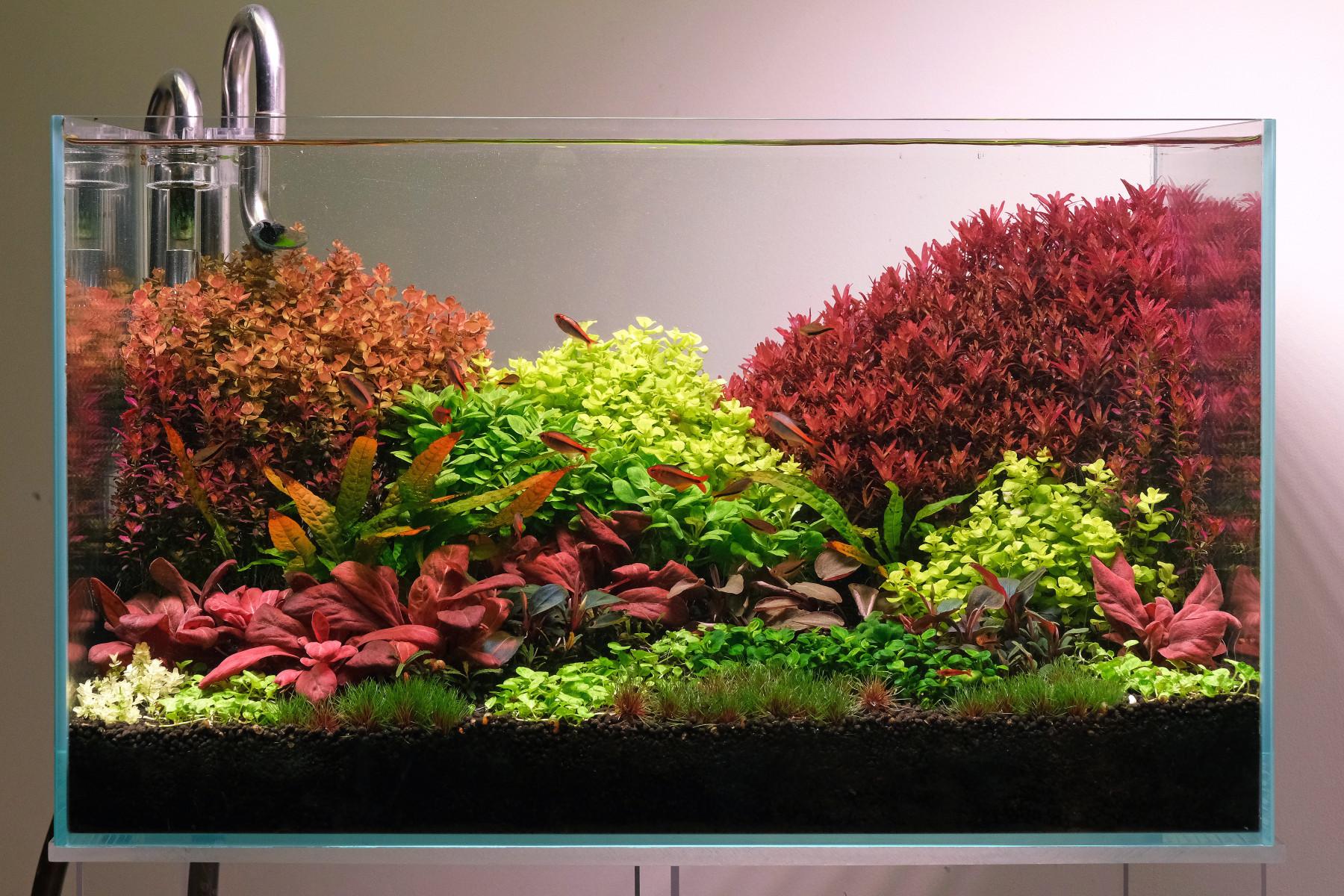
High light, high nutrient levels, and plenty of silicates, yet not a trace of diatoms visible. Nutrient/light availability alone does not dictate algae outcomes in planted aquariums. Plant dominance and algivorous microbes in a healthy planted aquarium keeps algae at bay.
Summary:
-
Strong light and nutrient availability feeds algae in the absence of plant competition.
-
Healthy plants deter algae, but plants require lights and nutrients to grow well.
-
Unhealthy plants and deteriorating older growth attracts algae, even when light and nutrients are low.
-
Organic waste triggers algae spores to bloom when combined with high light.
-
Beneficial microbes control algae, but their populations take time to develop.
-
Stable growth environment with high plant mass pushes tank's ecology towards plant dominance and natural algae resistance.
-
Shocks to the biological environment or plant growth trigger algae blooms.
-
Algae blooms caused by surges in nutrient/light availability can overwhelm natural controls.
What Are the Main Freshwater Aquarium Algae Types and What Does Each One Indicate?
While the triggers for most algae types are similar - organic waste, elevated light and nutrient levels combined with poor plant health, different algae types lean towards slightly different types of environments.
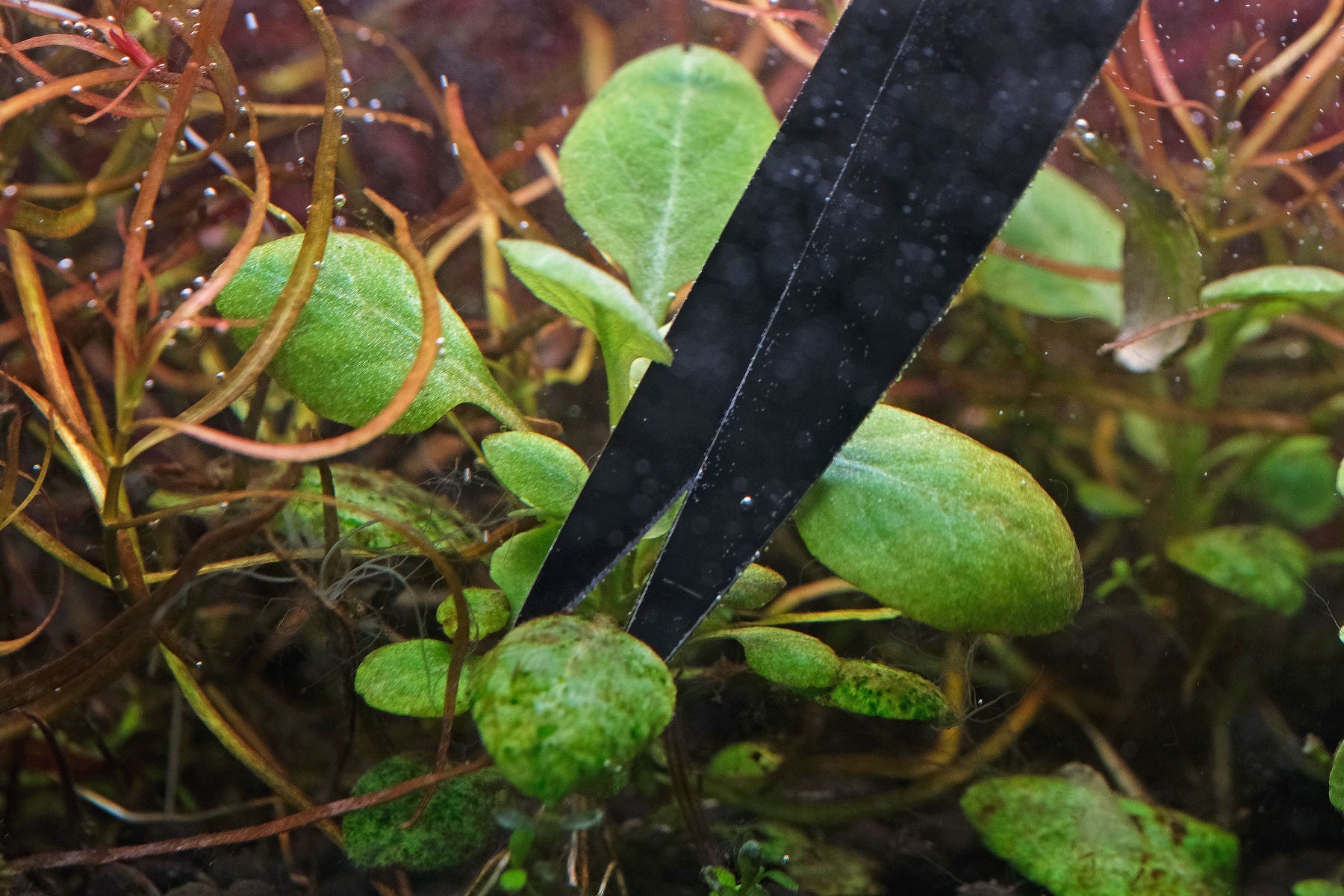
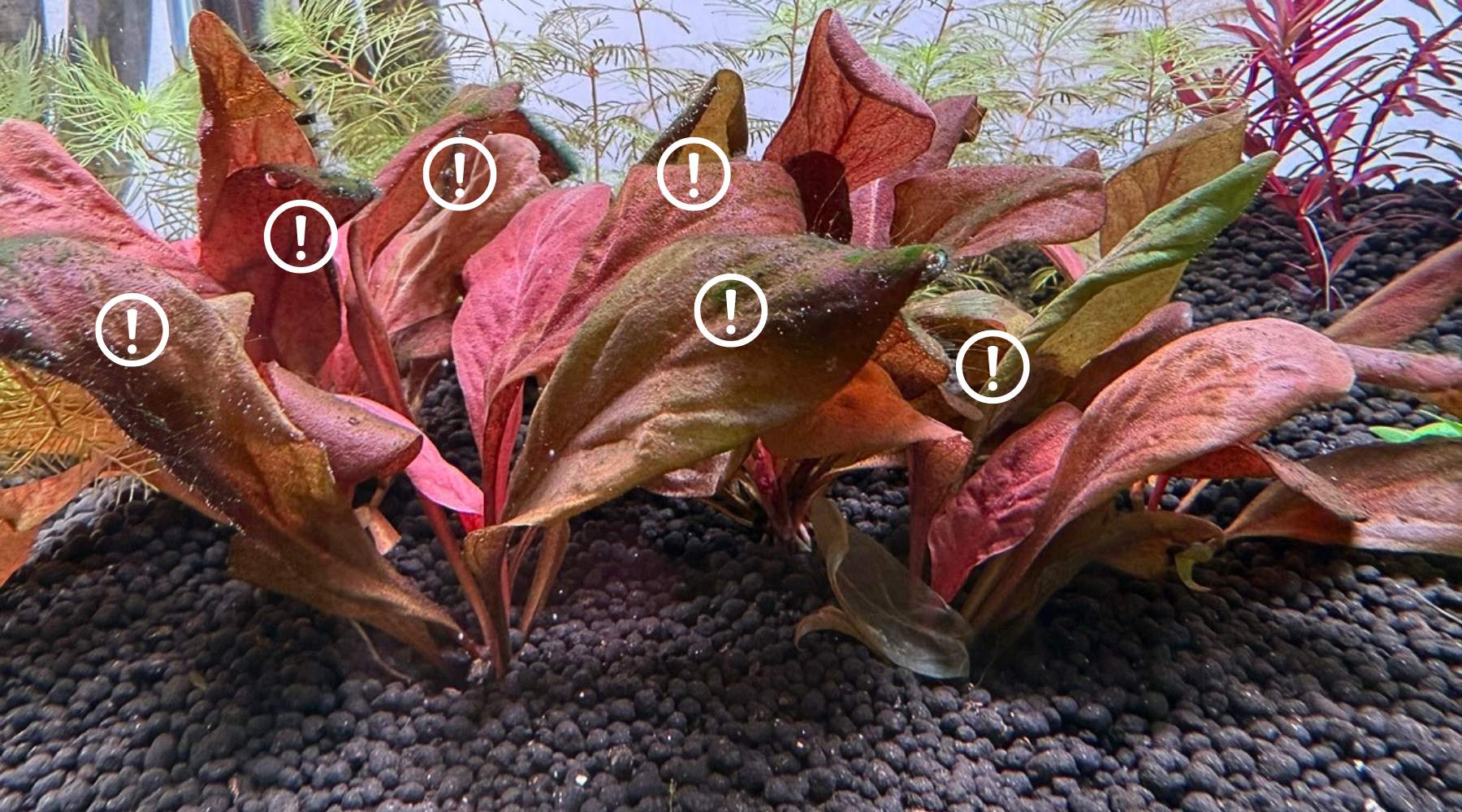
Green spot algae (GSA): tiny, hard, dark-green dots on front glass and old leaves on slow growing plants like Anubias, Bucephalandra and Cryptocoryne. GSA clings tightly to hard surfaces and does not wipe off with a sponge; you need a scraper. Short term blooms of GSA limited to older leaves can happen due to temporary plant adaptation stress; if the leaves are badly deteriorated, they should just be trimmed off to make space for new growth.
If GSA is persistent across longer horizons, it usually indicates a lack of general plant vigor - boosting growth conditions (CO2, nutrient levels) will stop it from spawning. If it is the only algae type present, it can indicate a lack of phosphate. (if you are using APT3 or APTe- you have enough phosphates- period).
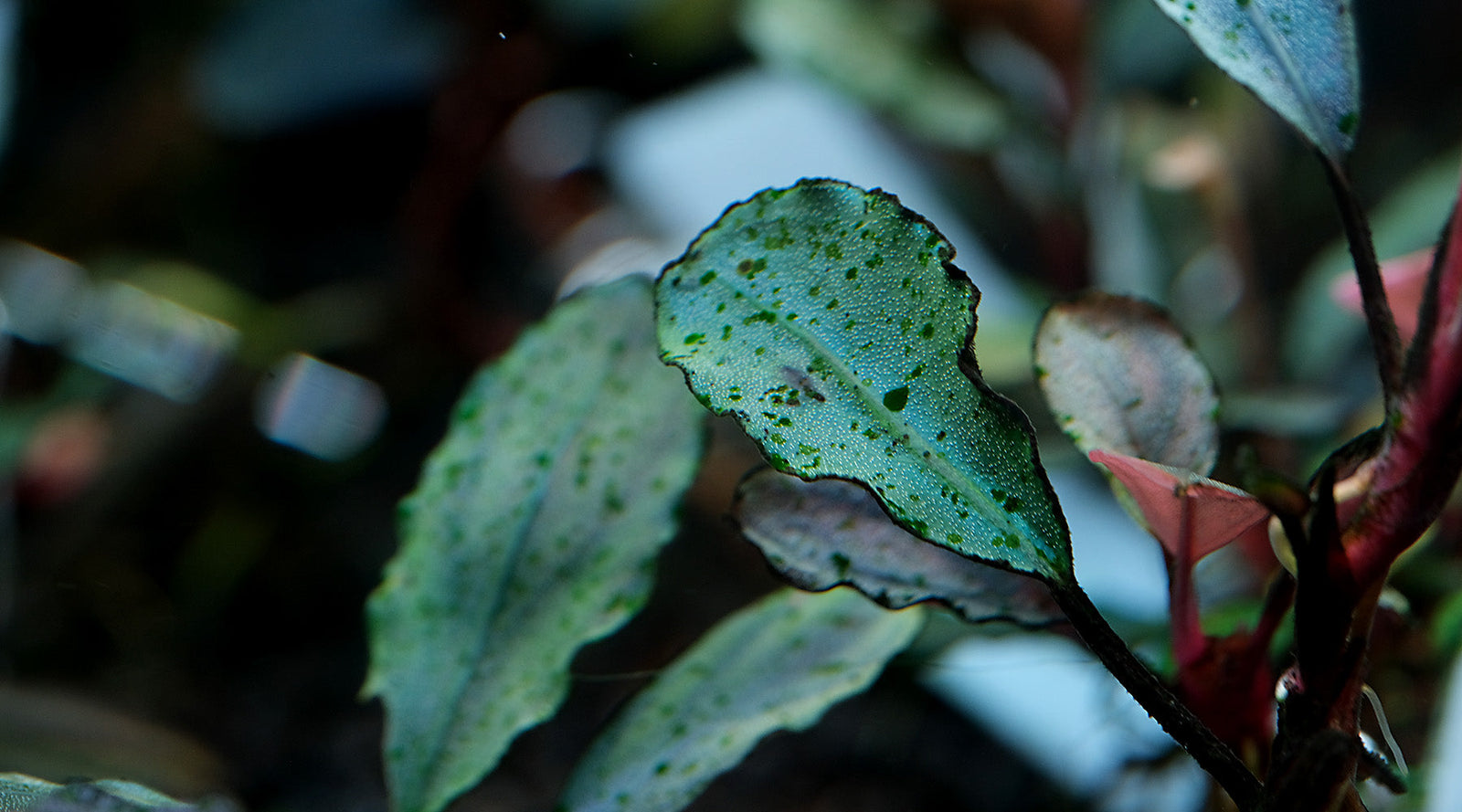
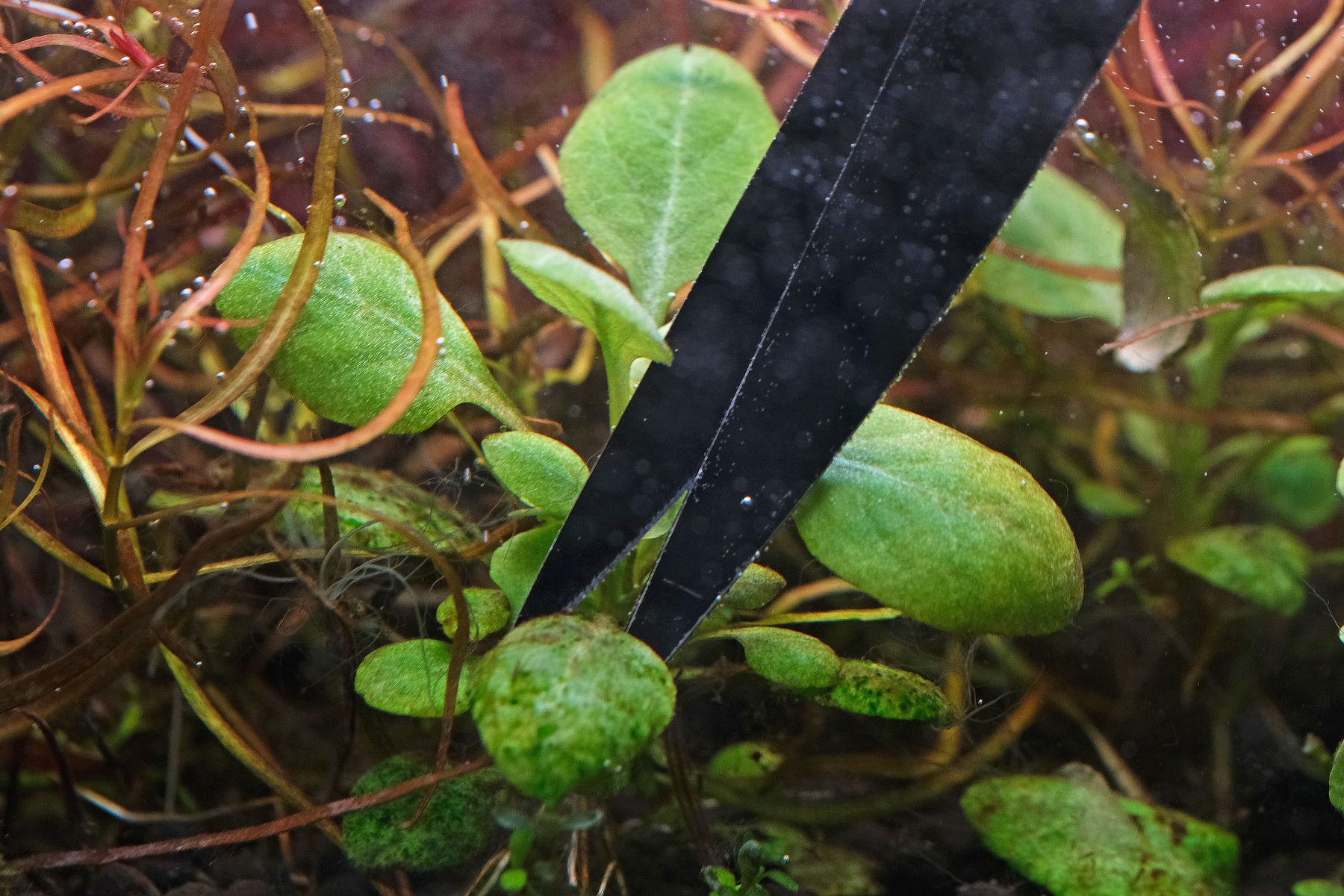
As new growth is produced by plants, older algae infected leaves should be trimmed off to make space for new leaves. This makes use of the natural leaf renewal cycle to maximize fresh, algae resistant leaves.
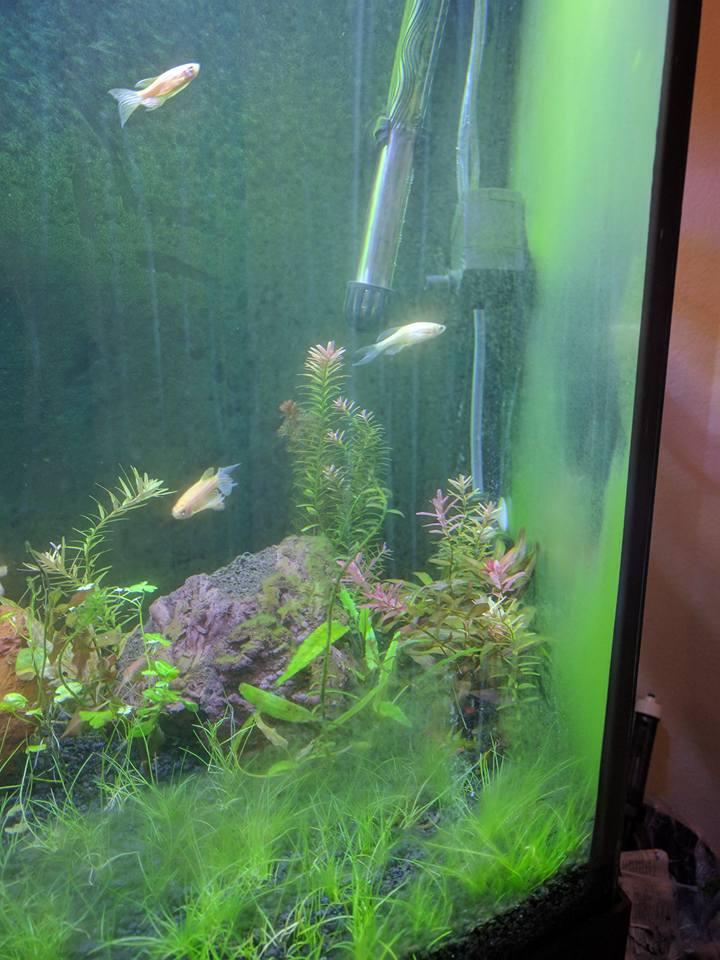
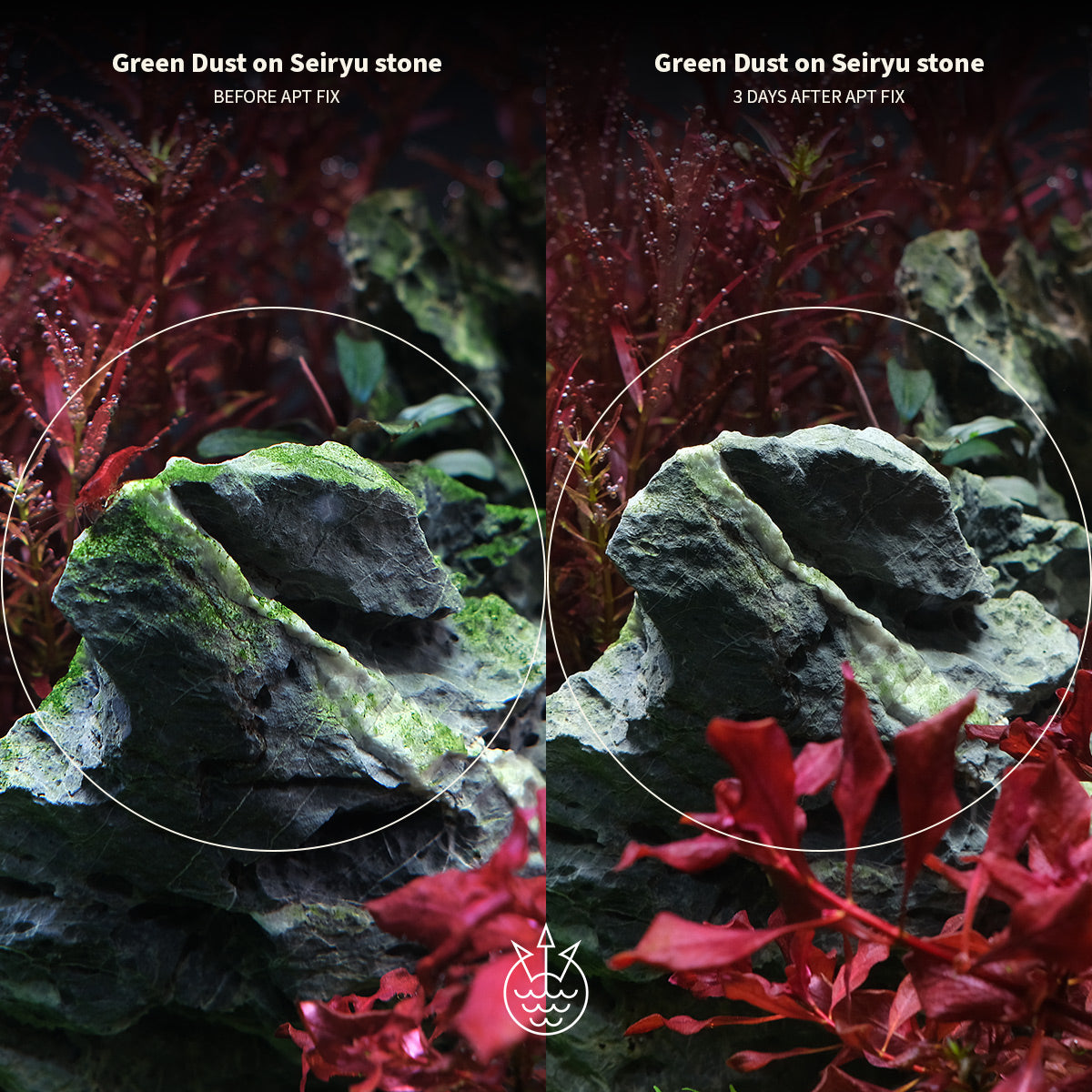
Green dust algae (GDA): a soft, powdery green film on aquarium glass and hardscape that wipes off in clouds and makes tank water hazy. It is most common in warm aquariums that use a lot of light and fertilization in the water column without sufficient microbial maturity or plant mass. It spawns quickly, and the spores cycle in the water column and reattach to tank walls and hard surfaces even if you wipe the glass daily. The most common cause is hobbyists using too much light and heavy nitrate fertilizer while assuming that they have enough plant mass for plant dominance to provide algae control.
Should aquarists continue to wipe off GDA and do water changes ? For mild cases, as plant dominance increases and biological maturity develops, it can stop spawning with time.
For more severe cases, reduce light strength significantly and reduce water column nitrogen levels. This reduces the multiplication rate of the algae while giving time for the microbial community and plant mass to catch up. Serious cases of GDA are very sticky with high light levels. Plant dominance with 80+% of the aquarium planted can shift the balance away from algae. Tuning up CO2 can also give plants extra vigor to shift the balance. Improving the microbial environment can also help - seed aquarium with mulm/filter media from other stable matured aquariums, and make sure oxygen levels are good through sufficient surface turnover and flow.
Bristle-nose plecos readily consume this algae and are very effective.
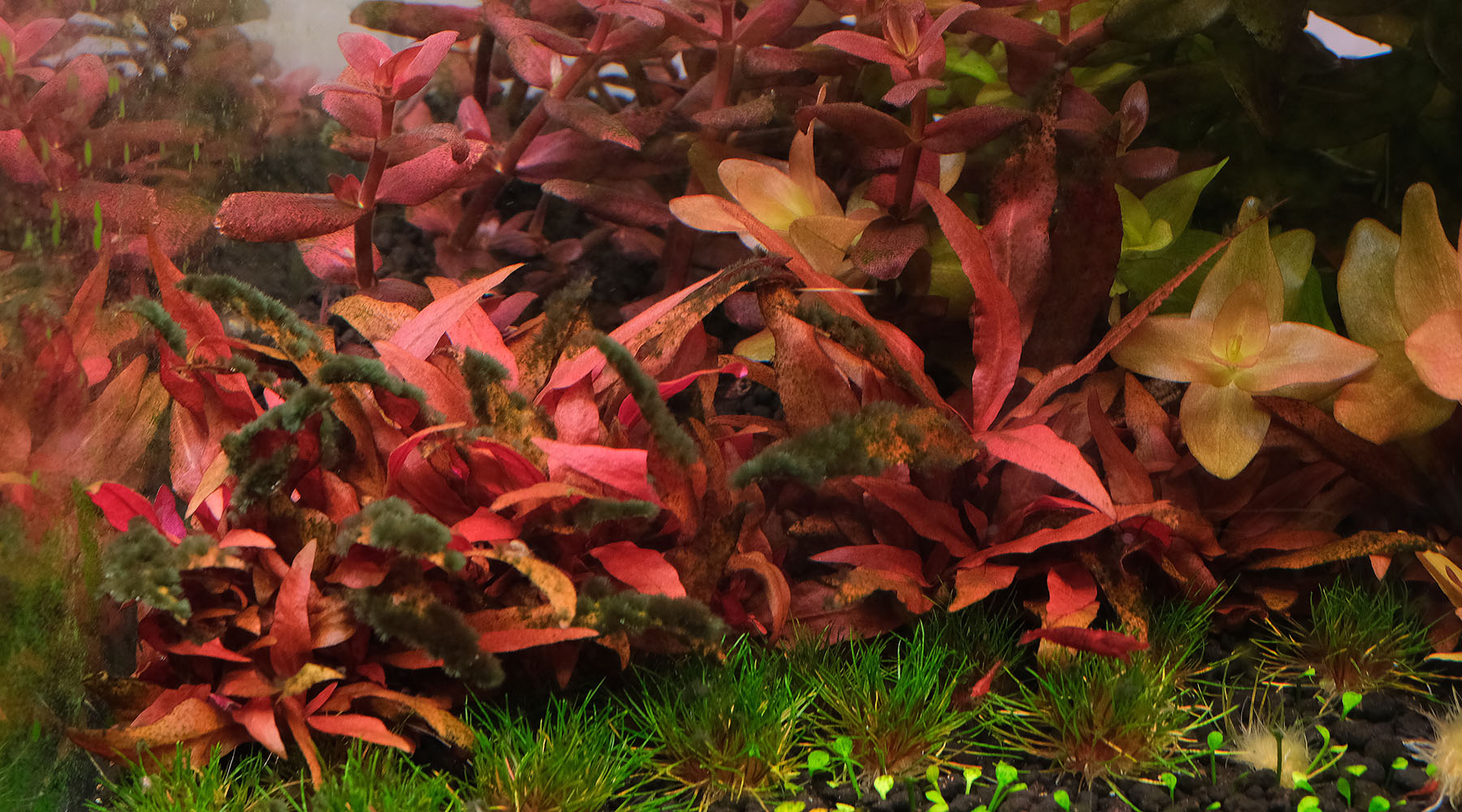
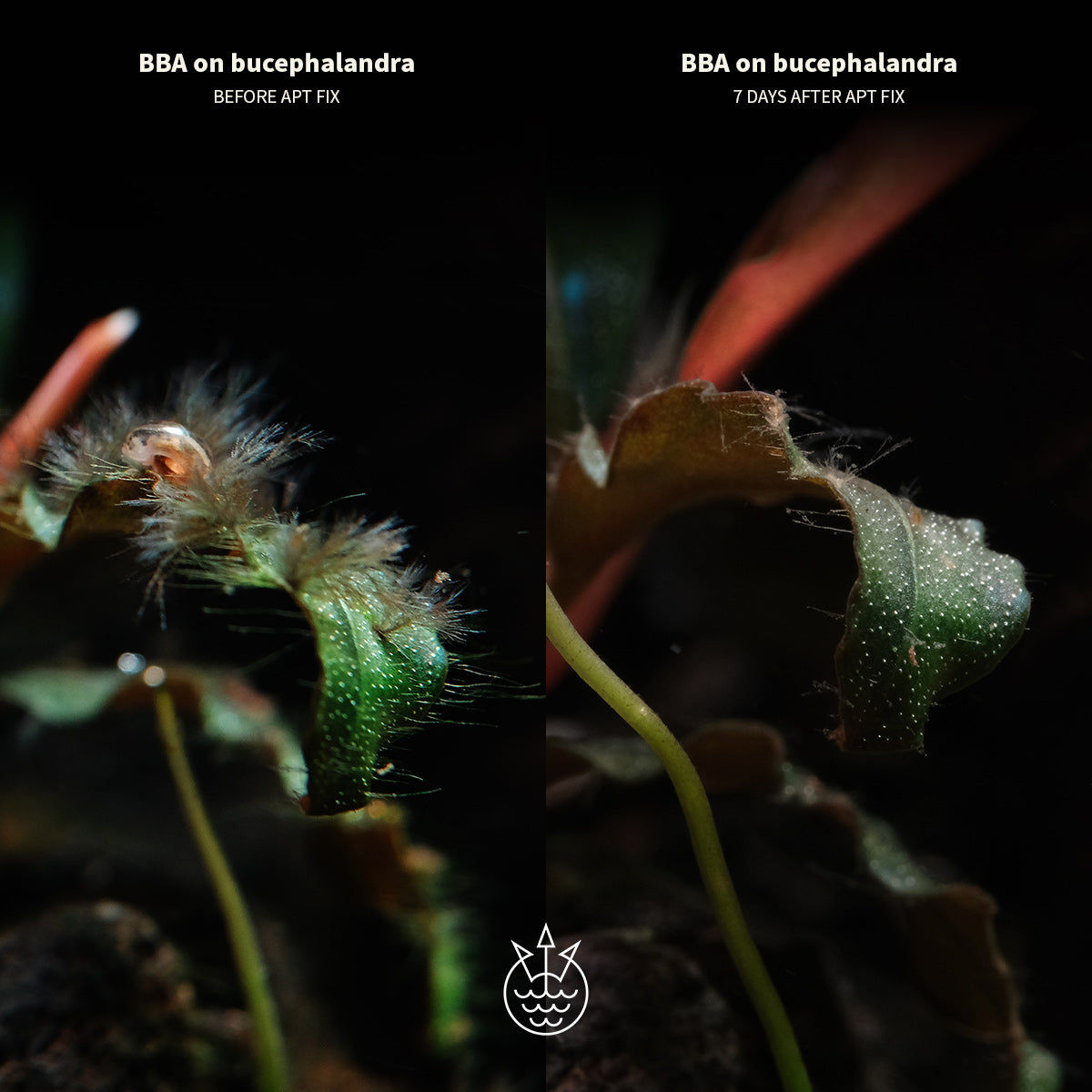
Black beard algae (BBA) and black brush algae: short, stiff, dark tufts on the edges of slow growing plant leaves, on hardscape, spray bars and filter pipes. This type of red algae thrives on fluctuating CO2 levels, older deteriorating leaves, overcrowding plants and is triggered excess organic waste in the ecosystem. If it spawns on plants - it is a sign of stressed plants or fluctuating CO2 levels. If it spawns on hardscape, it is usually a sign of accumulated organic debris in the substrate/filter. BBA prefers areas of high flow - overly turbulent flow hitting more delicate species can cause it to spawn.
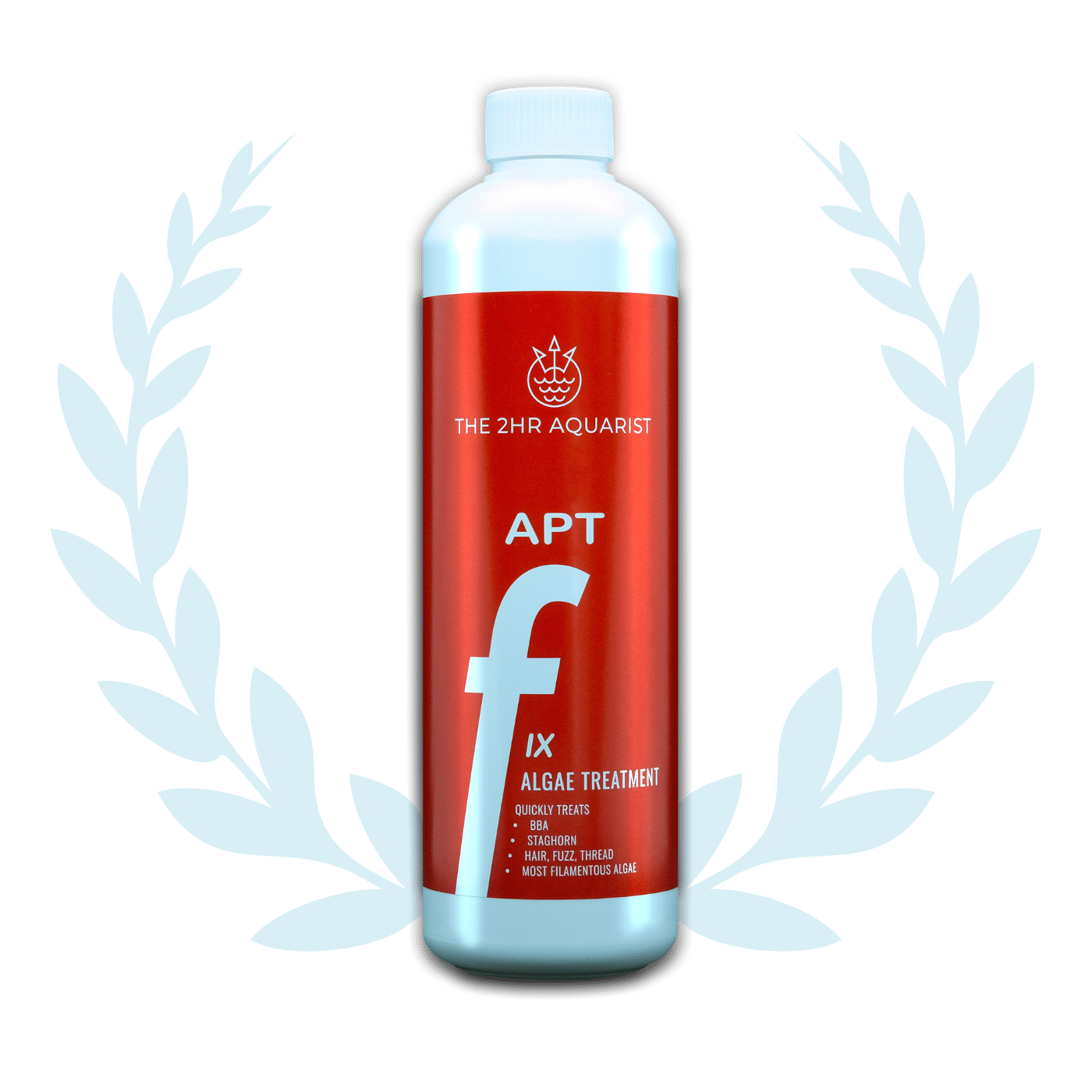
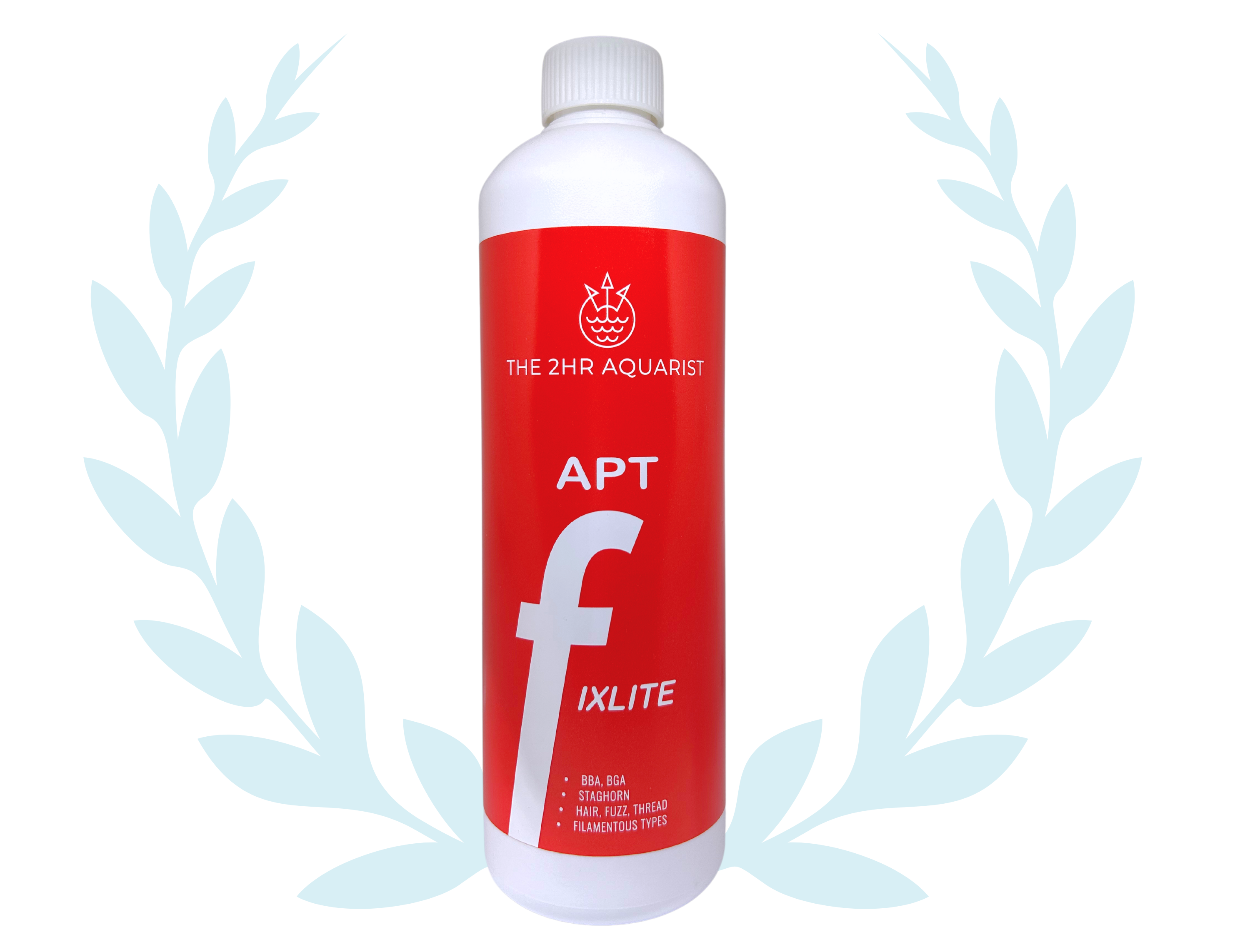
BBA is a difficult algae because it clings strongly and many algae eaters refuse to touch it unless weakened. Manually trim BBA-covered leaves, spot-dose APT Fix or APT FIXLITE, and siphon away detritus from the substrate surface. Service filters if they are choked. Old growth should be uprooted, discarded, and new growth replanted.


Trimming away deteriorating leaves and clearing old growth makes a big impact.

Clearing substrate detritus makes a huge impact on whether algae spawns or not in a high light aquarium.
Staghorn algae: thick, greyish to greenish branching strands that look like a tiny underwater shrub growing from leaf edges or hardware. It is generally caused by plant adaptation stress. In CO2 injected aquariums, adjustments to CO2 levels can cause short term blooms of it.
Deteriorating older leaves should be clipped once newer leaves are available. Large pieces can be siphoned off and the remainder can be burned off with algicide. Once growth conditions stabilize, it generally stops spawning.

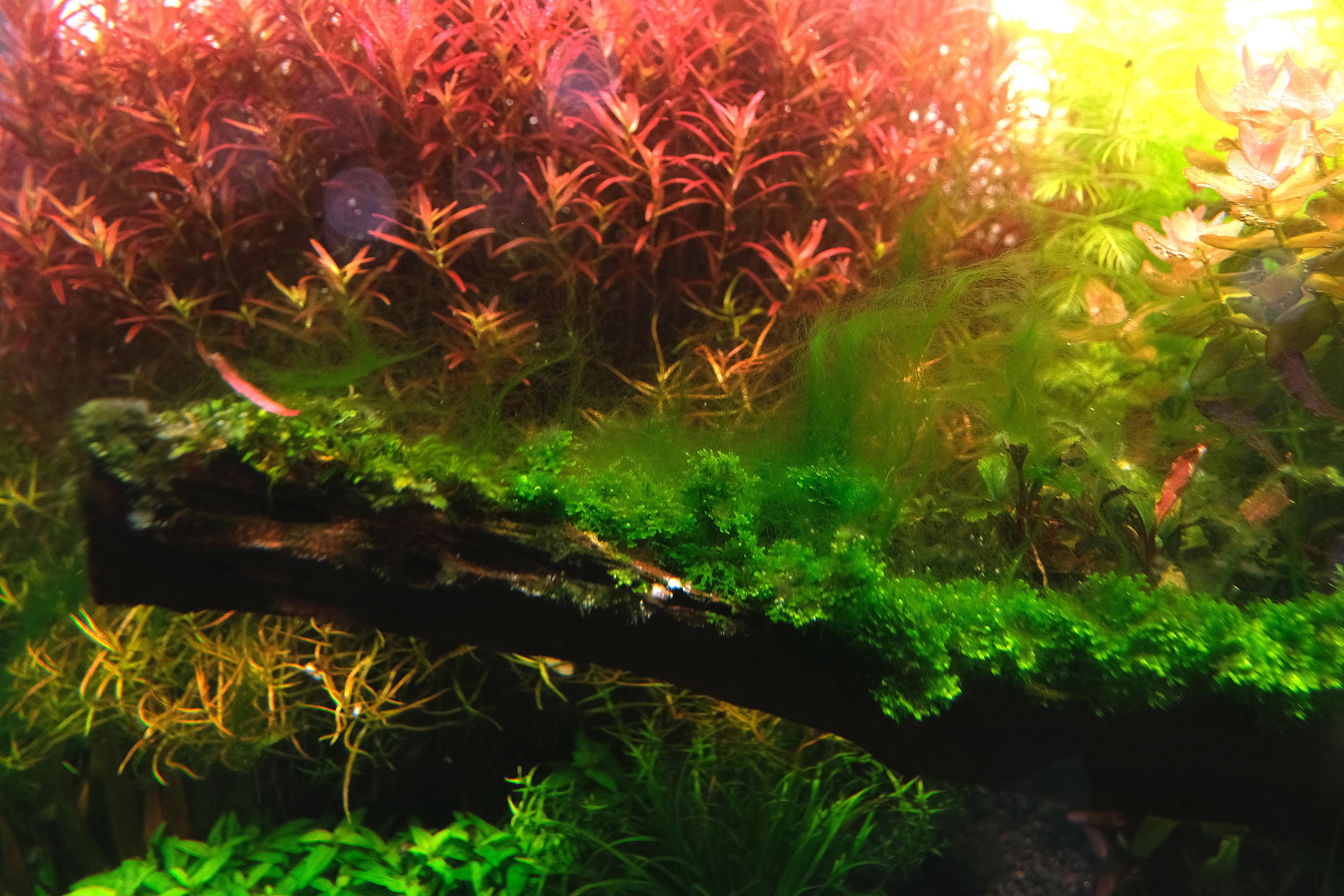
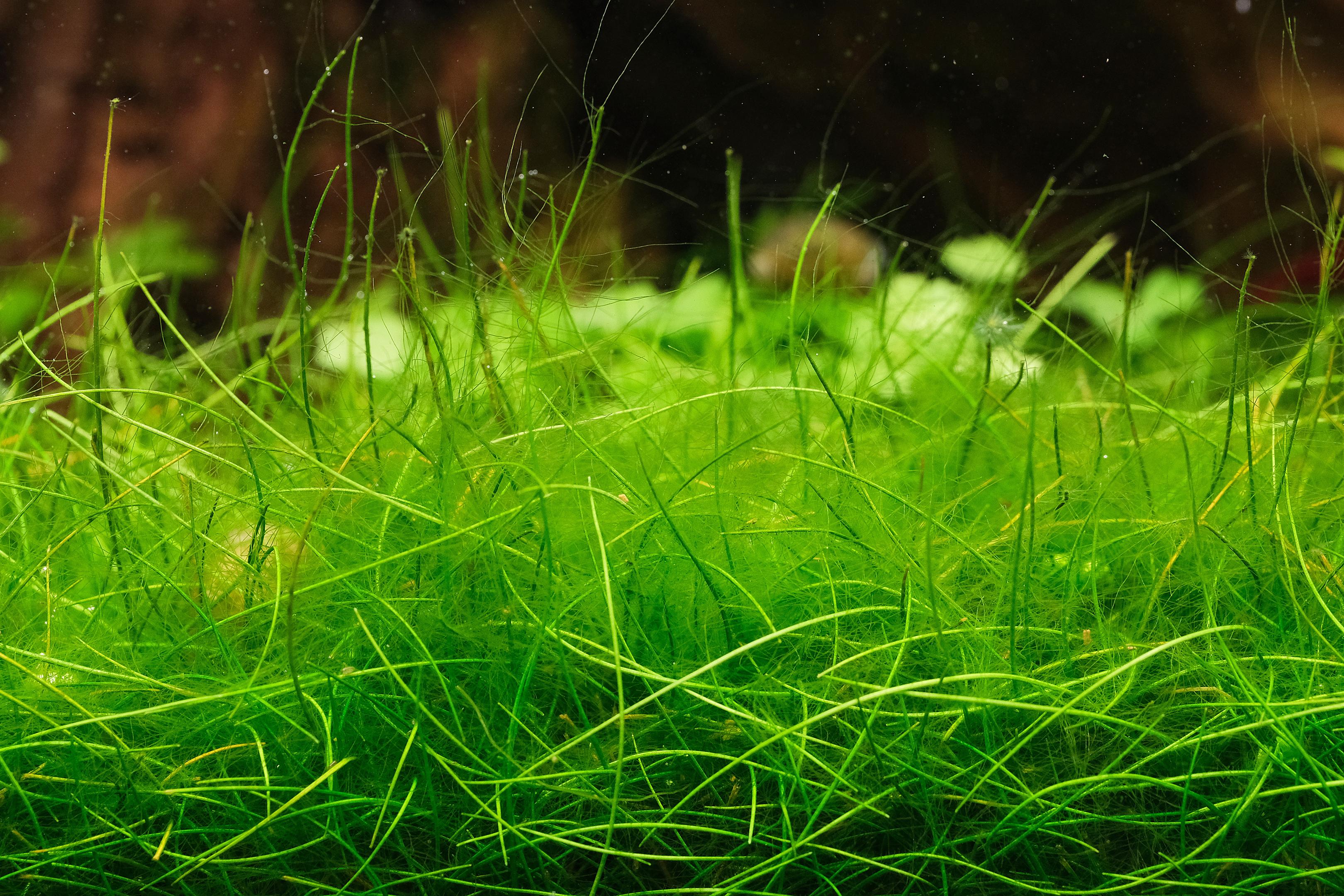
Green filamentous algae (hair algae, fuzz algae, thread algae): long, stringy green hair algae forms tangles that wave in the flow; fuzz algae forms short fuzz; thread algae forms single strands that can reach several centimetres. When attached to plants it generally indicates plant stress due to significant environmental changes. Large dips in CO2 availability, ammonia spikes, coupled with high light conditions is a common trigger. When attached to hardscape, it is commonly caused by ammonia spikes and high light conditions.
In slight cases, filamentous algae can be beat back by a combination of manual siphoning away, algicide application and removal of old growth. It can take a few cycles of removal to stay away. Reducing light and doing large water changes to remove ammonia and other organic wastes is helpful.
Hair algae issues can be sticky. This is especially so if there are large amounts of grown-in plants that have become unhealthy. This often happen in overcrowded planted aquariums, where plants have been trimmed in place but not replanted for a long time. Root zone compaction can also give rise to unhealthy top growth, even if growth parameters are in the good zone. In such scenarios, plants should be uprooted, substrate cleaned, and then fresh plants replanted. It can take a few cycles of replanting fresh top growth before algae stops spawning. Light levels should be kept low/moderate to prevent filamentous algae from multiplying faster than the tank can recover.
Amano shrimp and Siamese algae eaters feeds on filamentous green algae. Algicides like APT Fix/FixLite also burns off algae when spot dosed.
Blue green algae (BGA): cyanobacteria looks like dark blue-green slime that peels off like a sheet and smells like a muddy pond. Blue-green algae, or cyanobacteria, often result from low water circulation, low oxygen levels, high organic waste, and/or low nitrates. Cyanobacteria can fix gaseous nitrogen, and have advantage in low nitrogen environments. This is not a normal “algae eater” buffet; some strains can produce toxins that irritate livestock if allowed to cover large areas.
Shifting to a higher nitrate fertilizer (such as APTe) can shift the advantage towards plants. Smaller patches can be brushed off plants and siphoned off during a water change. In very severe cases, anti-biotics such as Chemiclean and Erythromycin can be used as a nuke.

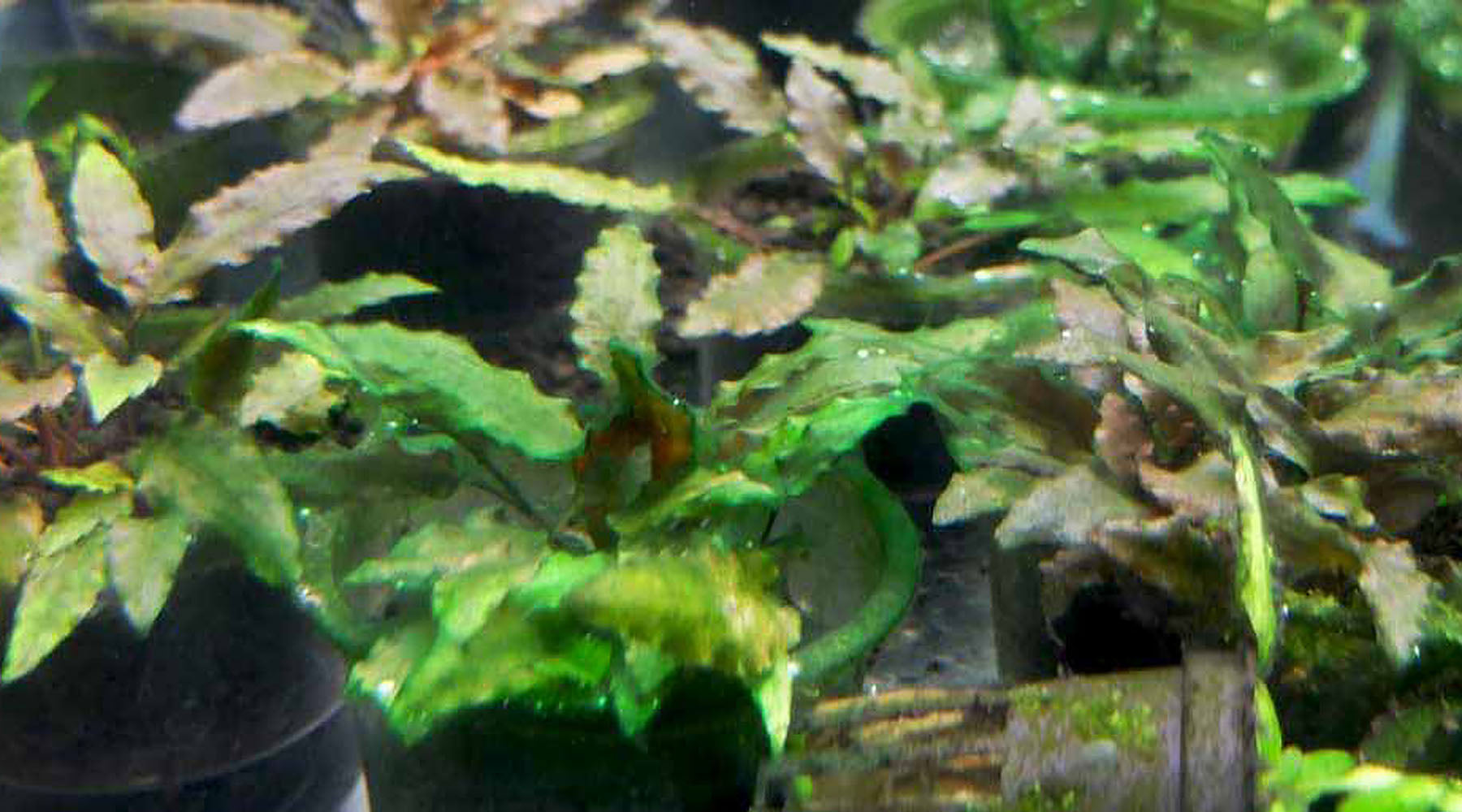
Brown algae/Diatoms: diatoms appear as a dusty brown film on glass, hardscape and young plant leaves. Brown algae, or diatoms, commonly shows up in newly set-up aquariums, especially in the cycling phase, and is widely associated with high silicates levels and phosphorus from tap water or new substrates. However, their presence/absence in aquariums are more closely tied to microbial
Diatoms are food for algivorous microbes and as the microbial system matures, microbes naturally control their spread. In new aquariums, diatoms can be siphoned off during water changes to prevent them from smothering plants. Light and nutrient levels should be kept low in new aquariums to prevent diatom blooms from getting out of hand. In most aquariums it fades once the filter and microbial populations mature.
Otocinclus catfish and Bristlenose plecos consume diatoms, but should not be added until the aquarium is more matured and stable.


When high light and nutrients are thrown at a new aquarium, diatom blooms can be spectacular as they multiply quickly.
Green water: aquariums with strong light can tip into a Green Water algae bloom with surprisingly little ammonia or dissolved waste in the water column, especially in young or under-filtered setups. Green Water itself is a bloom of free-floating algae that makes your aquarium look like pea soup, but it is usually harmless to fish. However, serious cases can be difficult to clear.
To fix aquarium Green Water fast: use a 5 day blackout or a correctly sized UV sterilizer to kill suspended algae cells in the water column. Diatom filters work as well. Very mild cases can be cured by dosing algicides, using flocculants and large water changes.

What to Do? Keeping The System Stable vs Making Changes
Many factors can cause short term algae spikes that are not persistent. One needs to differentiate carefully between fundamental problems that gives rise to persistent algae issues and short term algae spikes that will naturally subside. Doing dramatic actions that destabilize the aquarium's ecology when the algae spike is temporary causes more problems. On the other hand, fundamental problems require a more significant tweak, which can come in the form of a change of equipment, plant layout or maintenance habits.
Short term issues: Usually caused by a spike in organic waste, nutrient or light levels, change in parameters or plant growth issues related to the immediate area. Plants usually adapt after remedial action is taken to remove algae and trim/replant plants, and algae growth is not persistent on new growth. Keeping the system stable is the priority.
Examples:
-
Introducing new plants to the aquarium. Plants take time to adapt, producing new growth adapted to the new environment. Old growth often gets attacked by algae. Trim off old, algae infected growth and allow natural leaf renewal to take place. Replant fresh tops and uproot and discard old bottoms. This happens often when new plants are introduced to the aquarium even when growth parameters are good. Work with the natural leaf renewal cycle and not against it.
-
Increasing light and nutrient levels can cause Green Dust Algae to spawn on glass. If the planted aquarium has high plant mass, and healthy microbial system, the GDA will spawn for a couple of weeks before stopping. Solution: Manually clean off GDA, keep parameters stable, and let aquarium adjust to higher light and nutrient levels over time. If GDA remains for more than 2 weeks, it may indicate that the aquarium cannot take that high a light level, and tuning down
-
Adding many new fish to the aquarium causes a spike in ammonia/nitrates. This can also cause GDA to spawn on glass and filamentous hair algae to attach to plant leaves. If the planted aquarium has high plant mass, and healthy microbial system, the algae will spawn for a couple of weeks before stopping. Solution: Manually clean off GDA, keep parameters stable, and let aquarium adjust to higher light and nutrient levels. Trim off badly affected plant leaves to make space for new leaves.
-
Heat spikes during summer, having a fish/livestock die-off and other parameter fluctuations can give rise to similar algae spikes as above.
-
Adjustments in CO2 levels can trigger BBA and Staghorn to spawn and attach to plants. Spot dosing algicide can get rid of these easily. Keep levels stable and plants will eventually adjust.
-
Root zone compaction and overcrowding. Aquariums are like underwater bonsai, but at grow at 10X speed. Shallow substrates mean that root zones often get compacted quickly with fast growth. Root zone compaction, and natural deterioration of older growth attracts algae. For more picky aquarium plant species, the plant needs to be periodically uprooted, thinned out, substrate cleaned and enriched, then replanted. Changing fertilization/light levels do not solve root zone problems.
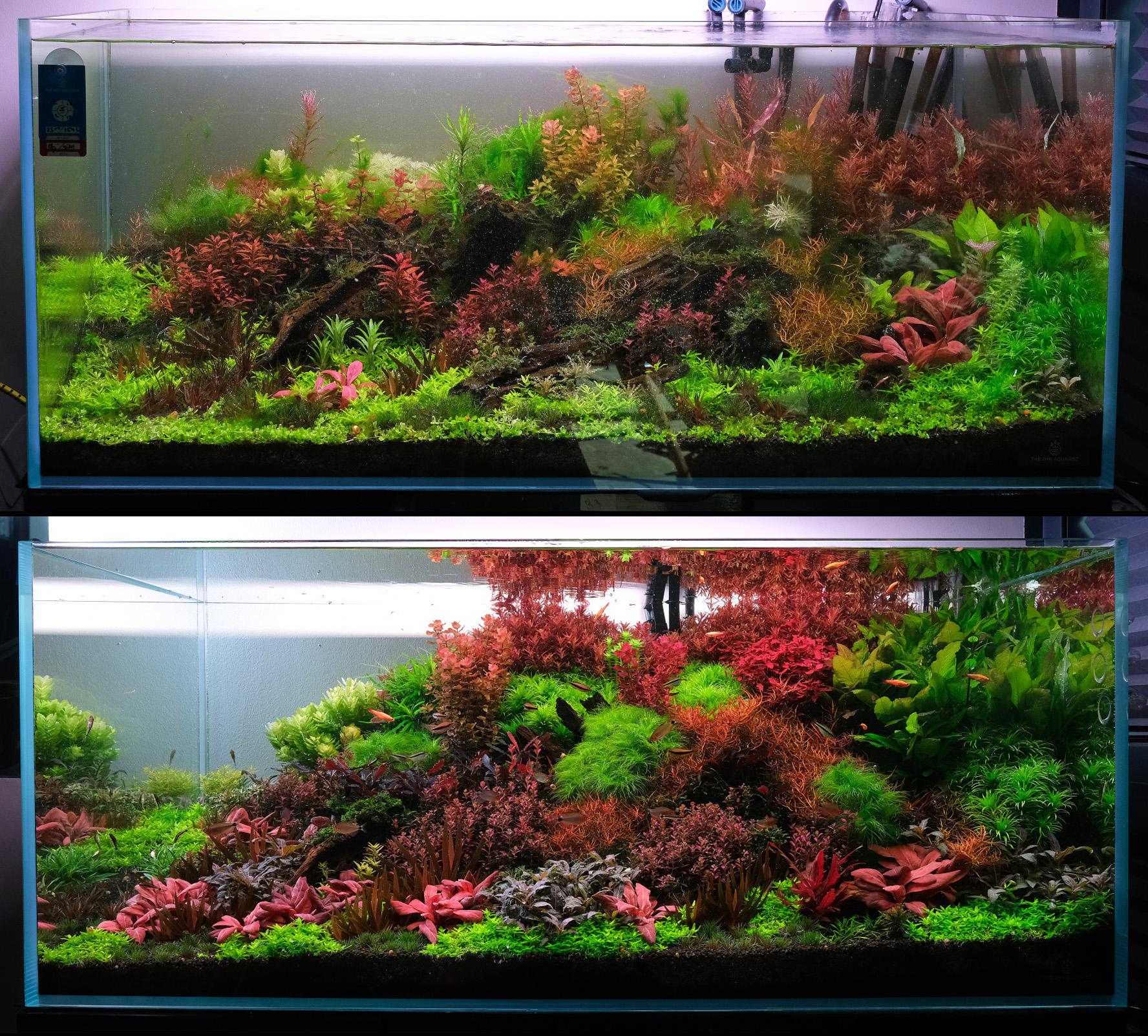
No changes to light/CO2/nutrient levels were made in the aquarium above to solve the algae problem. Just replanting of fresh growth and removal of algae-infested old growth, and allowing plant dominance to set in.
Fundamental problems: Caused by design choices, equipment choices, maintenance methodology that does not match requirements of plant selection. Band aids such as algicides or algae eaters do not fully solve the problem and the aquarist will be trapped in a never-ending cycle of fighting algae unless more significant changes are made.
Examples:
-
Poor carbon levels leading to persistent poor plant growth/vigor. This is the number 1 problem in most low tech aquariums, but ignored due to hobbyists being unable to accurately measure low levels of CO2. What cannot be measured, gets ignored. Social media is also filled with survivorship biased examples. 95% of aquarists fail at growing carpeting plants in low tech aquariums. However, the 5% that succeed are the ones that post non-stop on social media. Low tech aquariums should switch to a plant selection that can survive well with lower carbon availability, or look for more effective ways to naturally generate carbon dioxide. Natural carbon dioxide generation is often a hit or miss, depending on many other variables - which leads to much more varied outcomes in low tech aquariums.
-
Unstable CO2 levels due to poor CO2 injection methods, such as using in-tank diffusers that clog often. Shifting water levels that drop below level of outflow can cause vigorous surface agitation that changes CO2 saturation rates by increasing off-gassing. CO2 fluctuations can also be caused by poor quality equipment. Fluctuating CO2 levels are a key trigger for BBA.
-
Poor nutrient management approaches leading to persistent poor plant growth/vigor. Common in aquariums that try to rely on livestock waste to feed their plants. Shifting to more comprehensive nutrient dosing regimes give more reliable results. Deficient plants cannot produce the defensive chemicals that deter algae naturally.
-
Low plant mass, and a lack of plant dominance in aquariums using a lot of light and nutrients. For aquariums using high light and nutrient levels, high plant mass is necessary to keep algae at bay. Algae invades readily in high light, high nutrient environments when plant dominance is lacking.
-
Unstable nutrient levels due to large shift of nutrient levels across the week through accumulation of fertilizer can cause plant adjustment and algae. Nitrate levels should be kept within a 10ppm range throughout the week - more sensitive plants will start to show adaptation responses if nitrogen availability changes significantly in the water column. Nutrient dosing approach needs to be done with more accuracy if plants show signs of new growth that is well formed, but old growth is constantly getting algae.
-
Difficult plant layouts. Using shade plants alongside high light plants is possible, but the shade plants will likely be more vulnerable to algae. Using complicated layouts that lead to difficulty monitoring overcrowding, and not trimming/replanting when it is required.
-
Poor light management. Many aquarists use excessively strong light levels because a powerful light unit was purchased. This is increasingly common due to the prevalence of high powered LED lighting available today. Reduce light intensity if you are in the very high light zone (150umols of PAR and above). No aquarium plant requires that much light to grow - the gains of using 150+ umols of PAR are mostly in plant density and aesthetics which can come later when algae growth is solved. The large majority of plants will grow well at 70-80umols of PAR range, and aquariums facing serious algae issues should reduce light intensity to this level until the tank stabilizes.
-
Excessively long light periods. Set a shorter lighting period of 6 to 7 hours for most planted tanks, avoid direct sunlight on the aquarium. Light periods can be extended again if algae issues fade.
-
Strong light and high nutrient levels in aquariums that are sparsely planted. Without the natural algae resistance of fully planted tanks (70%+ of substrate planted), algae grows readily in the open space of such layouts. Shift to low light/lower water column nutrients in such tanks. Root feed plants through substrate instead.
-
Poor maintenance mindset. Allowing organic debris to accumulate on the substrate thinking that aqua soil substrate do not need to be cleaned as livestock waste becomes nutrients for plants. While this is partly true, the decomposition process is not clean and the remaining organic waste, combined with high light levels, causes algae to bloom readily. Excessive organic debris in the substrate can also cause overly labile conditions and poor root formation. Change maintenance regime to include vacuuming debris off the substrate surface, and more regular water changes to maintain water quality.
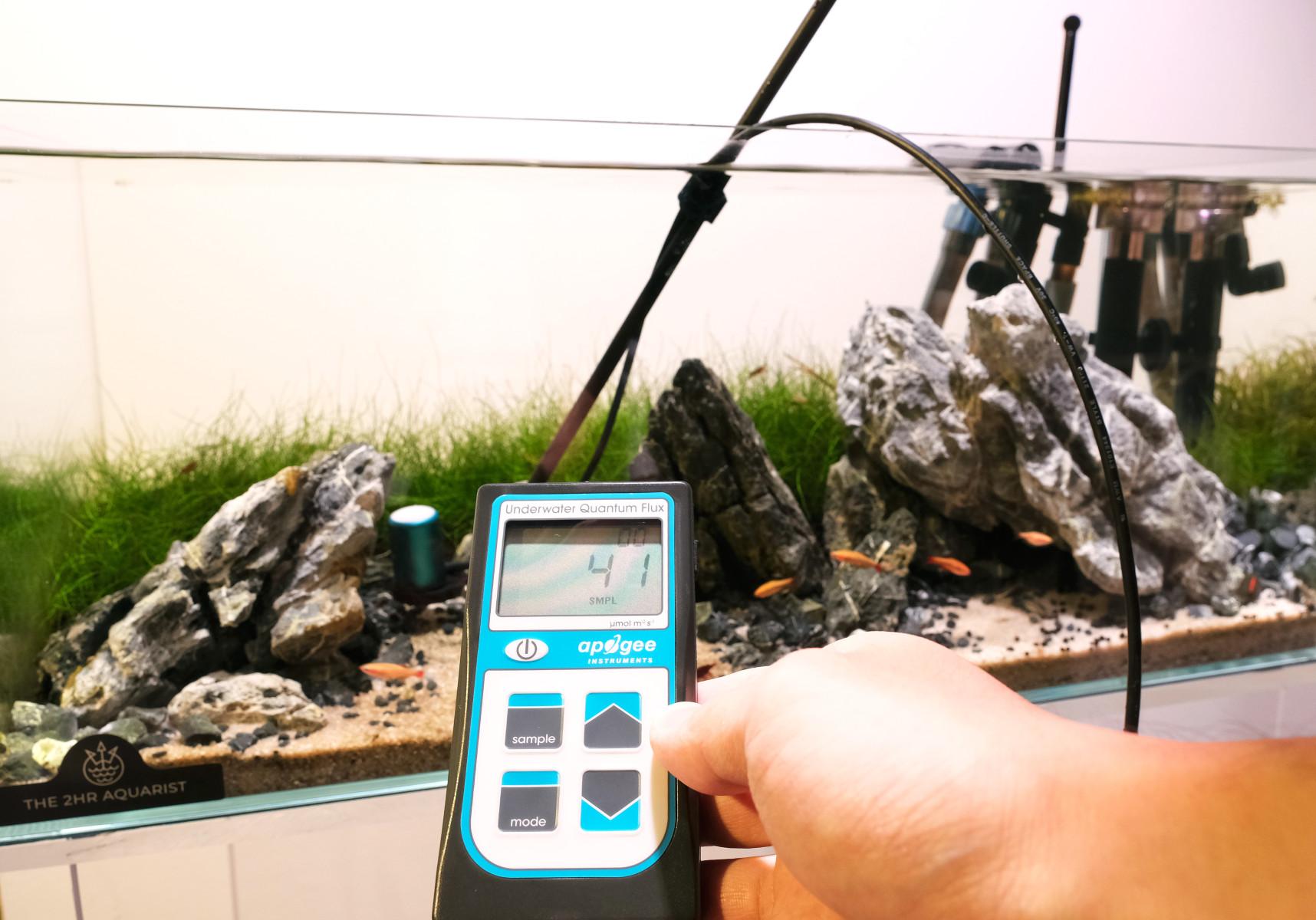
In aquariums growing less demanding plant species, low light intensity greatly alleviates algae issues.
How Does Algae Control Differ Between Low-Tech and High-Tech Planted Tanks?
Low-tech aquariums without injected CO2 run on lower light and slower plant growth. The growth of both algae and plants are slower in such conditions. It is common for low tech aquariums to lean towards green spot algae on old leaves, brown algae in the early cycling phase and filamentous algae on plants that cannot adapt well to low tech conditions. In aquariums with high organic waste levels, Black brush algae can still spawn. In low tech aquariums, choosing plant species that can adapt well to lower dissolved CO2 levels makes a big impact on algae outcomes. Growing species that are constantly stressed by insufficient carbon availability leads to unhealthy plants that attract algae.
Low tech aquariums take time to grow in fully, and many low tech aquariums are more vulnerable to algae due to low plant mass. Fully planted aquariums prevent algae as plant competition is the key factor that keeps algae at bay. Sparsely planted aquariums, which is common when aquarists just want to "test out" how having a planted aquarium is like, are extremely vulnerable to algae. Low tech aquariums that are fully planted at the start stabilize much faster and have less algae issues. Aim to plant 70+% of the available substrate in the aquarium.
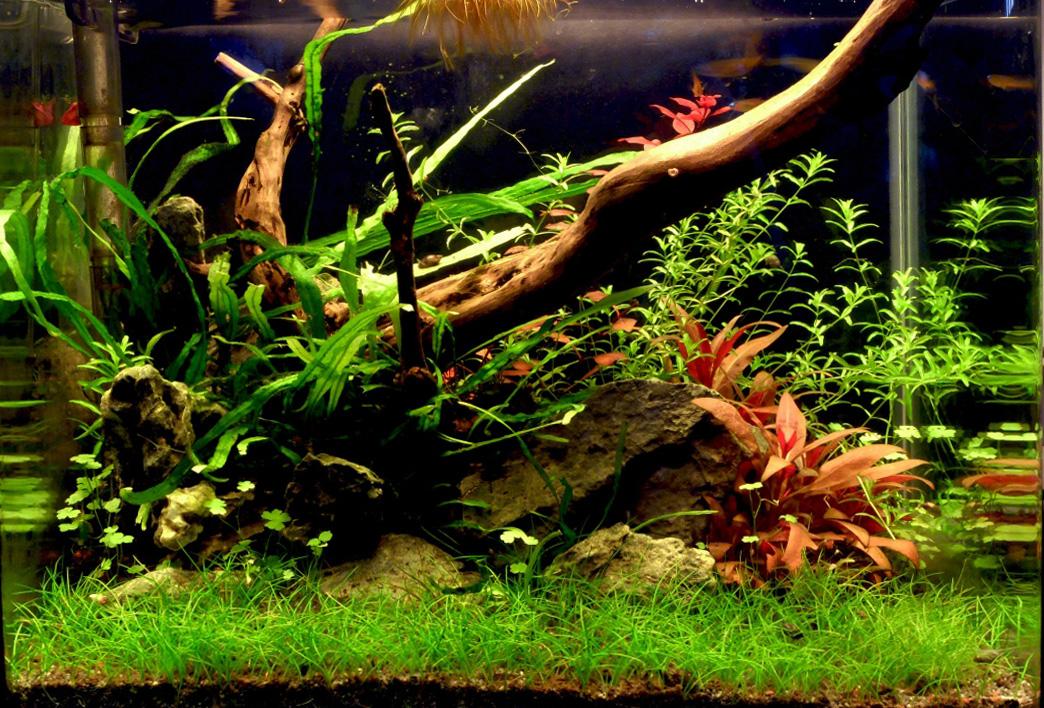
High-tech, CO2-injected planted tanks grows plants much faster, however, algae also hits harder when the aquarium is not well managed. High tech aquariums easily fills with plant mass due to the high growth speeds, and that high plant mass deters algae when the plants are growing well. The difficult part about high tech aquariums is keeping things stable. High light and strong fertilisation combined with fluctuating CO2 or poor distribution create ideal conditions for BBA, Green dust algae and filamentous green algae. True nutrient deficiencies are not the main cause for poor growth in high tech aquariums that recent very frequent nutrient dosing - rather, unstable nutrient levels caused by heavy dosing is a more common cause for growth problems.
In high growth speed aquariums dealing with overcrowding and old growth is also a major factor to consider. As plants grow, they naturally become overcrowded, and overcrowded plants produce less optimal growth over time. Many plant species need to be uprooted, divided, and replanted over time. This happen in faster cycles in high tech aquariums compared to low tech aquariums.




Share:
Do I Need CO2 to Grow Plants? An Honest Answer