

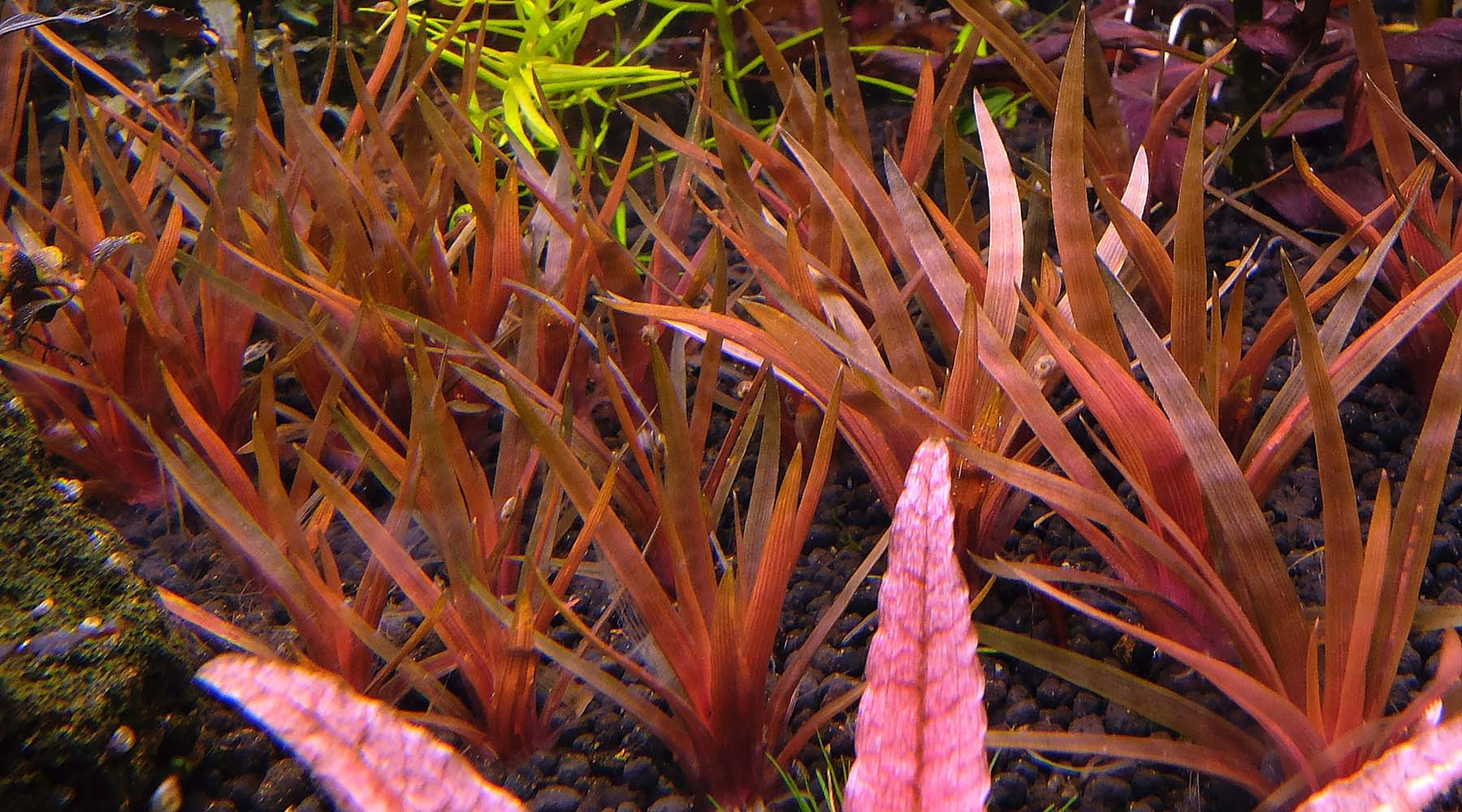
This reddish Eriocaulon originates from India and is a recent addition to the aquarium hobby. It is grown in some nurseries as a submerged bog/terrarium plant. The submerged forms can be relatively short, with adult plants being around 2.5 - 3 inches tall. It is reddish at the base of the plant with leaves fading to olive/orange towards the tips.
It will grow at a steady rate in the aquarium as long as light and CO2 levels are good. This plant should not be kept in the shade. It grows very well in ammonia rich aquasoils. The plant is delicate and should be handled with care; it is easily crushed. It is sensitive to KH and should be kept in low alkaline water. As a short plant - it's important to direct the flow/CO2 to the substrate zone.

The main difficulty in handling this plant is that the submerged forms do not ship well over long distances. If shipping for longer distances (3 days +) the submerged forms may be better. A healthy specimen is essential to ensure a smooth transition to the aquarium environment. Eriocaulon quinquangulare is often grown emersed on farms - as shown in the picture below. They are easier to transport in this form.
Eriocaulon quinquangulare is particularly CO2 demanding. It does better at 50ppm of CO2 rather than the standard 30ppm target in most tanks. Higher CO2 saturation greatly increases success rates with this plant. Low CO2 saturation manifests as softening and eventual melting of outer/older leaves. This can be observed in the leaf tips beginning to fray, and when the plant starts to look pale. When CO2 is inadequate, roots will be mushy and grey rather than bright white and firm when the plant is uprooted.

Nitrate limitation can increase the redness of Eriocaulon Quinquangulare; the reddish part at the base extends further towards the tips. Plants will also grow more slowly - as with any nitrate limiting regime - do it too severely and you risk a growth crash in the tank.
Unlike other varieties of Eriocaulon, this species does flower/seed regularly underwater. Flowering, if it does occur, also does not seem to signify end of life cycle.

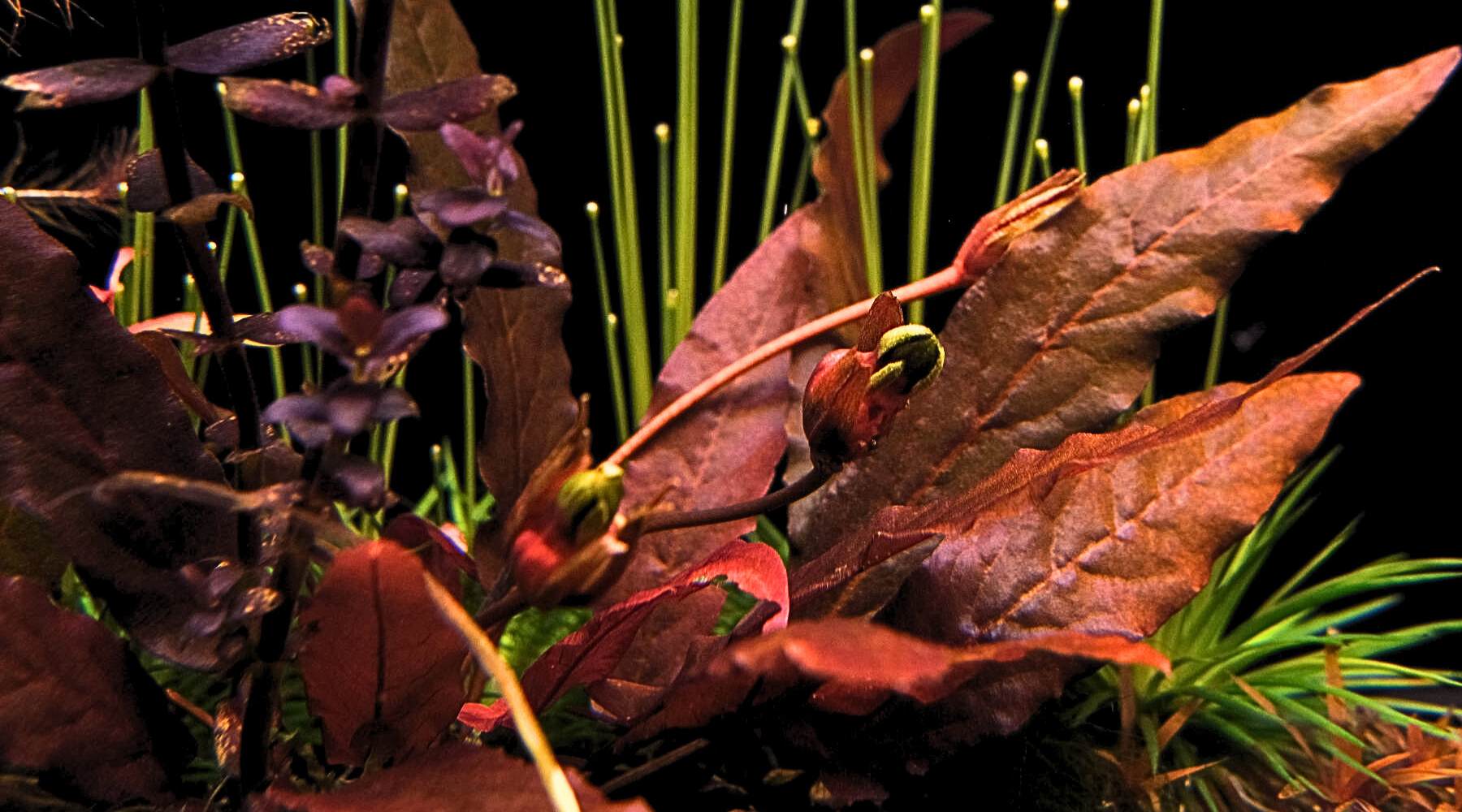
In the picture above we can see the relative size of young Eriocaulon quinquangulare compared to Centrolepis Drummondiana "Blood vomit" in the foreground, grown under nitrate limitation. The same plants about 2 months later are shown below.

Key success factors
- Low KH (3 dKH and below).
- High CO2 saturation (50ppm is good).
- High light levels (100umols and above is good)
- Grows fast in ammonia rich aquasoils.
- Short transport time when buying.
How to get it redder
- Stronger lighting.
- Good growth parameters with nitrate limitation. However, N limited plants are less robust and grow more slowly.
Propagation
- Adult plants split naturally as they grow; moving/replanting the plant also seem to trigger splitting in larger plants. Replanting does not seem particularly stressful for the plant, but growth tends to speed up after the roots have some time to grow in.
- As plantlets grow beside the mother plant, they can be separated gently by hand. The separation between plantlets should be obvious after the plant is uprooted.
This is the video's link on how to propagate this plant.

Single clumps grow pretty large if left alone. This clump was split into more than 10 separate plants.
Buying guide
- Healthy plants should feel stiff to the touch rather than soft. Avoid mushy plants at all cost - weaken plants will find it more difficult to transition to the new tank environment.
- Roots should be bright white rather than brown.
- Emersed plants take shipping/transit better than submerged forms. Submerged forms do not take shipping well and should be planted within a 3 day window.
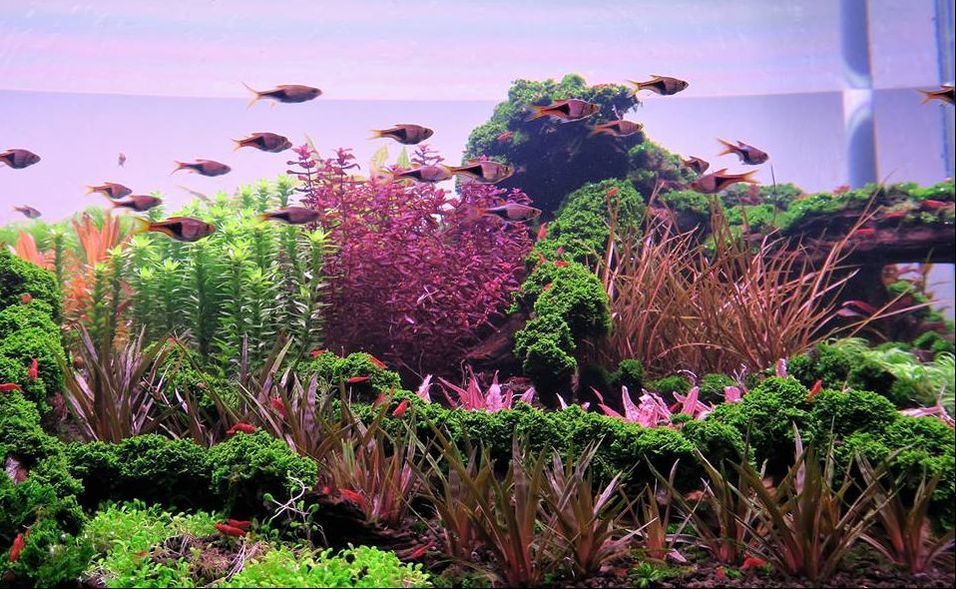
In the picture below, you can see the relative size comparison to other plants in Tom barr's tank.
As with some other Eriocaulons, the root system can be longer than the leaf portion of the plant. This is a medium sized specimen.

Click here to find out how to grow red aquarium plants.
Click here to read on how to optimize CO2 levels
Click here to browse more plant growing profiles
Click here to read on how to stabilize a new planted tank



Share:
How to grow Hygrophila pinnatifida
How to grow Centrolepis drummondiana (blood vomit)