Your Cart is Empty


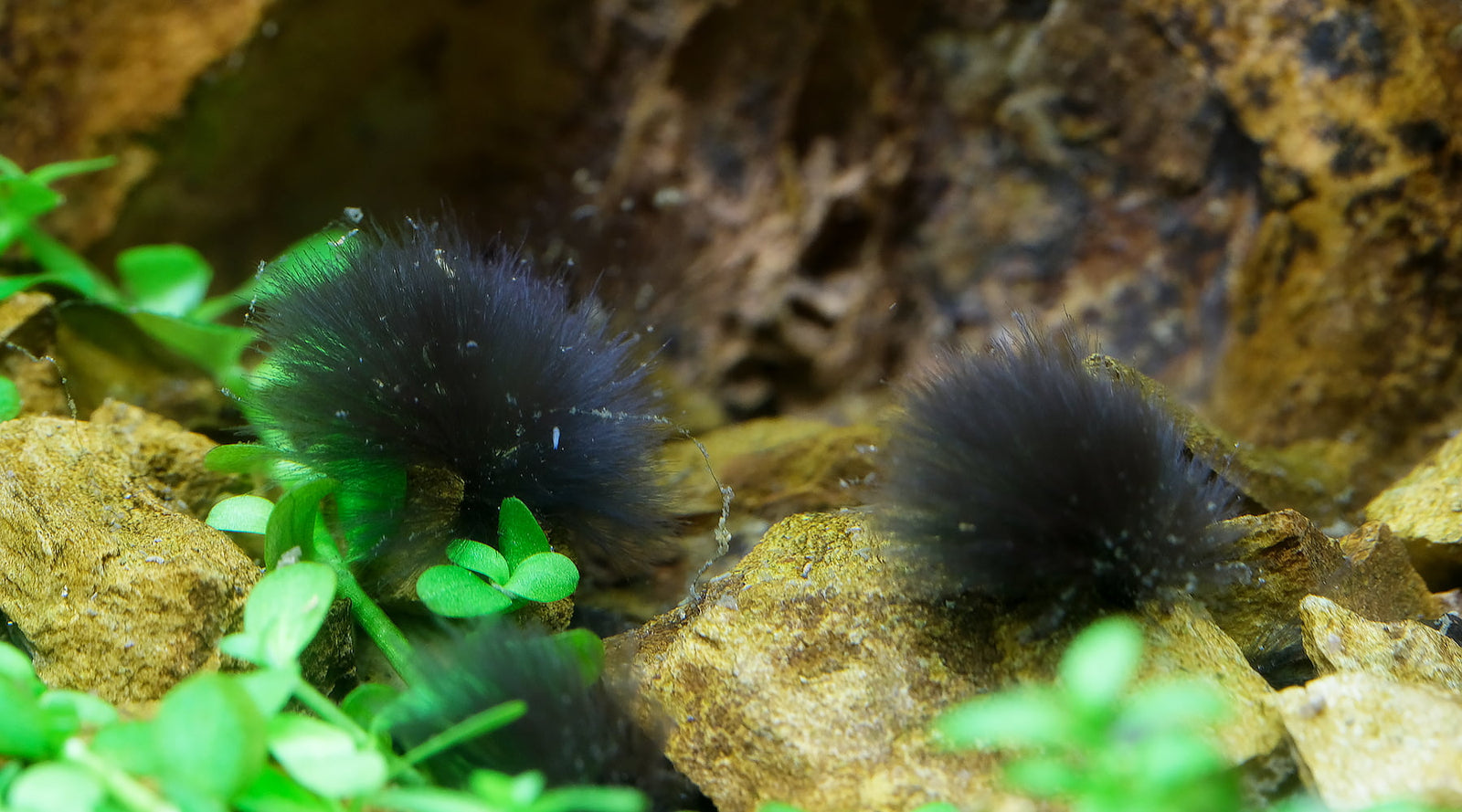
The term Black Beard Algae (BBA) refers to algae of the genus Audouinella, which contains many subspecies. Audouinella species occur in both marine and freshwater. These algae appear as short reddish or black hair. They grow in small clusters and first appear as small furry black dots about the size of the tip of a pen. They are often found on the edges of older leaves of plants, or on hard surfaces and filter outlets. Some species can grow to over a centimetre in length.
When aquatic plants experience adaptive stress, they release some of the excess metabolites directly through their leaf surfaces and edges. This triggers algal spores to bloom and attach to the plant. Adaptation stress occurs when a plant is transferred to a new environment or when there are sudden changes in the current environment. Healthy plants in a stable environment produce defensive chemicals that prevent algae from attaching, while stressed or unhealthy plants release waste metabolites that trigger algae attachment.
Fluctuating CO2 levels in aquariums are one of the biggest triggers for BBA to spawn, as plants have to make significant adaptations to their physiology to match the CO2 availability in their environment. This is one of the major triggers for BBA in CO2-injected aquariums.
As plants grow, they concentrate their energy on new top growth - where light is plentiful and there is an opportunity to break through the water surface to reach previously gaseous CO2. Older leaves further down the stem are abandoned and these are often colonised by algae as they deteriorate.

High levels of organic waste in a tank combined with high light levels can cause BBA spores to bloom. In tanks where the plants are healthy but there is a high level of organic waste in the tank environment, BBA will be found on the substrate rather than on the plants.
In planted tanks, fish and shrimp faeces and old leaves break down into organic detritus on the substrate. Many hobbyists believe that this provides a source of nutrients for the plants. While this is partly true, the decomposition process is not clean and the remaining organic waste, combined with high light levels, causes algae to bloom.
We recommend skimming organic detritus from the substrate surface during weekly water changes. In high light tanks this will have a huge impact on whether or not BBA is triggered to spawn.

 For plant species that are vulnerable to algae, doing large weekly water changes and siphoning off substrate detritus makes a huge impact. This is especially so for tanks that have slow growers and/or use high light.
BBA is commonly found in areas of high flow in the path of CO2. It is also commonly found on filter outlets and CO2 diffusers - which are often placed in the path of high flow. In such tanks, slowing down or redirecting the flow to create a more even flow distribution can help the situation. Existing BBA will still need to be treated with algicides, but a gentler water flow may reduce it's occurrence.
 American flagfish, mollies and SAE (Siamese algae eater) pick at it when there are no tasty alternatives. However, they are seldom adequate solutions.
As with all algae, higher light levels cause more spores to bloom. However, BBA has little to do with nutrient levels or light spectrum. Tanks with both very low and high nutrient levels are susceptible to it, and whether or not you use high blue light has no effect on the rate at which it blooms.
The main triggers for BBA are organic waste levels, deteriorating plants and CO2 fluctuations.
To learn more optimising CO2 gaseous exchange and flow patterns, Click here.
Click here for information on how to solve algae problems without algicides.
Click here for information on how to do proper water changes for a planted tank.
Click here for information on how to stabilize a new planted tank quickly.