
2HR CRAFTSPEAK: In this post we meet with Jordan Stirrat, a talented aquascaper from the UK who is especially well loved by the community for his active sharing of techniques and approaches.

I am a passionate aquascaper from Scotland, UK with four years of experience.


Originating from my memories as a child this aquascape resembles a pond bank.
When we are children, we are said to be at our most creative, therefore I thought taking a childhood memory and using it towards an aquascape would be a fascinating idea. Whilst I was young, I spent much of my free time in the woods with friends and nearby was a loch (body of water in Scotland).
This creation is in the memory of my happy childhood spent near the loch.
The hardscape concept started with a wooden bank surrounded with round stones and pebbles. The wood stretches out into the water and has earmarks of how tree roots may look at the edge of water in nature. The structure holds back a steep mound of aquasoil that almost reached the top of this shallow tank. Zip tied and stuffed with filter wool the wooden structure was used to keep the aquasoil from emerging into the front portion of the tank.
The emersed section included many different pond marginal plants that aren’t often seen in the aquarium hobby and are more likely found in your back garden pond.
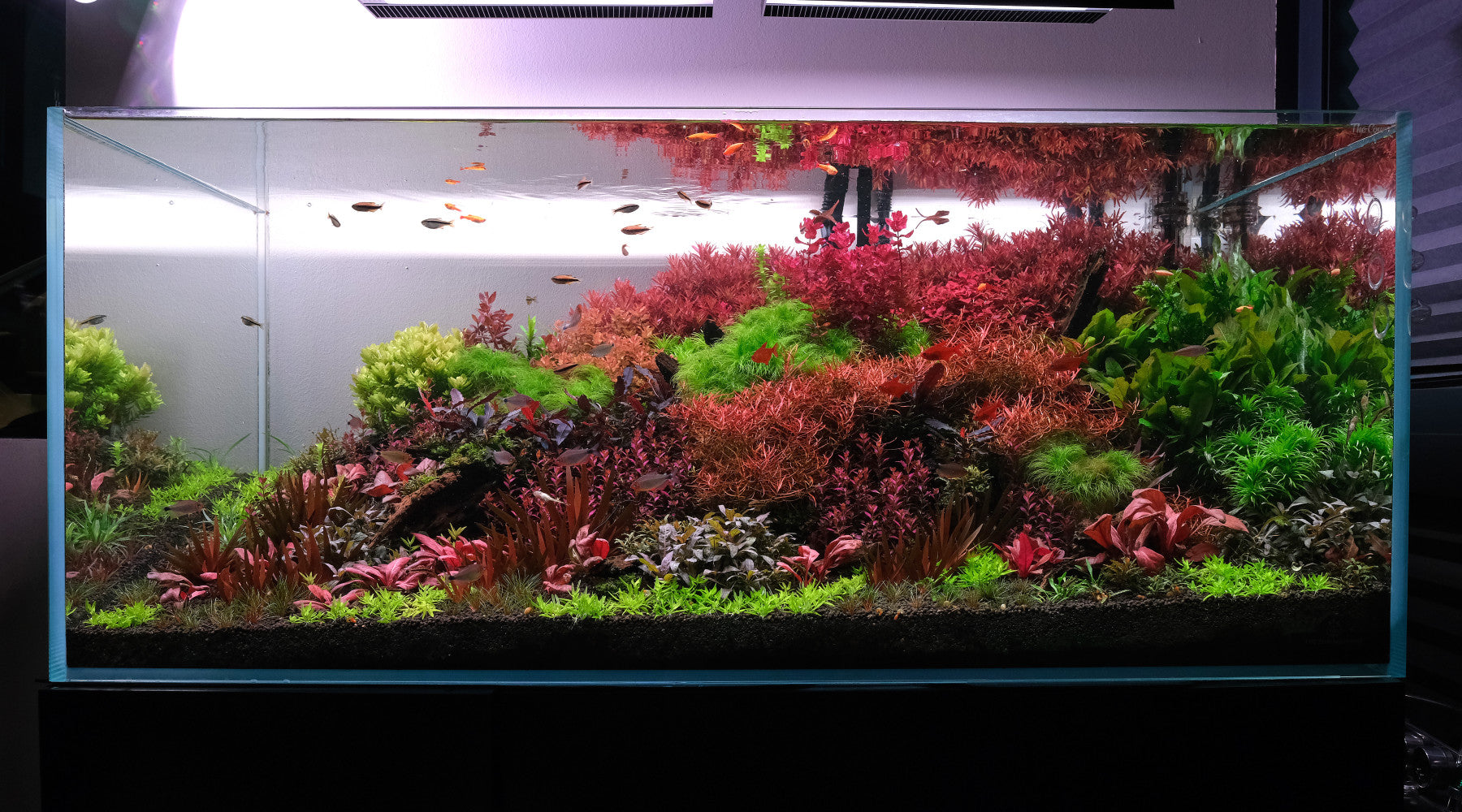
The submerged section (under water) is an area I played with colour, texture, and leaf shapes.
There are many dark green tones, but I have purposely added areas of bright green and red to draw the viewers eye in.
This aquascape was in my living room at a time where I had just started working from home. I often gazed over in the tanks direction and felt a true sense of relaxation from nature.
No other tank I have owned has provided me with such a sense of nature. This is my favourite creation to date.

Featuring an arc / bridge shape concept this is my most recent aquascape. While unique to me as I have never attempted to create such a layout it also unique because I haven’t seen many aquascapes like it online.
The ark provides an area of negative space in the centre of the tank while all the branches flow in one direction from the top left to the bottom right. A rib like formation can been seen on the left side allowing for planting to be done in-between.
I would normally sketch out my concept idea before collecting materials or introducing hardscape into the tank. This time I just went with the flow and positioned the wood and rock in a way that made sense to me.
As soon as I started, I was engrossed into the creative zone and by the end I had created something I probably wouldn’t have conceptualised.
This tank comprises of only epiphyte plants that attach to the hardscape. The plants have been used in the most natural way as no glue or thread was used. I feel that by placing the plants into the cracks and crevices in the hardscape this establishes the most natural appearance.
When looking for inspiration in nature we may take a closer look at how plants and moss propagate to let us get a better understanding of how they grow in nature. Moss and plants tend to grow in-between tree roots and not on the exposed roots themselves due to the flow of water or the abrasive elements. I really wanted to showcase my understanding of that in this aquascape.

Each tank had different maintenance requirements due to the plant choice and layout.
Faster growing stem plants require trimming more frequently whereas moss and slow growing epiphytes rarely need attention.
The marginal plants in the pond tank required trimming every week or two but this was a simple task when compared to trimming the dense stem bushes within the Brazilian style tank.


My approach to creating a hardscape or a new design varies with each project. Sometimes a comprehensive plan and preliminary sketch is created but often I might start by moving rocks and wood around on the floor to find a design that takes my interest.
If I find a single piece of unique hardscape that may also spark an idea or the same can be said with a nature photo I have taken.
When constructing hardscape I attempt to find ways two single pieces may fit together more naturally and see where that leads to.


I find that a bit of care and attention combined with lots of observation can be a very successful strategy. Finding the route cause of any issue and resolving it would be the ideal scenario and that’s what I aim to achieve.


I try to use at least one new plant with each aquascape in order to grow a bigger plant vocabulary. I choose plants based upon the hardscape layout or vision I have and rarely because I have an attachment to a specific species.


I would like to believe I can diagnose issues with my planted tanks quicker now and am able to resolve most issues without asking for help. When I was a beginner hobbyist I had great friends willing to help me with any questions I had and without them I wouldn’t have achieved the same success.
After mastering the basics you are able to focus more on the creative side.







Share:
Craftspeak Philippines