

How to Grow Ludwigia Super Red
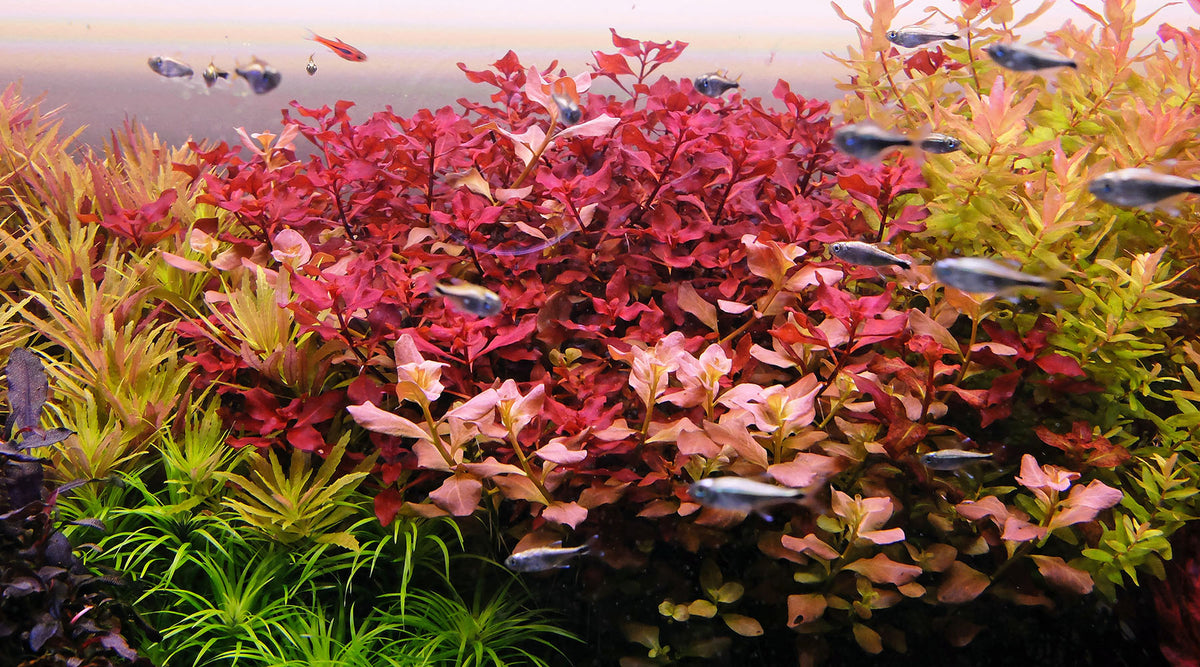
Ludwigia sp. 'Super Red' is a varietal of Ludwigia palustris and one of the easiest red plants to grow in a freshwater planted aquarium. Ludwigia super red, Ludwigia sp. red and Ludwigia super red mini are all common names for the same plant. With sufficient light and nutrition, it turns deep red with or without CO2 injection. Injected CO2 gives faster growth, larger sized plants and bushier growth. This article will describe the key success factors for aspiring planted tank aquarists to master this plant.
This plant will always look red as long as it has sufficient light and is in good health. Extra iron dosing and nitrate limitation does not induce redder pigmentation.
This plant colors up easily, and only requires 50-70umols of PAR to start showing its red colors. 80 umols of PAR as measured on the substrate level guarantees strong red coloration if other growth factors are in place.
CO2 injection makes the plant branch more profusely, and allows it to be trimmed into dense bushes. Plants grown without CO2 injection do not branch readily, making it difficult to get density.
This plant is easy to grow, and is very flexible with regards to water parameters. It grows aggressively when growth parameters are in place, shading other shorter plants easily unless it is regularly trimmed back.
There is no separate mini varietal for Ludwigia super red. Ludwigia super red mini refers to the same plant. Lean nutrient conditions forces the plant to produce smaller leaves. In lean conditions, the color tone of the plant can look purplish/darker red while in richer conditions the plant will be brighter red in color.

Is Ludwigia Super Red Mini a Separate Species From Ludwigia palustris?
No. Whatever the label says, super red, sp. red and super red mini are one cultivated red form of Ludwigia palustris. It entered the trade under different trade names that are still used by various sellors, so you will also see Ludwigia natans 'Super Red' or Ludwigia repens 'Super Red Mini' on retail labels.
There is no mini version. Plants grown in lean conditions are simply smaller, so lean nursery specimens pass for a "mini" strain until they are given better growth conditions, where they will show their usual size.
Ludwigia super red produces small, rounded leaves that taper to a point, roughly 0.5 to 1 inch long, attached in opposite pairs and red on both surfaces. The stems will keep growing until they reach the surface, so trimming determines the plant's final height. Among the common Ludwigia species it offers the lowest difficulty for the most dependable red.
Does Nitrate Limitation Make Ludwigia Super Red Redder?
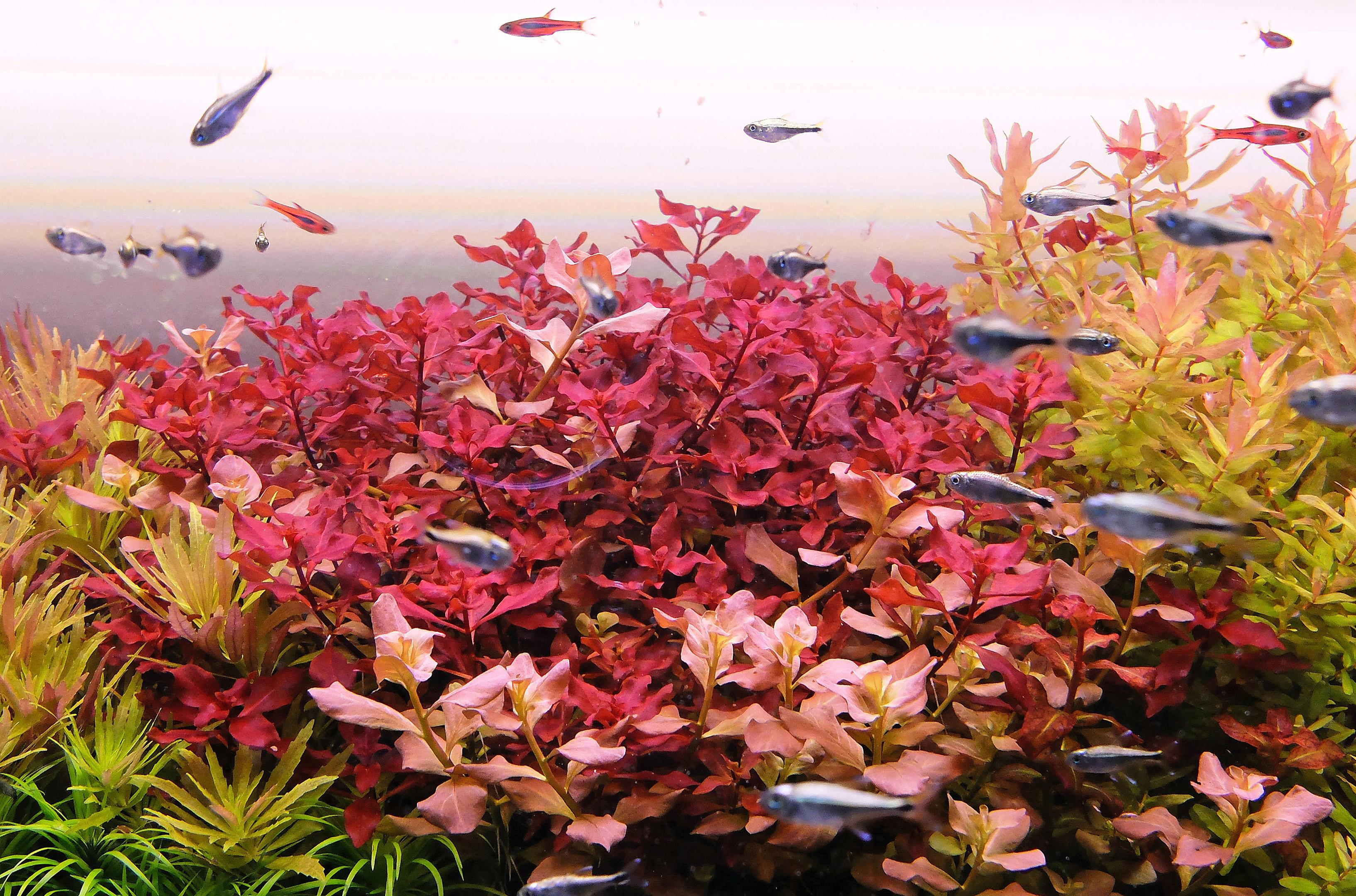
Red color in aquatic plants comes mainly from anthocyanins, pigments that act as a sunscreen for leaf tissue. Plants build more of them under strong light, much as skin tans, which is why most red plants get redder as PAR rises. Ludwigia Super Red is genetically inclined to produce them, so it colors up even under moderate light and does not require Nitrate limitation to color up. Nitrate limitation has no impact on coloration for this plant.
Nitrate limitation works on Rotala rotundifolia and Ludwigia arcuata because a nitrogen shortfall delays chlorophyll production; with less green masking the leaf, the red shows through. Ludwigia Super Red does not depend on that unmasking. Some guides will recommend maintaining nitrate levels between 5-15 ppm for optimal color. However, there is no truth to this statement, Ludwigia super red can be grown in both leaner and richer conditions. Low nitrates will simply make Ludwigia super red produce slightly smaller leaves.
Does Ludwigia Super Red Need CO2 Injection?
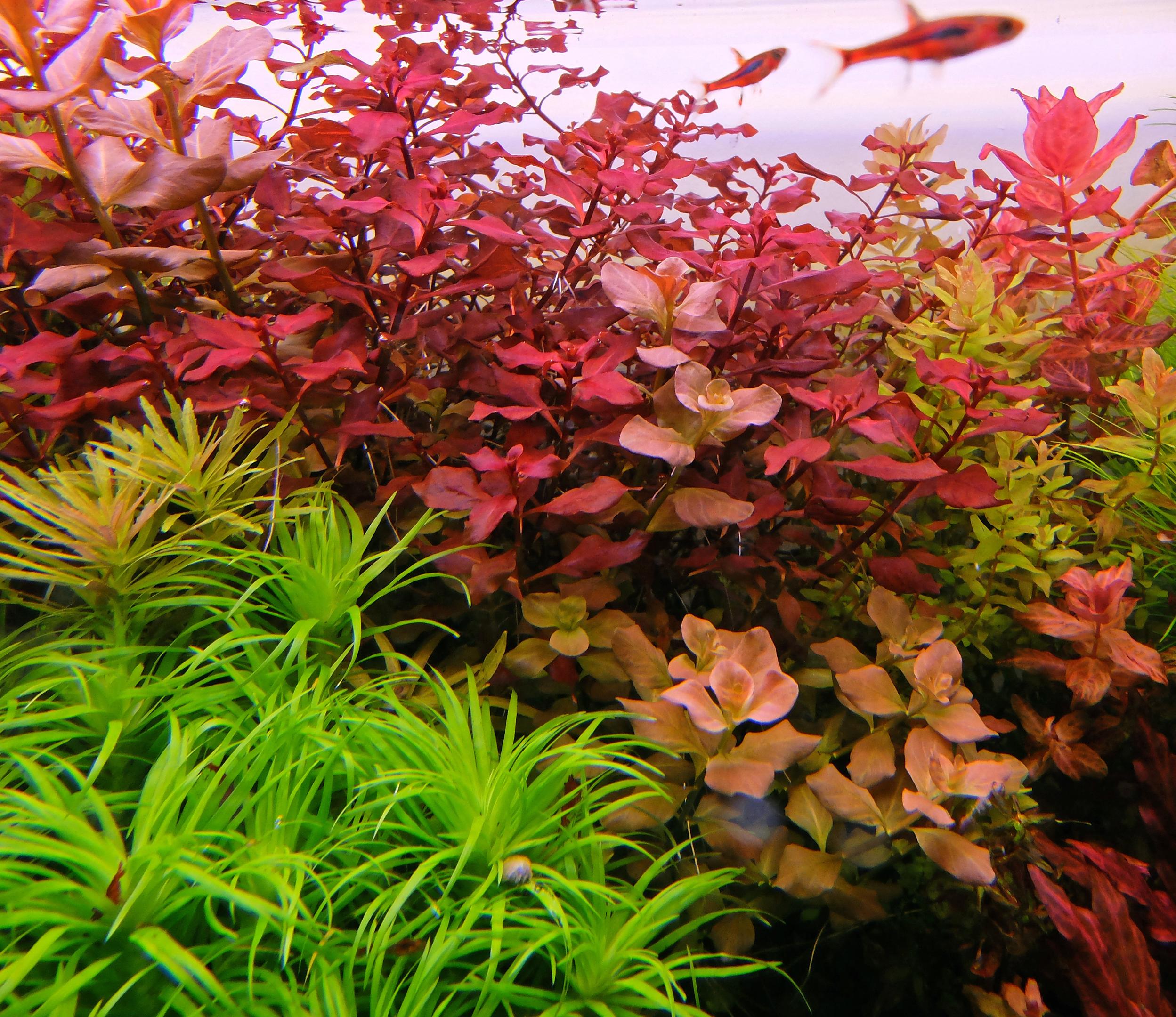
All plants use more Carbon for growth than all nutrients combined. Low tech tanks that can generate sufficient CO2 naturally through organic decomposition in the substrate and microbial action are the ones that turn out successful. Only a tiny amount of CO2 that dissolves in aquarium water comes from the atmosphere (less than 1ppm). Thus, the success rate for Ludwigia super red mini in a low tech tank depends on how the low tech aquarium is set up. Low tech aquariums have huge variance in their success rates, depending on how much CO2 is naturally produced.
Premature loss of lower leaves, lack of production of side shoots, and increasingly smaller new growth being produced are all signs of CO2 deficiency. CO2 deficiency is the number one reason for problems with plant growth in low tech aquariums, though folks tend to mis-diagnose growth problems as being nutrient related.
While many low tech aquariums can grow Ludwigia super red, it has much higher success rates in tanks with CO2 injection. CO2 injection produces denser plants that branch profusely and can be trimmed to dense bushes. CO2 injection also allows stem plants to preserve their lower leaves longer.

What Water Parameters Does Ludwigia Super Red Prefer?
Ludwigia Super Red is not picky about water parameters and can grow in both soft and hard water. It grows across a normal tropical range of 68 to 86°F (20 to 30°C+), and is suitable for warm tropical aquariums. It is flexible with pH and can grow well anywhere in the range of pH 4.5 to 8.5. It is amongst the easiest red plants to grow.
Does More Iron Make Ludwigia Super Red Redder?
Only if the tank was short of iron to begin with, which only occurs in aquariums where there is no nutrient dosing at all. Iron enables pigment production; it does not stimulate it. Plants use roughly 100 times more nitrogen than iron, and most plants pictured on this site were grown at just 0.03ppm of iron per day from APT 3 (formerly APT Complete). Most folks adding iron for color already dose plenty; targets such as 0.1 to 0.5ppm are not necessary - dosing large amounts of iron has no impact on plant pigmentation, and is not a substitution for getting other growth parameters in place. Plant pigmentation is closely tied to overall plant health, which is tied to many other non-nutrient factors such as overall microbial balance and horticulture techniques such as plant placement and trimming.
Ludwigia super red needs similar nutrients to other aquatic plants: nitrogen, phosphorus, potassium, magnesium, iron and trace elements. Having access to all elements is important - overloading on just 1 has no benefit for the plant. Feeding both the water column and the root zone is beneficial: water column dosing feeds freshly cut stems before their roots grow in, while nutrient-rich aquasoil feeds established roots.
To make Ludwigia super red redder, change one variable at a time, and judge each change on new submerged growth over two to three weeks.
Below 40 PAR, Ludwigia remains predominantly green. Check that you have enough light to grow this plant. Verify PAR at the substrate level, and raise it toward 80 umols if it falls short.
CO2 injection helps a lot in Carbon deficient tanks. Carbon availability influences plant coloration, plant health and side shoot formation.
Keep nutrition complete and steady. Over dosing Iron or limiting nitrates does not help coloration with this plant..
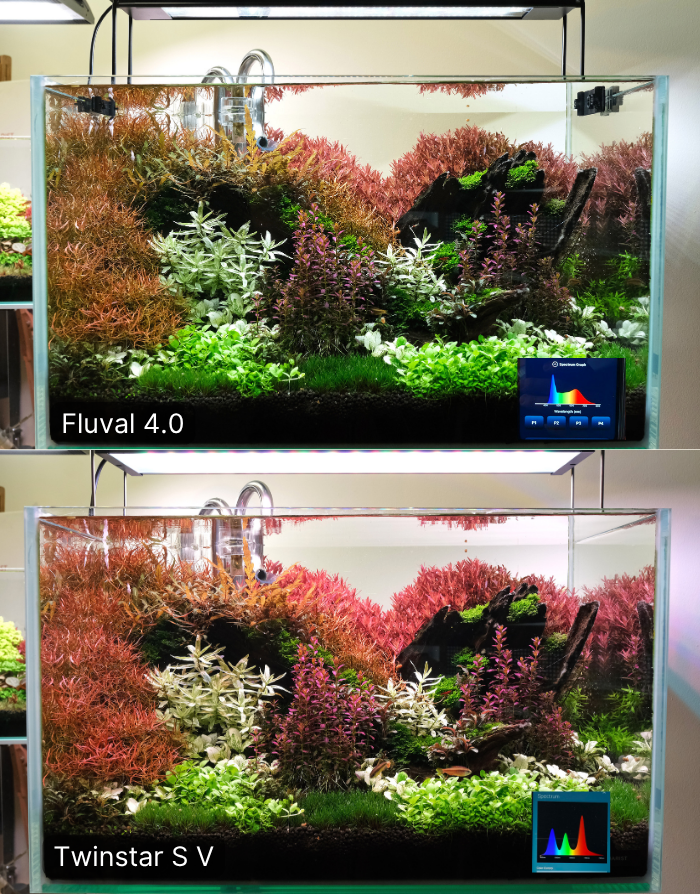
Upgrade to a light set that has sufficient red/blue spectrum. Better spectrum profile helps pigmentation and visual presentation.
How and Where to Plant Ludwigia Super Red
Live plants can arrive as lead-weighted bunches, potted plants or tissue culture cups. For the initial planting, remove weights and rock wool, or rinse the gel off tissue culture plantlets and split each portion into small groups or single stems. Strip the lowest inch of any leaves, then plant each stem individually about 1 inch (2 to 3 cm) apart. A group of 10 to 12 stems planted this way fills in far better than a compressed bunch as individual stems have more space to grow into.
Ccommercial plants are often grown emersed, so expect the first leaves to change or drop as the plant converts to submerged growth. The emersed grown leaves will deteriorate and be abandoned by the plant as submerged leaves are produced.
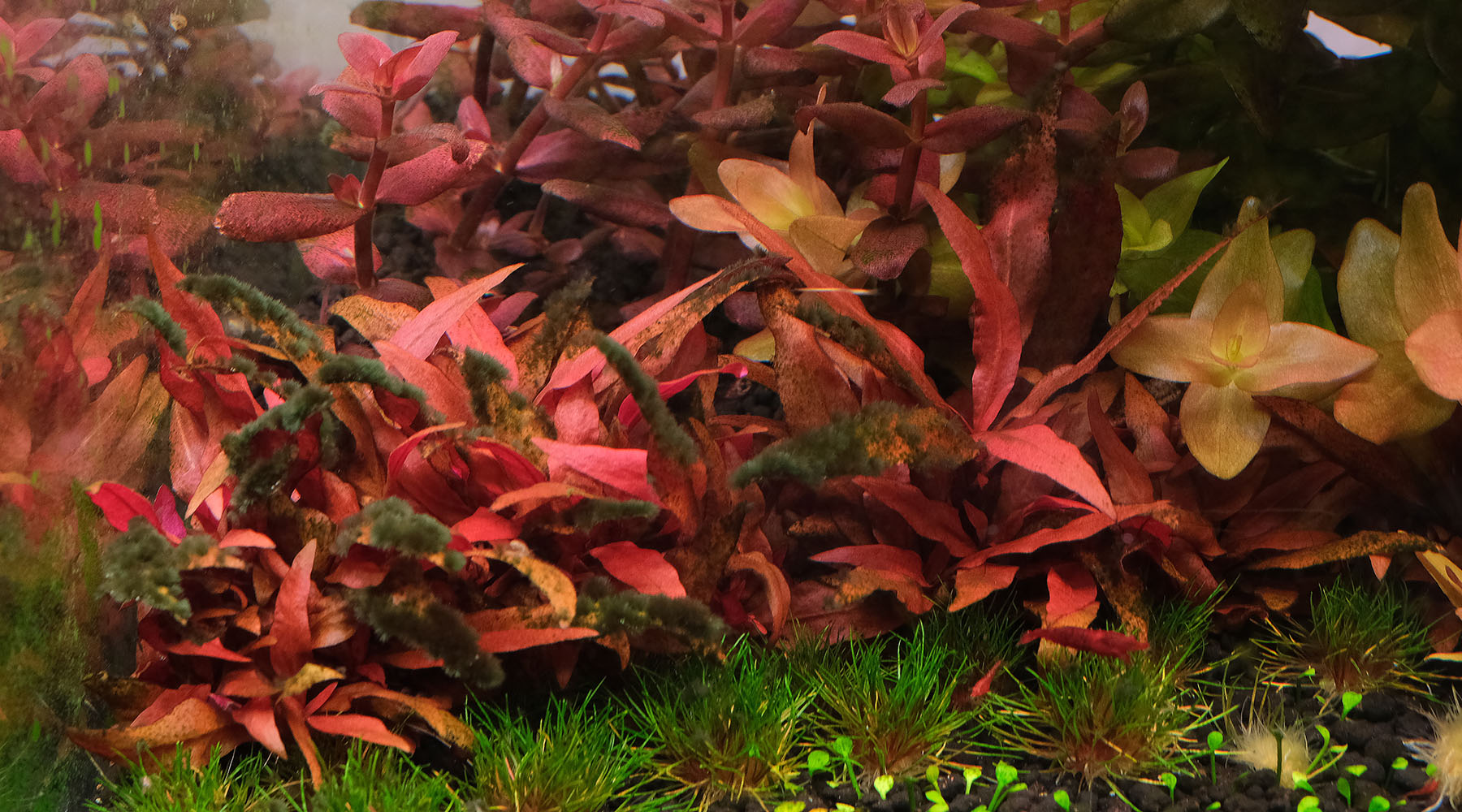
Ludwigia super red does best in the midground or background where it contrasts well against green plants and dark driftwood.
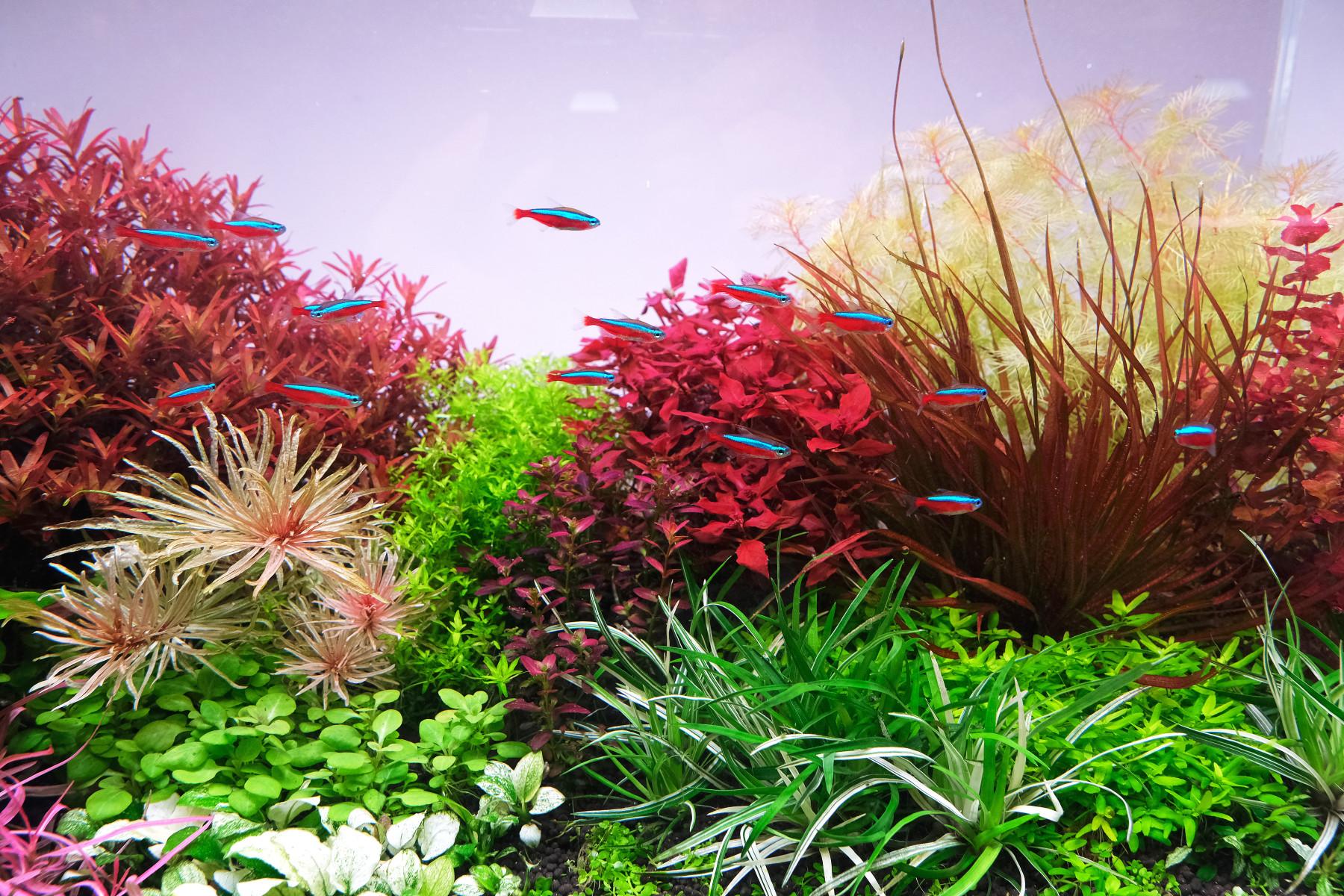
Ludwigia super red surrounded by other colorful aquarium plants
How to Trim and Propagate Ludwigia palustris 'Super Red'
Trim before the canopy regularly by cutting off the tallest shoots. Cut each stem at a node some distance below the final height you want, and stagger the cuts, shorter at the front and taller at the back, to create a slope. Each cut node pushes out one or two side shoots, so the bush thickens with every round of trimming. As new shoots appear at the base of the cut stem, remove taller outliers that break the shape of the slope.
Ludwigia sp. 'Super Red' can be propagated easily via stem cuttings. After repeated trimming, the lower portions of stem plants will eventually deteriorate. This is part of the natural life cycle of such plants. When this happens, the plant needs to be topped and replanted. Cut tops of around 4-6 inches (15 cm), then strip the lowest leaf pairs before planting the bare end directly into the substrate. The old rooted portion should be uproot and discarded. By regularly topping and replanting, stem plant bushes can be rejuvenated indefinitely.

Why Does Ludwigia Super Red Lose Its Lower Leaves or Turn Green?
This plant needs at least a moderate amount of light to grow red leaves. Below 40umols of PAR, leaves will be predominantly green. Aim for 80umols of PAR on the substrate.
Stem plants continually adapt their internal machinery to match the current aquarium environment. New leaves are produced optimized for the current environment, while old leaves have limited plasticity to adapt, and are discarded. Stable tank conditions allow for older leaves to persist longer. Unstable tank conditions forces the plant to reprogram often, and this is paired with the discarding of older growth.
In low tech aquariums, CO2 deficiency is the number one cause for loss of lower leaves.

Further readings: See how to read PAR values, fine-tune light spectrum and optimize CO2 levels, see our guide to growing red aquarium plants, or browse more plant growing profiles.

Share:
How to grow Bucephalandra
How to grow Myriophyllum "golden"