

The relationship between light and CO2
The key question is, if there is no CO2 injection and CO2 levels are low, does higher light increase growth rates? The answer is yes, although the increase in growth is nowhere near as great as when CO2 is injected.
This is demonstrated in the experiment below by Andersen (1999) Interactions between light and inorganic carbon stimulate the growth of Riccia fluitans, University of Copenhagen.

Figure (above) shows how 1 gram of Riccia develops over two weeks at given lighting and CO2 levels.
- At low light, low CO2, Riccia barely grows and 1g grows into 1.16 grams after 2 weeks (white line).
- At low light, high CO2, 1g grows into 1.75g (green line)
- At high light, low CO2, 1g grows into 2.41g (blue line)
- At high light, high CO2, 1g grows into 6.9g (red line)

The other result of the experiment showed that the increase in growth rates when either CO2 or light was increased was subject to diminishing returns. This means that when light or CO2 is lacking, small increases give a big boost to growth, but increasing from a medium to high level still gives a boost to growth, but in a slightly smaller way.
It also shows, counter-intuitively, that even in a low-tech planted aquarium, high light has a significant effect on growth. While this may cause more algae problems in an unbalanced planted aquarium, using high light in low-tech tanks allows the growth of more difficult species that don't usually adapt well to low-tech conditions.
The Impact of Light at different CO2 levels
The chart below compares photosynthesis in a tank with high CO2 vs low CO2.

At low CO2 levels, photosynthetic rates are limited by the low CO2 levels, so the maximum amount of light that can be utilised is lower than in a high tech planted tank. The photosynthetic curve therefore tapers off at a lower point as light levels increase compared to a high CO2 tank.
However, plants can allocate energy to different functions; for example, a lack of nutrients can cause the plant to allocate more energy to root growth, a lack of light stimulates stem elongation and more energy to light absorbing pigments and chlorophyll. At low CO2 levels, plants invest more energy in enzyme production to aid CO2 uptake & fixation.
Therefore, the light compensation point (the level of light at which the net energy needs of the plant are met) is actually higher for low-tech tanks than for CO2-injected tanks. In the latter, CO2 is readily available, so plants need less light to have excess energy to grow. This leads to the curious combination that, at the extreme end of low light, high tech tanks can survive with lower absolute light levels than low tech tanks, while also being able to utilise much higher light levels when available.

This is detailed in the chart above. The red line is the light compensation level of photosynthesis. Only above this level do we get net growth. Below this level, plants starve.
So what?
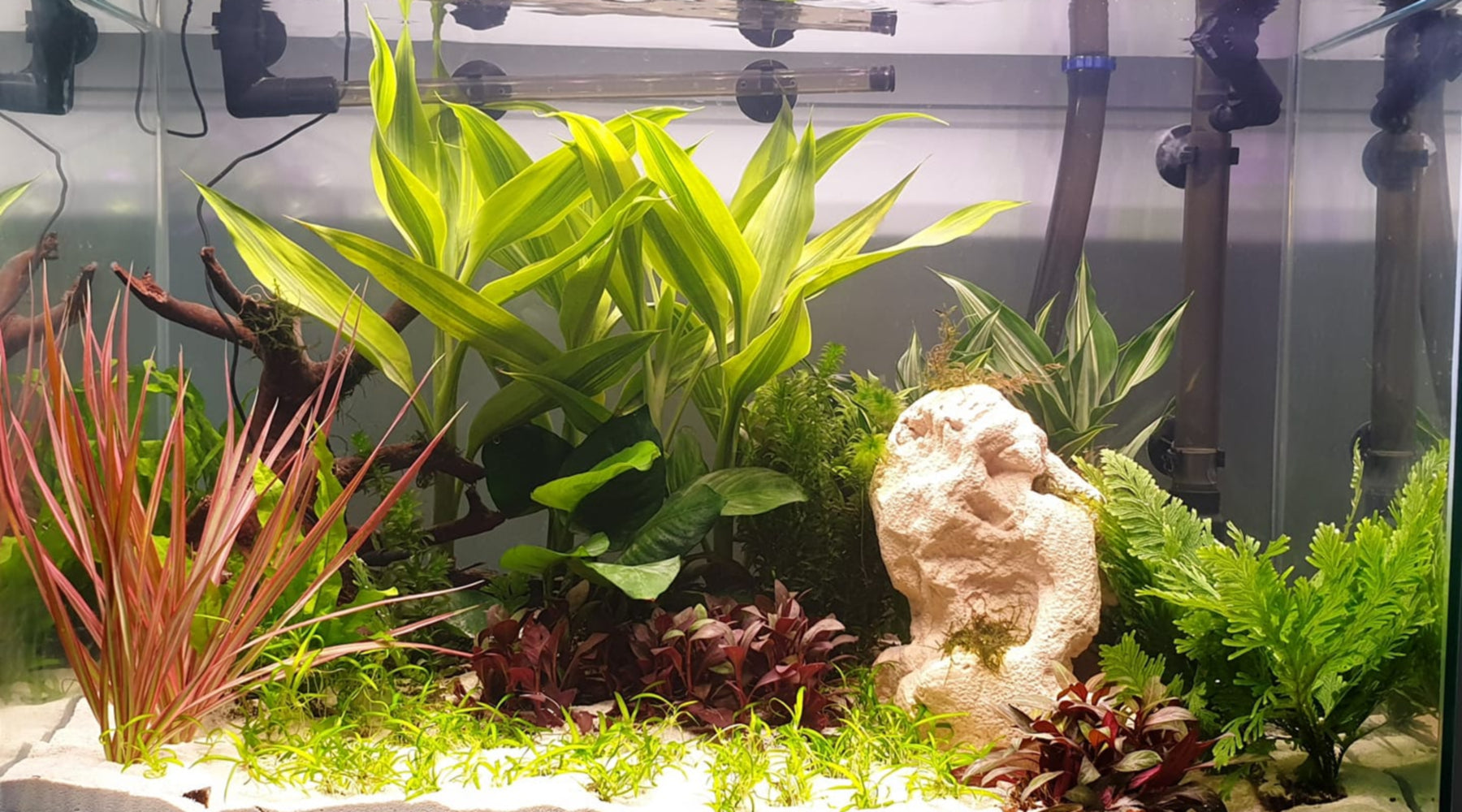
This means that having more light in low tech tanks WILL improve growth rates, even though the marginal impact is smaller than compared to in a CO2 enriched tank.
Using higher lighting in low tech tanks is one way to grow more difficult species that otherwise do very poorly in low CO2 environments.
The main downside of using higher lighting is that one may face more algae issues.
For high tech planted tanks, growth rates also eventually taper off as light levels are increased even with CO2 enrichment. There is little marginal gain to growth rates by increasing PAR beyond 600-800 umols.

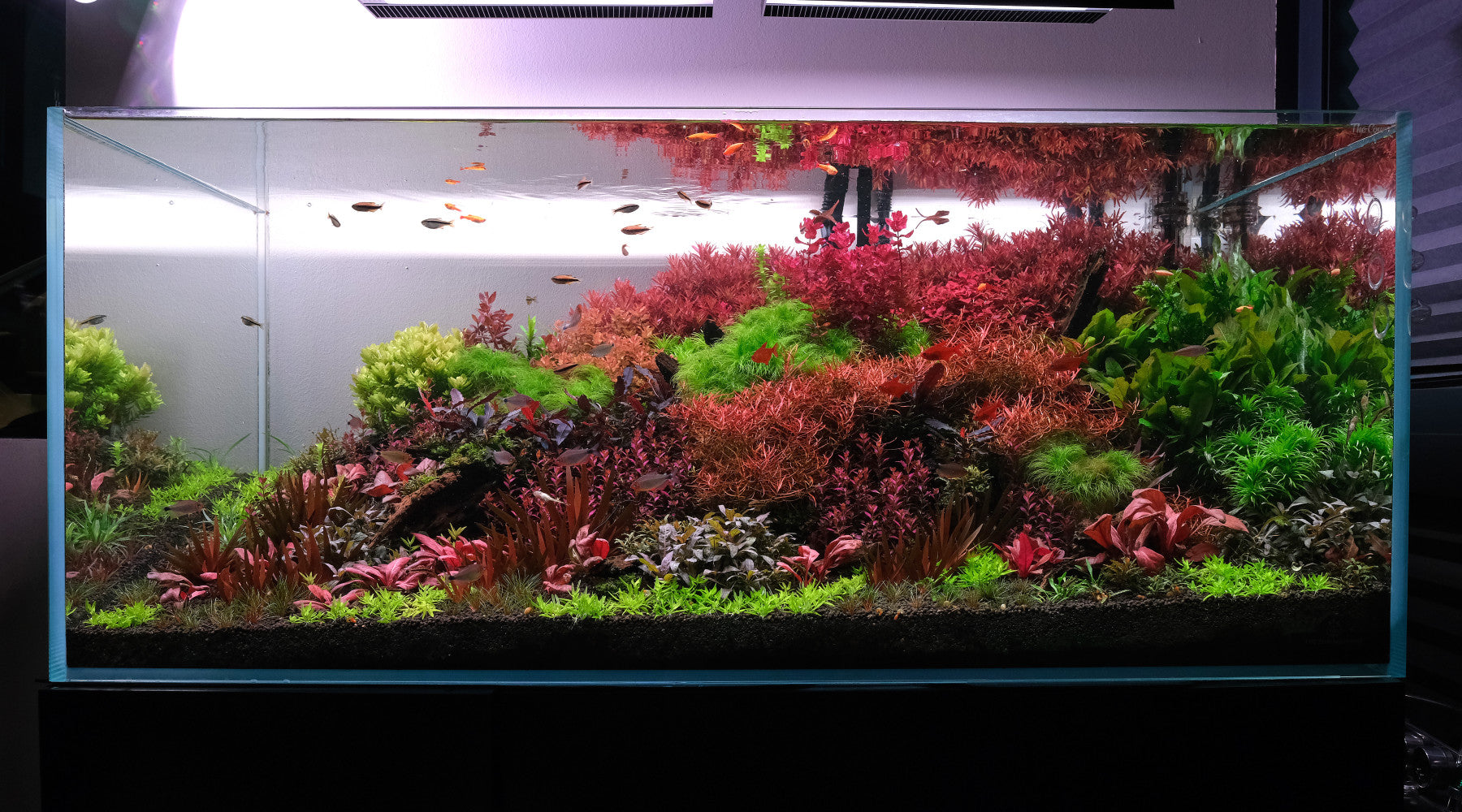
Using soil and higher lighting is one way to cheat past the limitations of low tech / non CO2 injected planted tanks. In this tank, the Monte carlo carpet grows in significantly over a 3 month period.
To learn more about reading PAR tables, click here.
To learn more about algae control, click here.













Share:
How do I know if my CO2 levels are too much for my fish?
How to set up a CO2 system for the first time