

Introduction
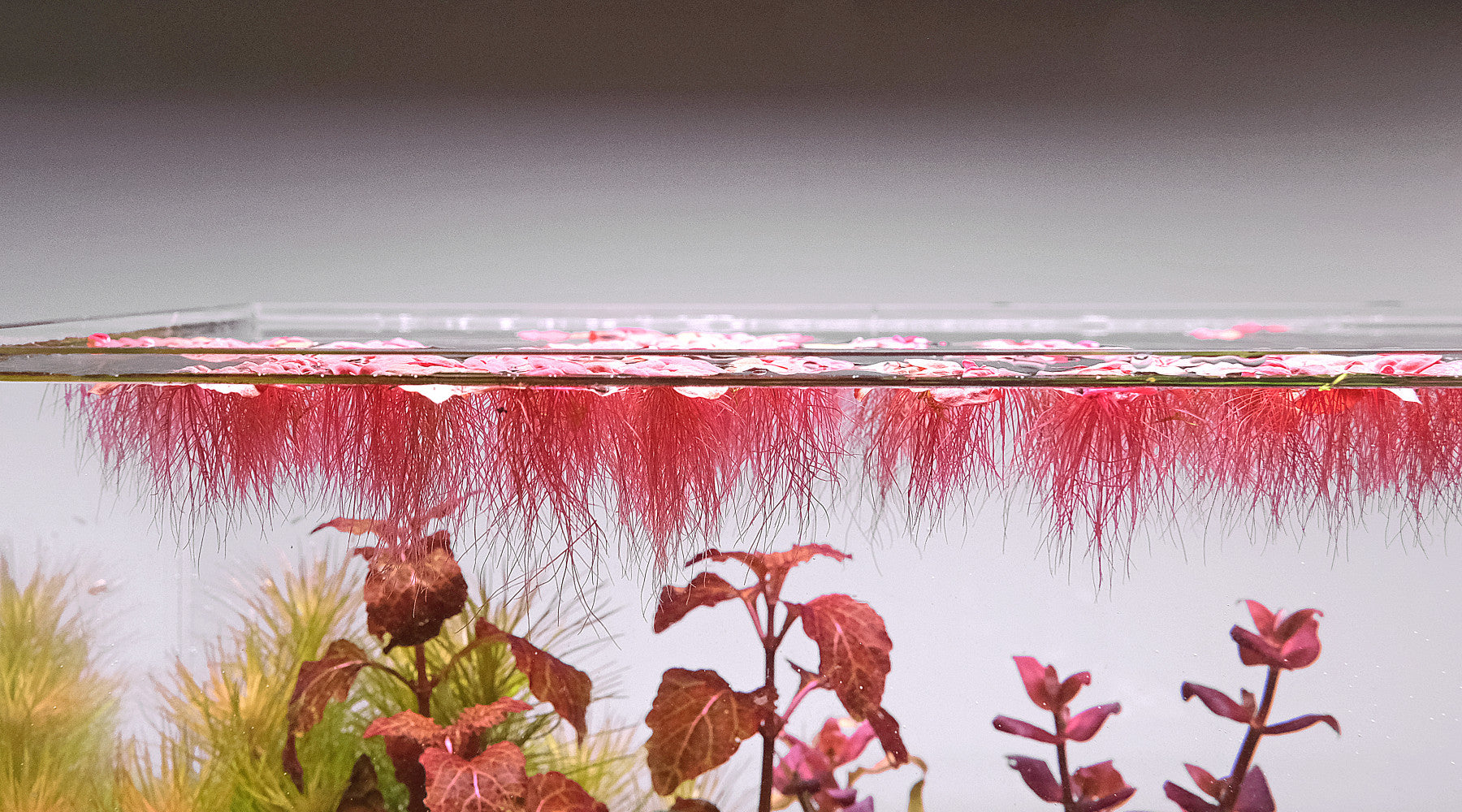
Phyllanthus fluitans is a floating plant native to the tropics of the Americas. It has round leaves that alternate on a short stem and clusters of short red roots. The common name 'red root floater' is derived from these red roots. It is a decorative floating plant that reproduces very quickly in nutrient-rich water and high light levels. They are very useful in aquariums for absorbing ammonia and nitrogenous waste compounds. The root system also provides a home for microorganisms and the leaves provide a much appreciated cover for shy fish. For many aquariums that do not have the conditions to grow submerged plants well, floating plants such as Phyllanthus fluitans are a great stand-in.
As a floating plant, they are closer to light sources and are also able to take up carbon dioxide from the air - meaning they are not limited by the gas exchange limitations of submerged growth. They tend to reproduce rapidly as long as there is sufficient light and nutrients.

The leaves can be either green or red. The main factor that causes red leaves is nitrogen deprivation. Even plants grown in low light will turn very red if deprived of nitrogen - the opposite is also true; under high light levels it can still grow completely green leaves if it has ample access to nitrogen. For aquarists who want to redden their red root floaters, growing them in tanks with low nitrate levels in the water column and low fertilization levels will quickly redden the leaves. At higher dosages and higher nitrogen levels, the leaves will turn green and the plant will reproduce much faster.
 Red root floater with reddish leaves grown in low nitrogen water at 189 umol PAR. This tank is dosed with APT 1, which contains no nitrogen.
 Red root floaters with greenish leaves grown in water with higher nitrogen levels at 436 umol PAR (more than double the picture above). This tank is dosed with APT Complete, which contains nitrogen.
 In densely planted tank dosed with APT Complete. Nitrate limitation due to higher plant density in the tank is turning the new leaves reddish.
 Add a bunch of red root floaters from a nitrogen-limited tank to a tank with a higher level of nitrogen available in the water column; the old leaves remain reddish, but the new leaves produced are completely green. Older leaves have limited plasticity to adapt to new conditions, but the plant will grow new leaves optimized to use the newly available resources.
Key success factors
- Minimal light levels are necessary, higher light levels give faster propagation rates.
- Low nitrate/nitrogen levels in water column turn leaves redder.
- Overly turbulent flow can be damaging to the plant, gentle current is preferred.
- Dosing nutrient liquid fertilizer is not necessary in most tanks that have other sources of nutrients such as livestock/soil. However, it can greatly accelerate propagation rates.
- Be aware that large numbers of floaters can block light from reaching aquatic plants growing in the tank substrate.

Propagation & trimming
They grow quickly without much input as long as there is enough light and a source of nutrients. Excess plants can be picked up and discarded. In tanks where Red Root floaters reproduce rapidly, they can cover the water surface so densely that surface gas exchange is inhibited and oxygen levels in the tank are reduced. Floating corrals can be used to limit their spread.







Share:
How to grow Lysimachia parvifolia (Samolus parviflorus red)
3 Key pillars for aquatic plant growth