
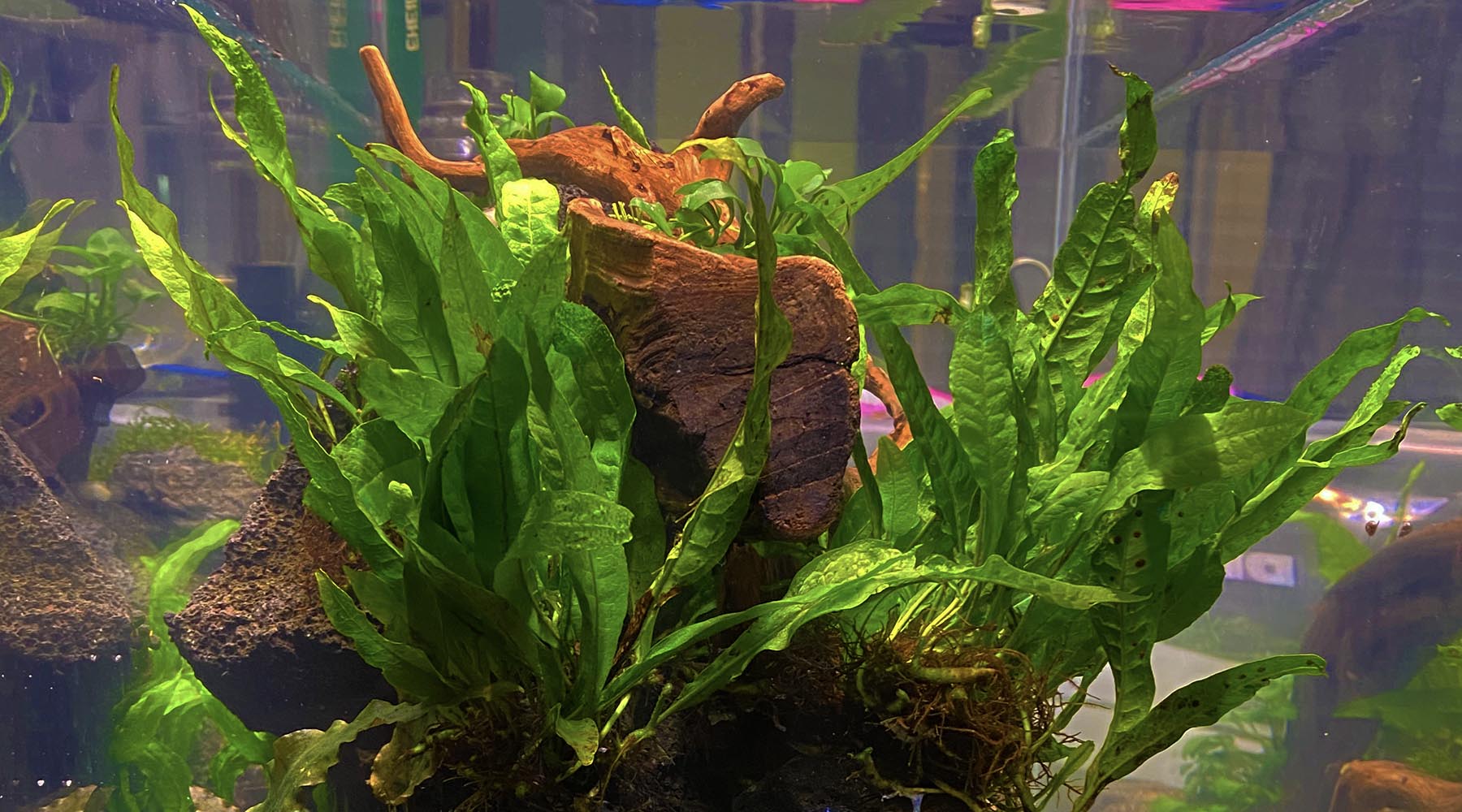
Java fern (Microsorum pteropus) & its many variants.
Java fern can be found in various tropical and subtropical regions in Asia. There are many variants available - Needle leaf variant (long, thin narrow leaves >40cm), Philippine variant (shorter leaves <15cm), 'Windelov' variant (branched leaf tips <20cm), narrow leaf variant (shorter leaves <15cm), 'Trident' variant (multiple lobes per leaf)
Microsorum pteropus develops a creeping rhizome on which the roots and leaves grow from. The rhizome can be attached to rocks or driftwood with string or glue, and after a few weeks it will attach naturally through its roots. It is one of the easiest aquarium plants to grow as it tolerates a wide range of water parameters and takes shading and crowding well. This means that it can be placed in almost any position in the tank. Due to its aesthetic similarity to land ferns, it matches driftwood very well, and this is where it is used most often.
Unlike what some folks presume, Java fern can grow well in high light levels though the leaves may grow to be slightly lighter green colored. Maintaining a clean tank with good plant health overall is essential in such circumstances to prevent algae. It can also be planted on aquarium substrate as long as the rhizome itself is not buried.
Even though it is a tough plant, it does grow much better if its basic needs are provided. Having enough NPK in the water column, and good all round fertilization gives faster, greener growth. General tank stability is also important as it is a slow grower and is slow to adapt to changes.
It can be propagated easily by dividing the rhizome of the plant. Baby plantlets also spawn on leaf edges now and then.
Anubias barteri 'nana' and its many variants. Bucephalandra; similar genus to Anubias but with more variety and color.

Anubias barteri 'nana' has been a long staple in the aquarium trade. It is hardy, and often sold attached to driftwood wood which allows easy placement in fish-only tanks as it doesn't require soil to grow. This also means that it can be moved around for alternate tank arrangements.
It is a slow grower that can take shade well. So many advantages in one plant ! However, this does not mean that it is indestructible. Being slow growing means also that if its leaves are damaged through neglect it is slow to recover. Its leaves are also prone to algae if the plant is not growing well. As with java fern, even though it is a tough plant, it does grow much better if its basic needs are provided. Having enough NPK in the water column, and good all round fertilization gives faster, greener growth.
Anubias can be planted in almost any position in the tank, which gives it a lot of flexibility. As it can be placed anywhere, it is also often used to hide connection points between hardscape elements. It can also be used beneath larger/taller plants as it can take shading. Commonly it is used on wood/rock as a epiphyte.
There are a few different varieties; the smaller the varietal, the greater the cost usually. Anubias 'petite' has leaves around the size of a fingernail. While smaller varieties such as Anubias 'pangolino' has leaves half the size of small finger fingernail.
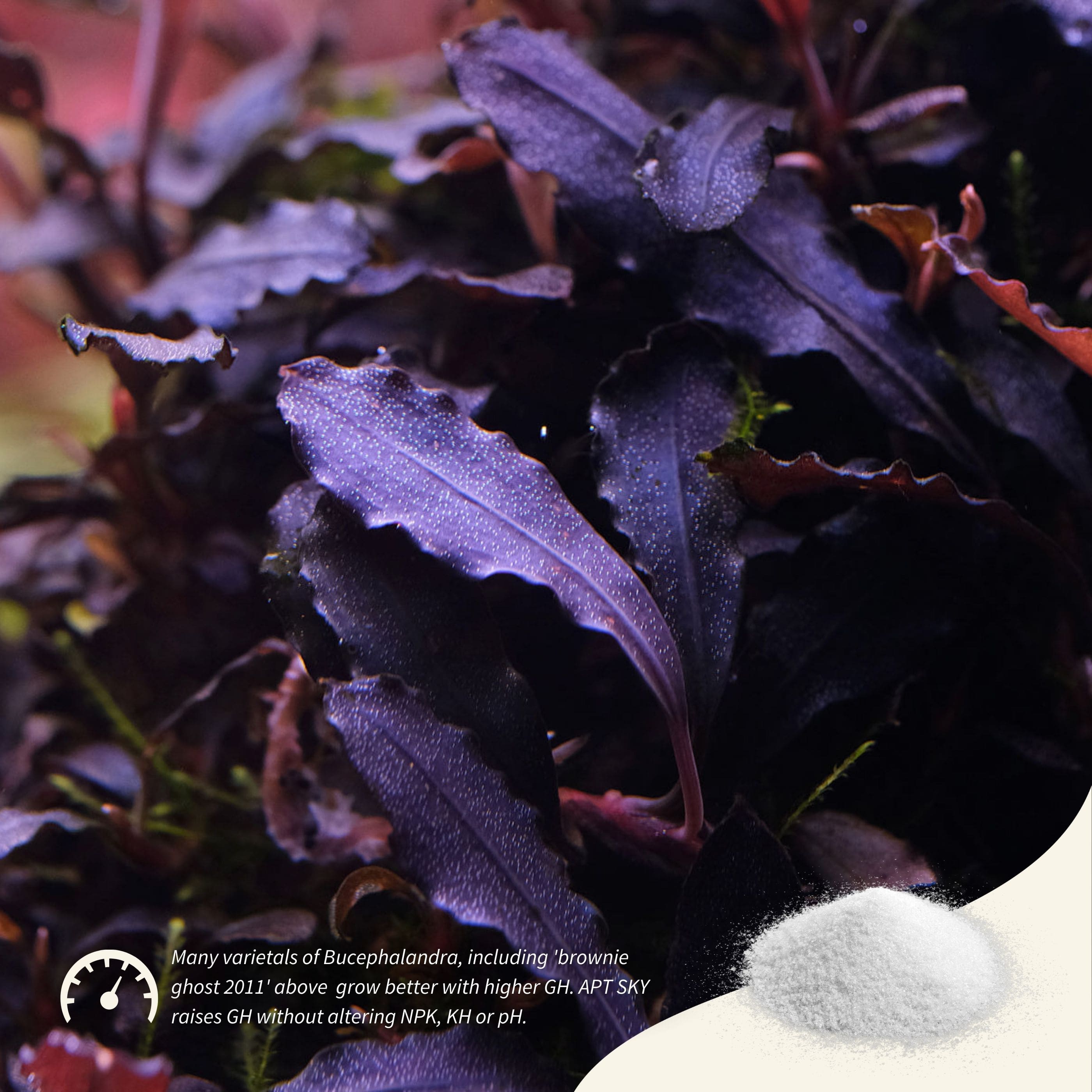
Bucephalandra grow similarly to Anubias species except that certain varietals are more sensitive to water conditions. Many of the colored varietals also show much more vibrant coloration with CO2 injection than without. They come in a very large variety of sizes, leaf shapes and color tones. The only downside is that they are generally costlier than Anubias to purchase.
Hydrocotyle tripartita
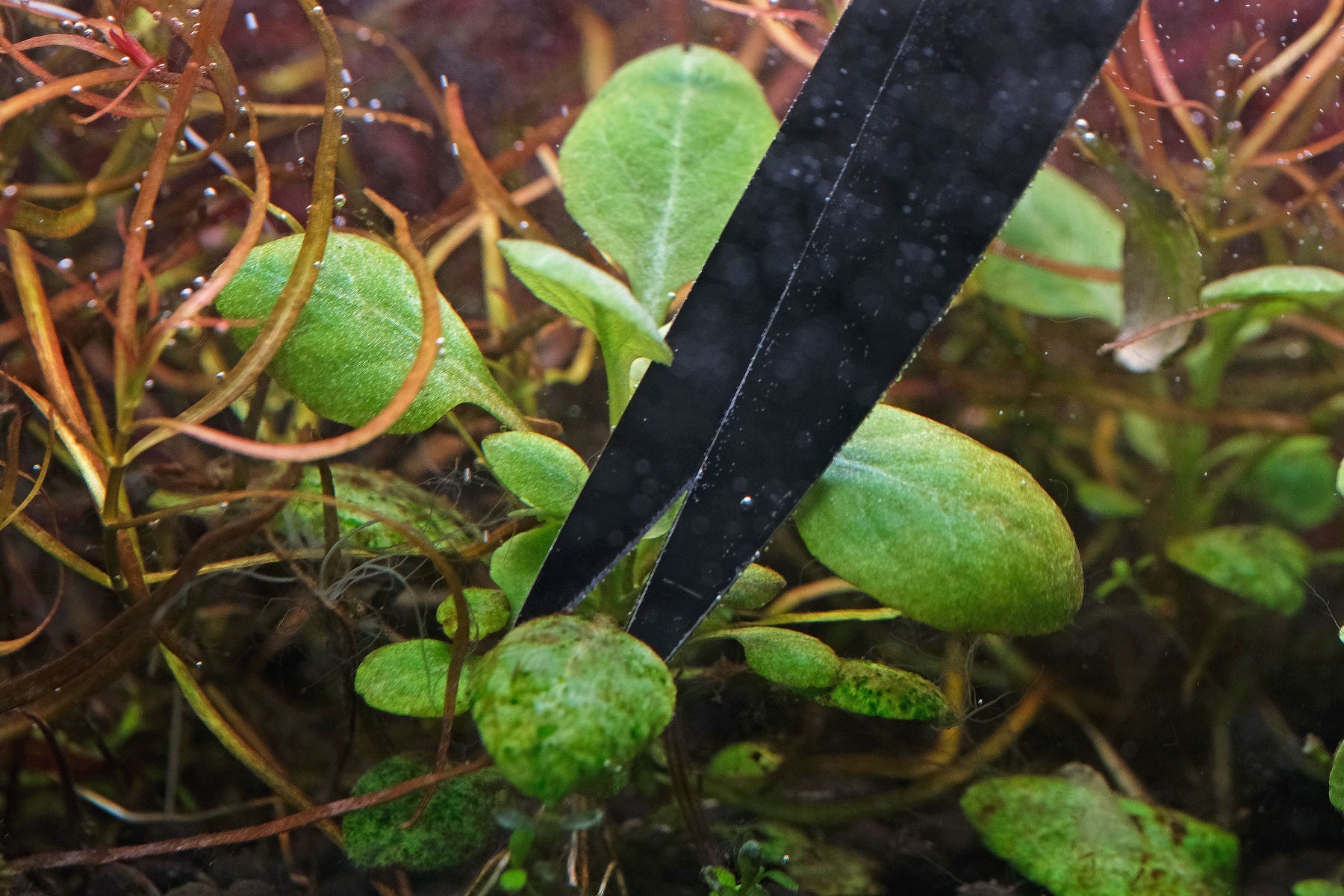
Hydrocotyle tripartita is a plant that propagates through runners. It is commonly used as a ground cover however, it grows very well attached to cracks and crevices. It grows very aggressively when rooted into nutritious substrate, so growing it on hardscape is better as it can be controlled easily with frequently pruning; over repeated trimming cycles it forms a nice dense bush.
Although a very easy plant to grow, it grows much better in CO2 injected tanks.

Hygrophila pinnatifida

Hygrophila pinnatifida is a stem plant that propagates aggressively through runners. It has attractively pinnate leaves with a lovely red hue when grown under high light and low nitrogen conditions. It takes low nitrogen conditions well though plants grown in low N will be smaller than counterparts grown in richer N conditions. Smaller plants may be more desirable in aquascaping.
When planted into rich substrate, it spreads very aggressively and becomes a wilder to control plant. As the plant growers larger, it will start producing runners from its internodes. Baby plants will spawn from such runners and these can be cut and re-attached elsewhere.
Due to its color and attractive leaf shape it gives good contrast to other plants regularly used on hardscape such as Anubias and mosses. However, unlike those plants H. pinnatifida is not shade tolerant and needs to be used in well lit areas.
Mosses

There are a large variety of mosses available in the hobby and all of them are very easy to grow. Their usage in the aquarium exploded with the popularity of hardscape focused tanks. However, many folks with no hardscape experience shy away from them; either thinking that they are messy or hard to handle. They are actually very easy to use once you know how to.
Moss can be broken into smaller pieces, and each piece will grow if left in a area where there is light and flow. The easiest way to attach mosses to hardscape is by using super glue, which cures underwater in seconds. Most aquascapers use superglue rather than string to attach mosses as it is faster and more precise. You can also do this while the hardscape is already underwater in the tank. Take a small amount of moss on one finger, apply a small dab of gel super glue to the moss, then press it against the hardscape - hold for 5 seconds and the moss is attached. You do not have to worry about the orientation of the moss, it will grow towards the light in time. This works for every type of moss.
With this technique, it is easy to 'paint' entire surfaces with moss. Many hardscape focused aquascapes have very little soil; the aquascapers just attach moss to every surface.
Mosses also require regular trimming to keep them in shape; the part cut ends can be replanted elsewhere. With regular trimming, new growth orientates towards the light and looks neater.

Head to this section for detailed care guide to the plants above.


Share:
VIDEO: How to make a moss tree
How to grow red plants (Bahasa Indonesia)