
Small tanks (~30L / 8 gallons or less) fit easily on a side table or desk and can be great fun. However, small ecosystems can be difficult to manage. It is somewhat like trying to dispense exactly 0.3ml of fertiliser instead of, say, 3ml. Small ecosystems are prone to excess: too much light, too much organic waste. They are often underpowered in terms of filter media and water flow. The result can be a never-ending battle with algae. And in a small aquarium, every problem is magnified because its small size makes every imperfection more apparent.
While it is possible to be successful with various types of small tanks, we find that these 3 choices make for far higher chances of success:
#1 Low Light + Shade Plants

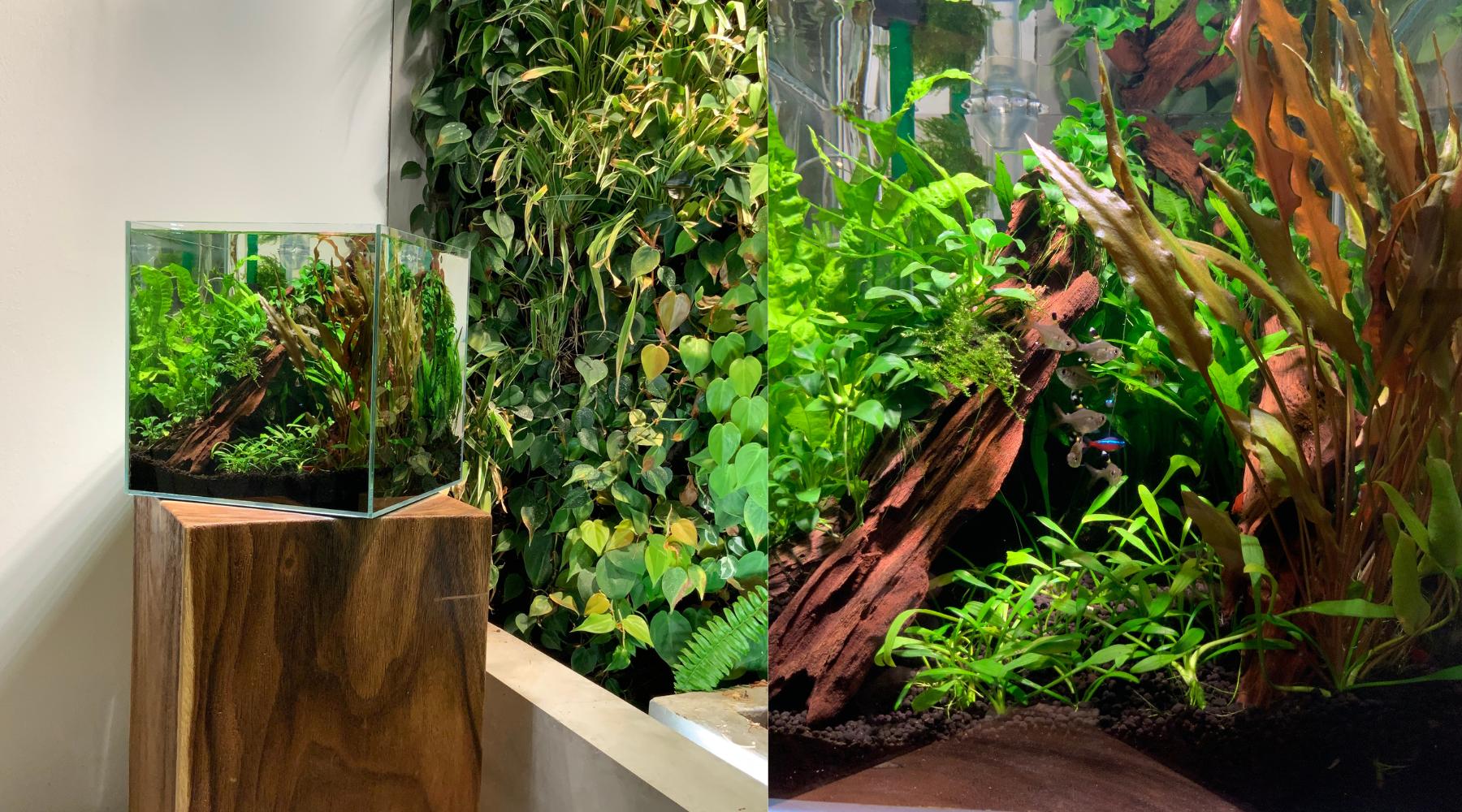
The amount of light on the substrate of the 1- foot cube on the left is around 8 umols. In comparison the tank on the right receives ~200 umols. Both look 'bright' to the eye, but the tank on the right receives around 25X more light energy.

Above: ambient lighting in our gallery looks 'bright' but at 2 umols, only shade-loving terrestrial plants thrive. The human eye is unfortunately a poor judge of light strength.
A Good Pairing
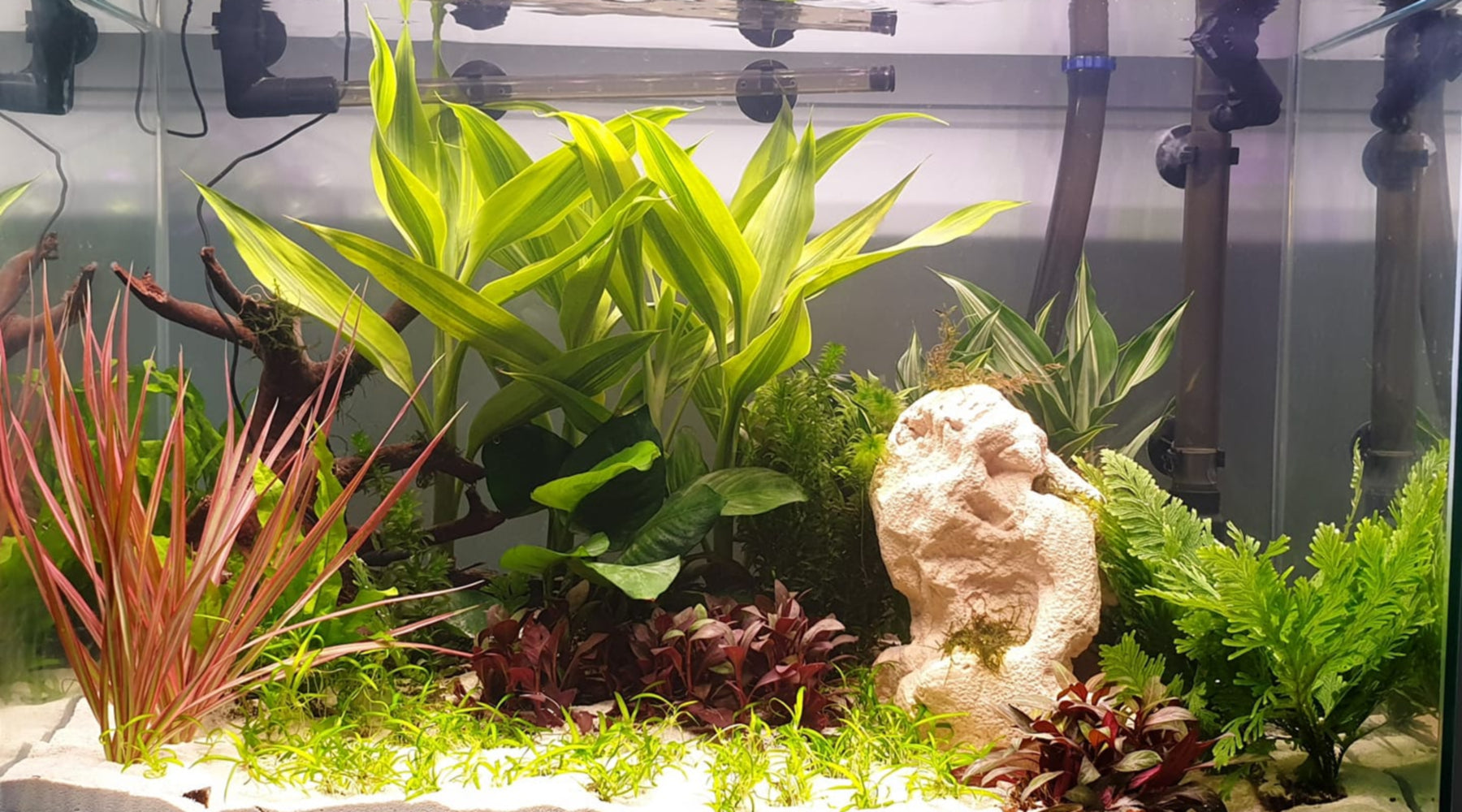
In small tanks, a winning combination is low light (<10 umols) , with a good mass of shade-loving plants. In the tank above, we use Java Fern, Anubias nana 'petite' and Cryptocoryne wendtii 'bronze'. The 'carpet' is Cryptocoryne 'Parva'.
We have a separate article here on how to measure light strength. The key is precision, and the trick is to err on the side of 'less, not more'. In terms of plant choice, this also means avoiding most stem plants. Yes, they can survive, but with a low quality of life- becoming weedy and bare.
#2 Larger filter, Less animals

Most small aquariums use simple hang-on-back filters. These are fine, but such a small 'digestive system' makes for a higher risk of algae. The 1ft cube above (containing about 20L / 5 Gal of water after subtracting the volume taken up by rocks and substrate) uses an Oase Filosmart 100 (rated for a 100L tank).
This oversized filter makes the tiny aquarium far more resilient. Also note the lily pipe outflow and surface skimmer, both of which are uncommon-but impactful- in such a small tank.
If you are keeping a Betta or fish that prefer a slower flow, then concentrate on reducing the light and adding more shade plants.
#3 Deeper substrate + Aquasoil

Many small tanks have a very shallow and often inert (sand or gravel) substrate. We have found that a deeper substrate (4 to 6cm in this example) harbours more beneficial bacteria and this in turn contributes to the stability of the tank. Epiphytes such as Java fern can grow well with their rhizomes slightly buried. Rooted crypts grow better in aquasoil. Overall, healthier plants are extremely resistant to algae.
What about CO2?
The 1ft cube aquarium above does not use any CO2 injection (and no 'liquid CO2). It will grow faster with some CO2 injection, but that also means more frequent trimming and housekeeping.
Other Parameters
| KH | 0 |
| GH | 0 |
| pH | 6.8 |
| NO3 | 0* |
| PO4 | 0^ |
| Temperature | 26-29C / 79- 84F |
*When we measure the water for nitrates, the reading is the residual level after plant absorption. Even in tanks with lots of fish, it is actually normal and healthy to have zero NO3 readings- it is one of the ‘secrets’ of keeping algae under control. A standard daily dose of APT3 adds less than 1.5 ppm of NO3, and most well planted, mature tanks with moderate fishload easily digest that amount every day. So when we measure NO3, it reads zero. (This can be shocking to EI users!)
^Phosphates are tricky to measure because of the way it binds to organic matter and substrate. In other words, measuring zero does not mean there are no or insufficient phosphates. If you dose APT3 or if you have a heavy fishload, you have enough phosphates.

Share:
APT Feast: the pilots' view
Flowering Underwater?