


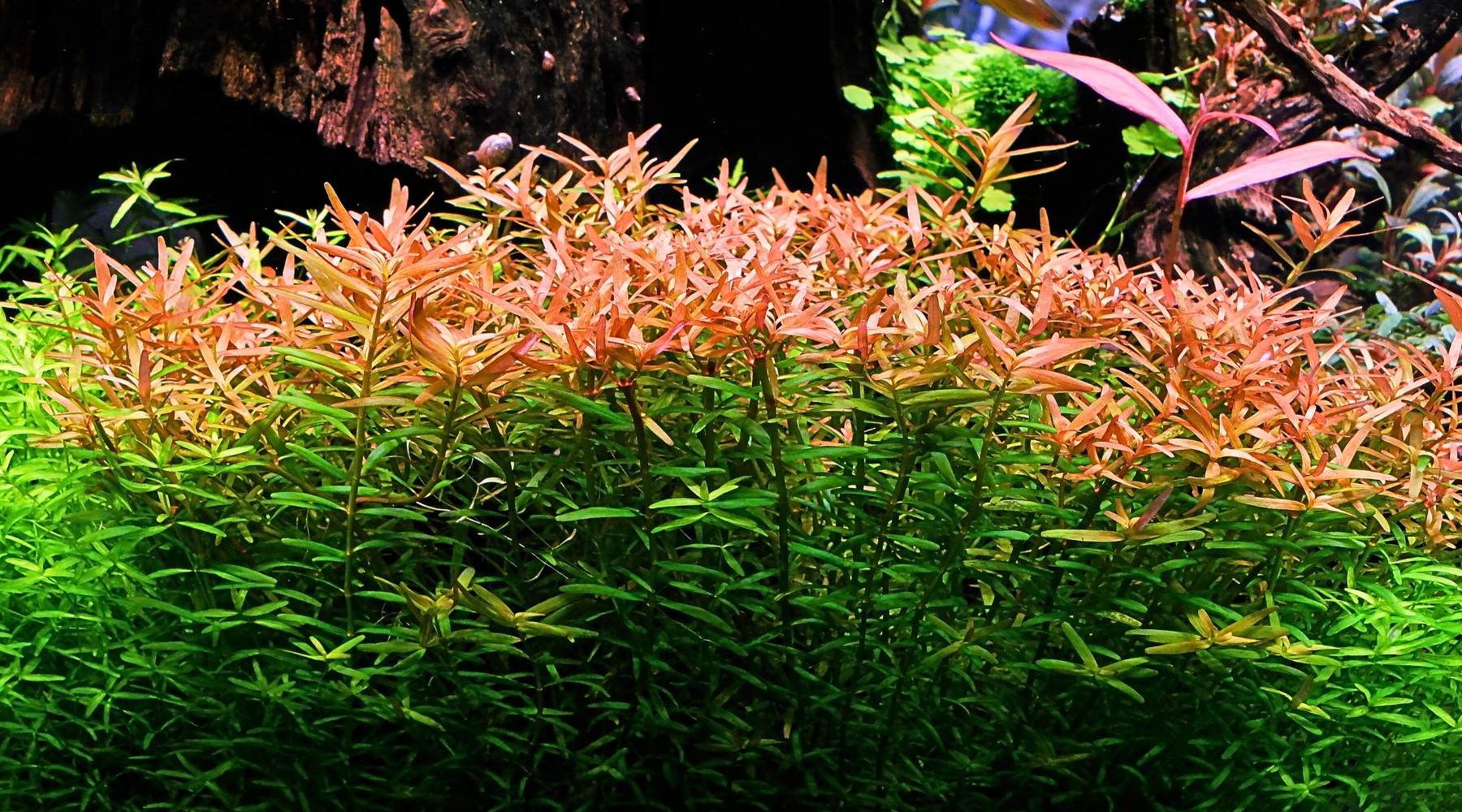
Ludwigia arcuata has attractive reddish foliage and is easily trimmed to form dense bushes.
Introduction
Ludwigia arcuata is a delicate stem aquatic plant native to the USA. It is often confused with Ludwigia brevipes, which is similar but slightly larger with wider leaves. It is also similar to Didiplis diandra, which is much harder to grow well. Ludwigia arcuata has attractive orange - reddish leaves and thin stems and leaves.
Ludwigia arcuata is tolerant of a wide range of water parameters and is generally an easy background aquarium plant to grow as long as it receives sufficient light and nutrients. The main problem most people have with it is that it grows yellowish rather than reddish and many people also find it difficult to achieve a compact bush. This stem plant will grow much redder with nitrate limitation and requires stronger lighting to induce better colouration and more branching. These two aspects will be discussed in more detail below.
Ludwigia arcuata can be pruned aggressively. This encourages the formation of side shoots and the plant can become very bushy. It is quite tolerant of dense growth and can be pruned for many weeks without the need for replanting. In aquascaping it can be used as a mid/background plant in smaller tanks due to its fine texture.
 Using a combination of low water column nitrates and high substrate N through the use of Root Tabs allows for deep colouring yet profuse branching to produce good density bushes. Grown with APT Complete and APT Jazz Root Tabs.
Key success factors
- CO2 necessary for coloration and for it to sprout profusely and produce dense bushes.
- Sufficient light (80-100 umols of PAR gives lighter orange tones, while upwards of 150 umols of PAR gives redder coloration and more branching).
- Nitrate limitation gives much deeper coloration without excessive lighting. Impact starts being visible when NO3 levels <5ppm.
To learn more on CO2 setups, click here.

How to get it redder
- Stronger light (80-100 umols of PAR gives lighter orange tones, while upwards of 150 umols of PAR gives redder coloration).
- Stronger red/blue light spectrum.
- Low nitrates in the water column causes it to become significantly redder (5ppm and below).
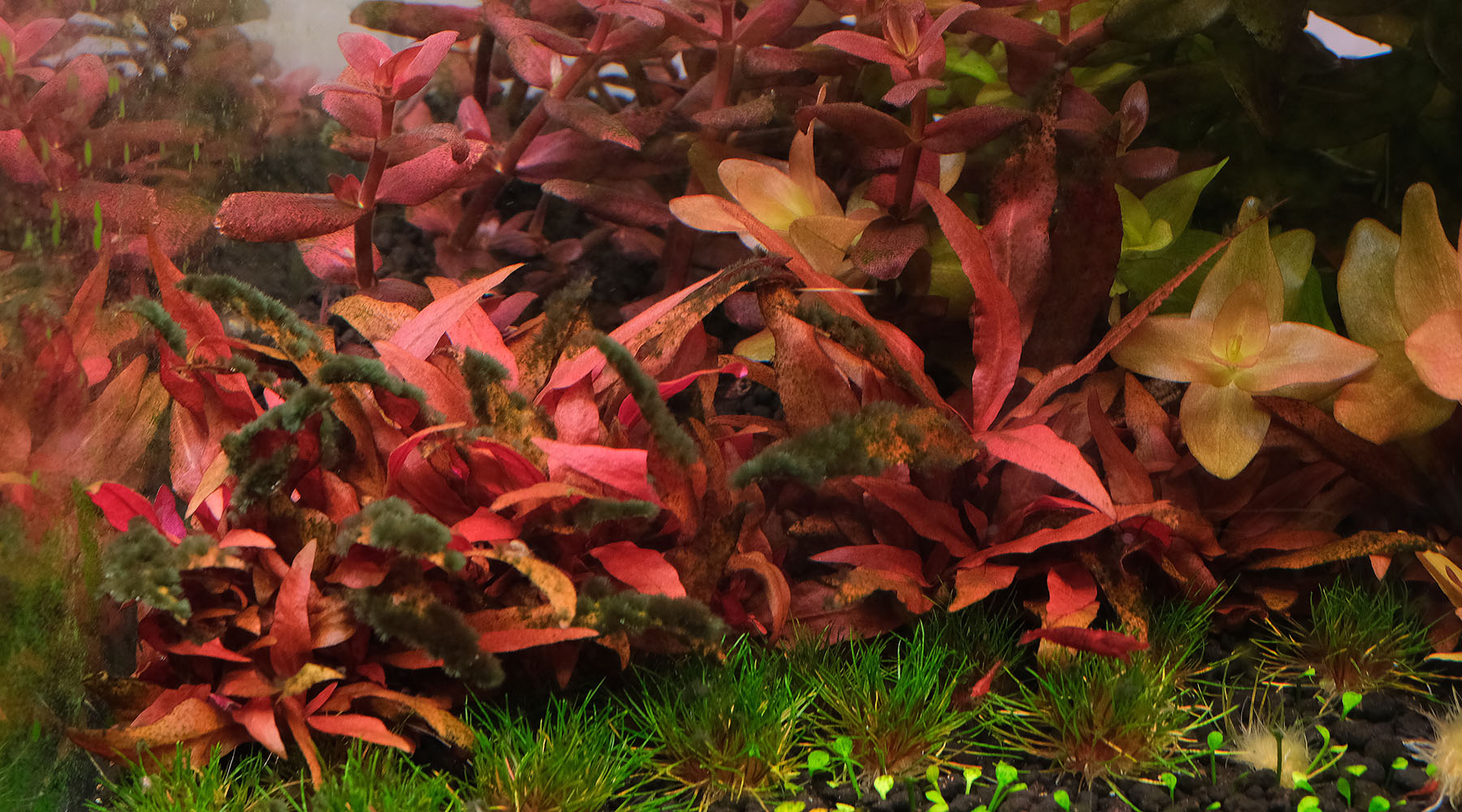
This is one of the plants that will show much redder colours under nitrate limitation - meaning the plant will grow much redder when starved of nitrates. Overdo this and the plant will stunt. As it can tolerate much lower nutrient levels than other plants - other plants will usually stunt first.
However, Ludwigia arcuata will branch out more if it is not starved of nutrients. So to get good colouration and density at the same time, nitrate limitation must be well managed. Low nitrate levels in the water column can still be combined with a rich substrate to achieve good colouration. A good method is to use a richer substrate or ammonia-rich root tabs to supply N to the plants through the root zone, while strongly limiting NO3 levels in the water column (to near 0 ppm levels).

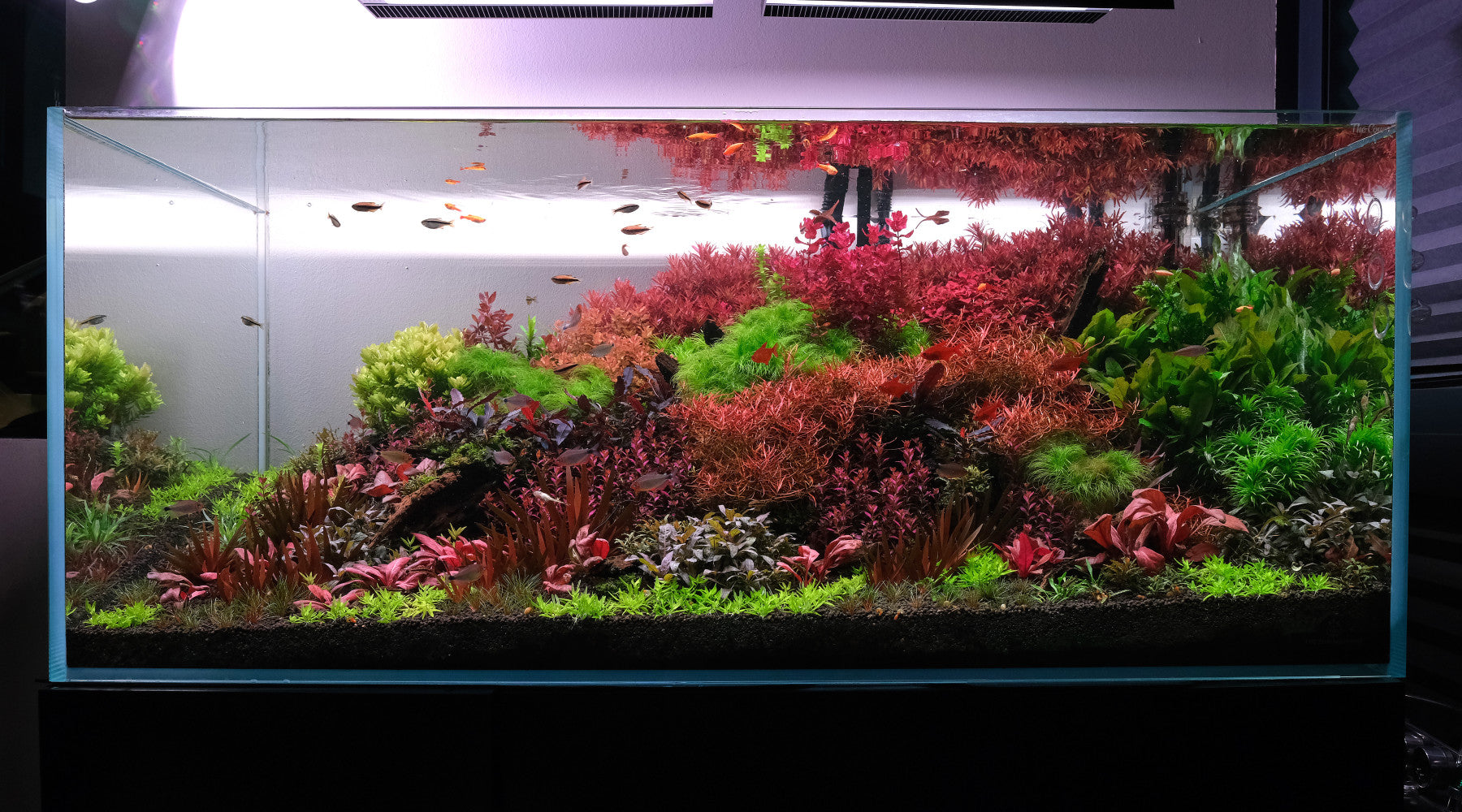
Trimming allows Ludwigia arcuata to be cut into dense bushes. In the tank above it appears orange rather than deep red under low NO3. Ludwigia arcuata becomes much redder under low NO3.
Trimming
Cut off the top of the plant a few inches below the desired final height. Side shoots will sprout from the remaining lower part to fill in the area. As the side shoots form, cut away the faster growing shoots that stick out above the rest. In time you will have a nicely shaped shrub.
This stem plant will grow sideways if there is plenty of light and space. Planting a little closer together at the start - with the stems about 1.5cm apart - will encourage them to grow more vertically.
Click here to find out how to read PAR values.
Click here to find out how to fine tune light spectrum.
Click here to find out how to grow red aquarium plants.
Click here to read on how to optimize CO2 levels
Click here to browse more plant growing profiles
Click here to read on how to stabilize a new planted tank



Share:
Java fern (Microsorum pteropus) galls/disease
How to grow Lobelia cardinalis