

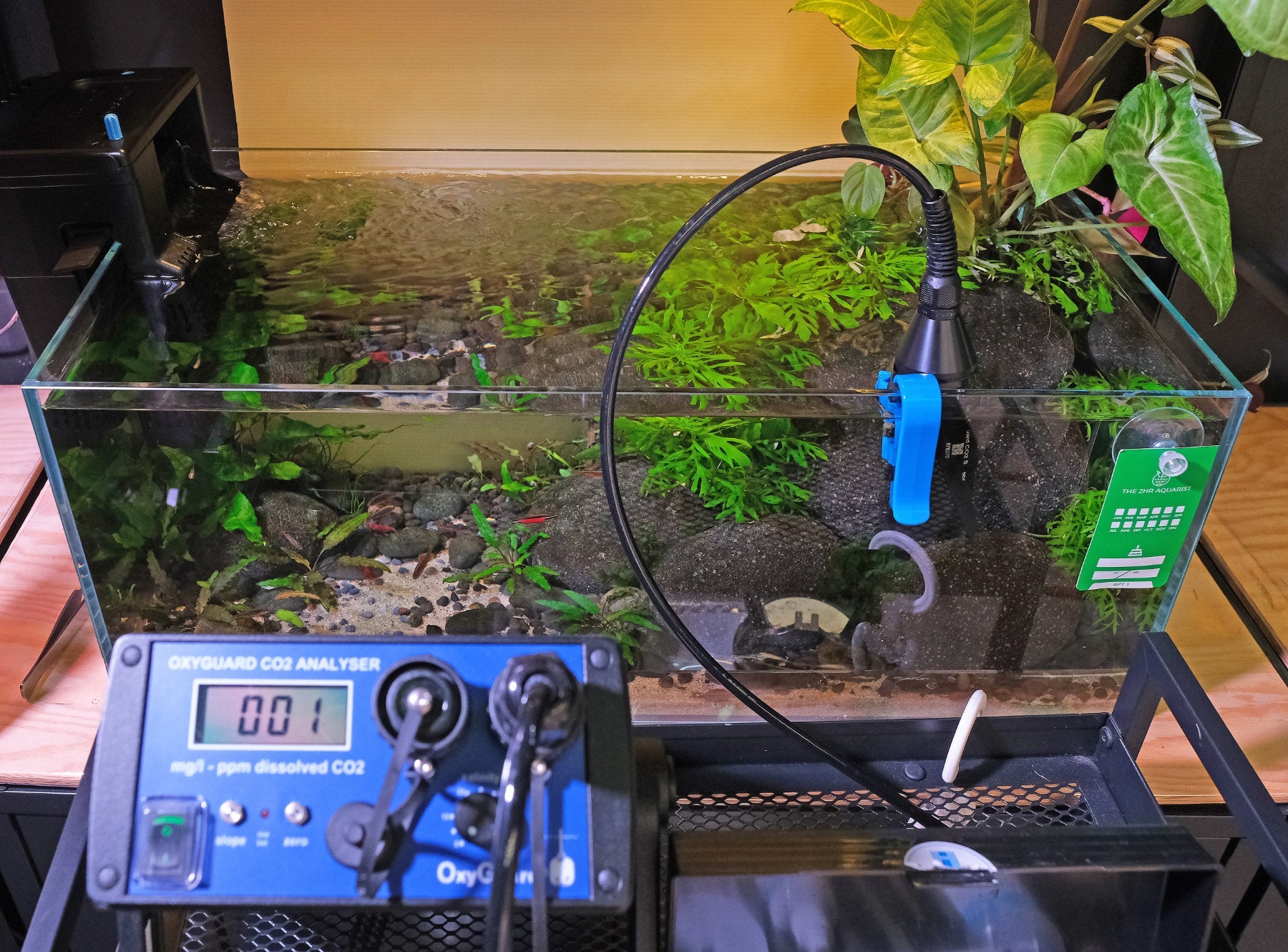
A CO2 diffuser is not just a bubble maker. It is the part of your CO2 system that breaks carbon dioxide gas into tiny bubbles so more of it can dissolve into aquarium water, reach aquarium plants, and drive better growth in a planted tank. The best method depends on tank volume, filter flow, how much mist you can tolerate, and whether you value clean aquascape visuals or easy tuning.
-
Smaller bubbles dissolve faster because they have more surface area relative to their volume.
-
A finer ceramic membrane, or tiny nanoholes in a good diffuser, produces superfine mist and more efficient dissolution.
-
Inline methods usually keep the aquarium cleaner-looking and need less frequent cleaning than in-tank units.
-
Regular maintenance matters: soak a new ceramic disc in water for 30 minutes before use, and clean clogged discs before they start producing coarse bubbles.
-
If bubbles enlarge over time, a 10 minute bleach soak followed by very thorough rinsing often restores performance.
What Should You Look for in a CO2 Diffuser?
Most of the difficulty is not technical. Search co2 diffuser and you get a nice glass model, then a stainless steel model, then an inline diffuser, then a shop shouting about stock, prices, free shipping, return windows, order dates listed, cancellation policy, recurring purchase, deferred purchase, payment method, authorized seller, and whether the item will be fulfilled by Tuesday. None of which tells whether the thing actually diffuses gas well :)
The part most hobbyists skip is the only part that decides performance. A CO2 diffuser is only as good as its membrane, its placement, and the flow pattern carrying those bubbles through the tank.

How Does a CO2 Diffuser Work?
The underlying process is surface-area transfer. That is the whole mechanism.
A CO2 diffuser takes a steady stream of high pressure carbon dioxide and forces it through a ceramic membrane, where the gas exits as bubbles. If the pores are very fine, those bubbles are smaller. Smaller bubbles have more surface area compared with their volume, so they dissolve faster into water before they reach the surface and escape. That is why a good ceramic disc, a fine-pored membrane, or a diffuser with tiny nanoholes performs better than a coarse one.
Once dissolved, CO2 becomes available to plants for photosynthesis, and part of it forms carbonic acid, which lowers pH. In a tank with stable KH, a well-tuned system drops pH by roughly 1 unit below its fully degassed baseline, which corresponds to somewhere near 30ppm CO2. That is normal and useful when controlled properly. Stop staring at bubble count alone. The real question is how much carbon dioxide gets diffused into the water column where plants can use it.

In-Tank CO2 Diffuser vs Inline Atomizer vs Reactor: Which Is Best?
There are three main diffusion methods, and each makes sense in the right tank.
|
Method |
How it works |
Best use |
Main drawback |
|---|---|---|---|
|
In-tank CO2 diffuser |
A glass, acrylic glass, or plastic CO2 diffuser sits inside the aquarium and releases tiny bubbles directly into the water. |
Small to medium tanks, simple setups, people who want easy installation. |
Clogs faster, visible in the tank, efficiency drops when dirty. |
|
Inline CO2 atomizer |
Installed in the hose between the external filter and the outlet, usually on the outflow line. |
Most high-tech tank setups, especially when you want less equipment visible. |
Can produce visible mist and needs decent pressure and flow. |
|
Inline CO2 reactor |
Dissolves gas inside a chamber on the filter line for very high dissolution. |
Larger tanks, people who want clear water with no visible bubbles. |
Bulkier, more finicky to size and tune, can reduce flow. |
While it may appear surprising, more bubbles alone does not mean more CO2. Bubble count measures what leaves the cylinder, not what dissolves. Large bubbles rise fast, spend very little time in contact with water, and vent most of their gas at the surface. A good CO2 diffuser produces a fine smoke-like mist. A poor model produces obvious bubbles that rocket to the surface and accomplish very little besides looking busy.

What Makes a Good Ceramic CO2 Diffuser Membrane?
The ceramic membrane is the heart of the CO2 diffuser. Not the glass body, not the stainless steel shell, not the nice packaging, and not the product video.
The finer the pores, the finer the bubbles. That means better dissolution, more stable CO2 delivery, and fewer dead zones where plants struggle. The tradeoff is working pressure: fine-pored discs and atomizers generally need somewhere in the region of 20 to 30 psi to push gas through cleanly, so the membrane and the regulator have to be specified together. CO2 diffusers made of acrylic glass, plastic, or stainless steel can all work well if the membrane quality is high. The material of the outer body matters less than the quality of the disc and the working pressure needed to push gas through it.
This is why some aquarium plants look equipped for growth on paper but still stall in reality. The tank may have a regulator, hose, bubble counter, and CO2 diffuser included in the system, yet the actual membrane is poor and the bubbles are too large. A well-made cheap CO2 diffuser can outperform an expensive decorative one.
How Do You Know If Your CO2 Diffuser Is Working Properly?
The first signal is mist behavior. Fine bubbles should be caught by the current, travel across the aquarium, and stay in contact with water long enough to dissolve. If bubbles shoot straight up, either the diffuser is dirty, the pore size is too coarse, or the flow pattern makes no sense. Placement near the bottom of the tank and in the path of a water current gives those bubbles more contact time. A drop checker held at green rather than blue confirms gas is reaching the water column, though it lags real conditions by an hour or more and tells you nothing about distribution.
The second signal is plant response. New leaves should come in larger, fuller, and more stable. Carpet plants should creep rather than stretch upward. Stem plants should hold better spacing, coloration, and density. If one side of the aquascape thrives while another lags, that is usually a circulation problem, not a fertilizer mystery.
The third signal is system stability. A tank with proper CO2 diffusion often shows steadier pH movement, cleaner growth, less algae pressure, and stronger oxygen production during light hours. Old leaves report history. New growth reports the present.
How Do You Set Up and Maintain a CO2 Diffuser?
-
Soak the ceramic disc in water for 30 minutes before first use. A wet membrane starts easier and produces a finer mist; a dry one releases large, uneven bubbles until it wets through.
-
Place the CO2 diffuser low in the tank where the outlet current can pull the mist across the aquarium. That improves circulation, contact time, and how much CO2 actually dissolves.
-
Clean the membrane regularly. Ceramic discs clog with biofilm and debris, and a clogged diffuser makes larger bubbles, less efficient diffusion, and unstable CO2.
-
Bleach the disc for 10 minutes in a dilute solution, roughly 1 part household bleach to 20 parts water, when the bubbles enlarge over time. Rinse thoroughly and dechlorinate before it goes back into service.
-
Match the method to the aquarium volume and filter. Small tanks can do nicely with a simple in-tank diffuser; larger or cleaner-looking layouts often benefit from inline atomizers or a properly sized reactor, and very large tanks may even need multiple diffusers.
Do Price and Brand Predict CO2 Diffuser Quality?
The criteria that get the most attention on a product page are usually the least predictive of performance.
Do not choose a CO2 diffuser by stock status, model number, quantity discount, dates listed, or whether the seller offers a continuing subscription, recurring or deferred purchase, or a payment method that defers the cost. A return window, cancellation policy, or whether an order is authorized and fulfilled quickly may matter for customer service, but none of it tells you if the membrane is good. That is the part that does the job.
What matters is this: does the model produce superfine mist, is the build clean, is the hose connection secure, is the pressure required within range for your regulator, is it easy to clean, and are replacement components available? Keep bleach, pressurized gas gear, and spare parts well away from children. Your aquarium plants do not care about marketing. They care whether carbon dioxide reaches them efficiently.

Glass, Stainless Steel, and Inline CO2 Diffusers Compared
The market offers a fairly wide range of CO2 diffusers across different materials and sizes, and it is worth knowing what the common options actually look.
Glass and acrylic glass diffusers are among the most visually popular choices in planted aquascaping, valued for their clean look and fine-pored ceramic membranes. Models like the ANS Opti Glass range are examples of glass designs made for different tank sizes, from nano setups to larger aquariums, with the ANS Opti Glass CO2 Diffuser Nano at the entry-level end. Stainless steel models such as the Dymax Stainless Steel CO2 Diffuser are noted for easy installation and are often chosen by hobbyists who want a more durable body alongside fine diffusion. Plastic-bodied diffusers are the most affordable entry point and can perform adequately when the membrane quality is good. Some brands extend the product line into companion items: the ANS Opti Glass CO2 Checker Set, for instance, pairs a diffuser with a checker tool.
The Aquario Neo CO2 Diffuser is widely discussed in the aquascape community for its tiny nanoholes that atomize carbon dioxide into a very fine mist. It comes in small, medium, and large variants, making it one of the cleaner examples of a size-matched design philosophy: match the diffuser to your total water volume rather than defaulting to one model for everything. That is the correct approach regardless of brand. For external setups, the Chihiros External CO2 Diffuser is an inline-style design that installs out of the tank, reducing visible equipment inside the aquascape.

Which CO2 Diffuser Is Right for Your Tank Size and Style?
In nature-style aquariums you may run gentler CO2 levels with modest light, often in the region of 10 to 15ppm. In that case, diffusion method matters less than overall stability. In high-tech tanks, especially those with demanding carpet plants or red stems held near 30ppm, diffusion quality becomes a major growth lever because the tank consumes carbon fast and punishes inconsistency.
Aquarium size also changes the recommendation. A small aquarium can use a glass CO2 diffuser and still look tidy if serviced often. A larger tank with an external filter usually makes more sense with an inline atomizer installed on the hose between the filter and outlet. For very large volume systems, or when you cannot stand visible bubbles, a reactor becomes the better choice. Whichever method you land on, the diffuser only sets how much gas enters the water; distribution and stability across the photoperiod are what the plants respond to, and both are worth reading up on separately.






























Share:
How to set up a CO2 system for the first time