

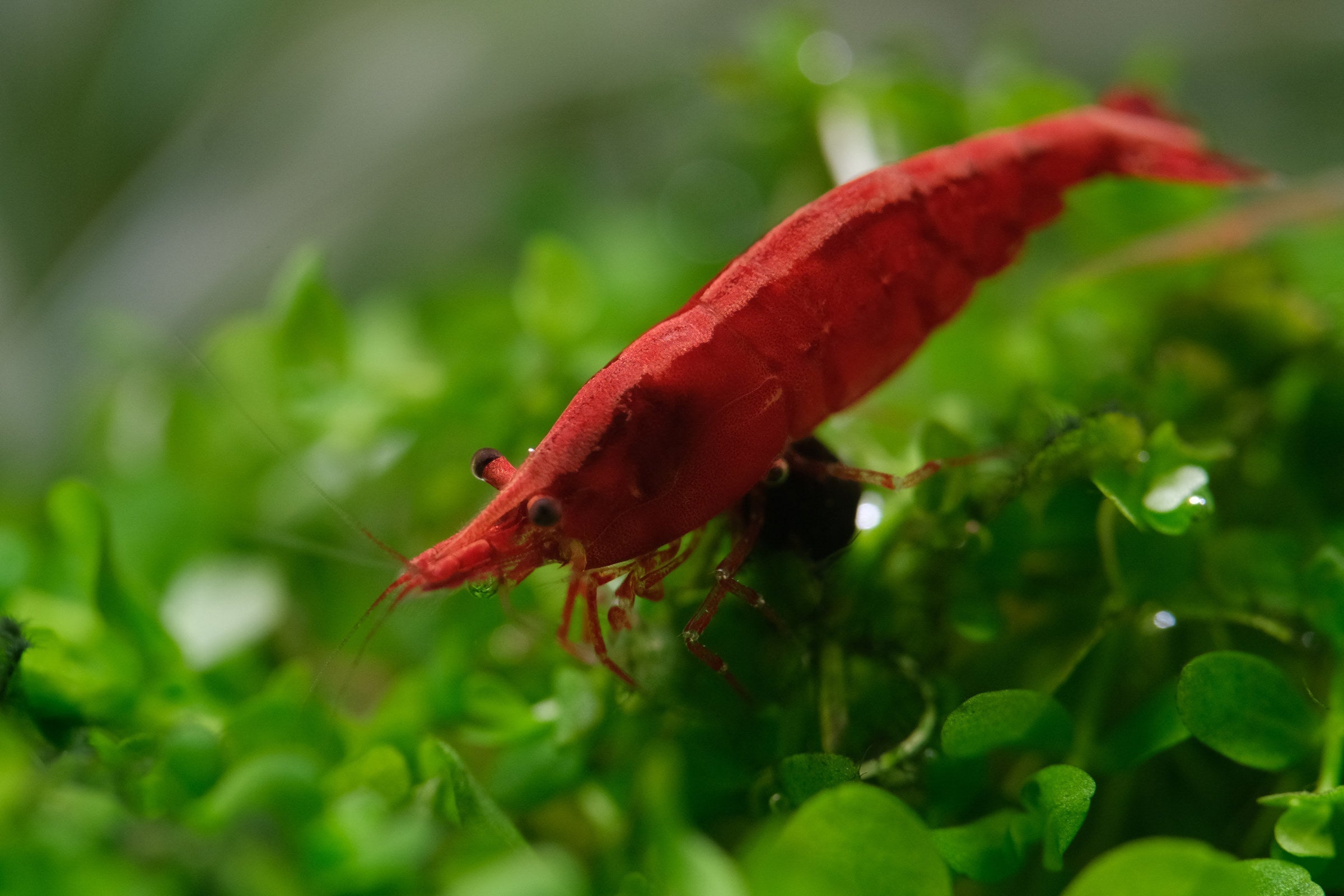
Neocaridina davidi, the red cherry shrimp, is the most forgiving dwarf shrimp in the freshwater aquarium hobby. Kept in a biologically mature planted tank with stable water, they will breed on their own with almost no intervention. Most beginner failures are not caused by the shrimp being fragile; they are caused by adding shrimp to a tank that is not yet ready.
Quick answer:
-
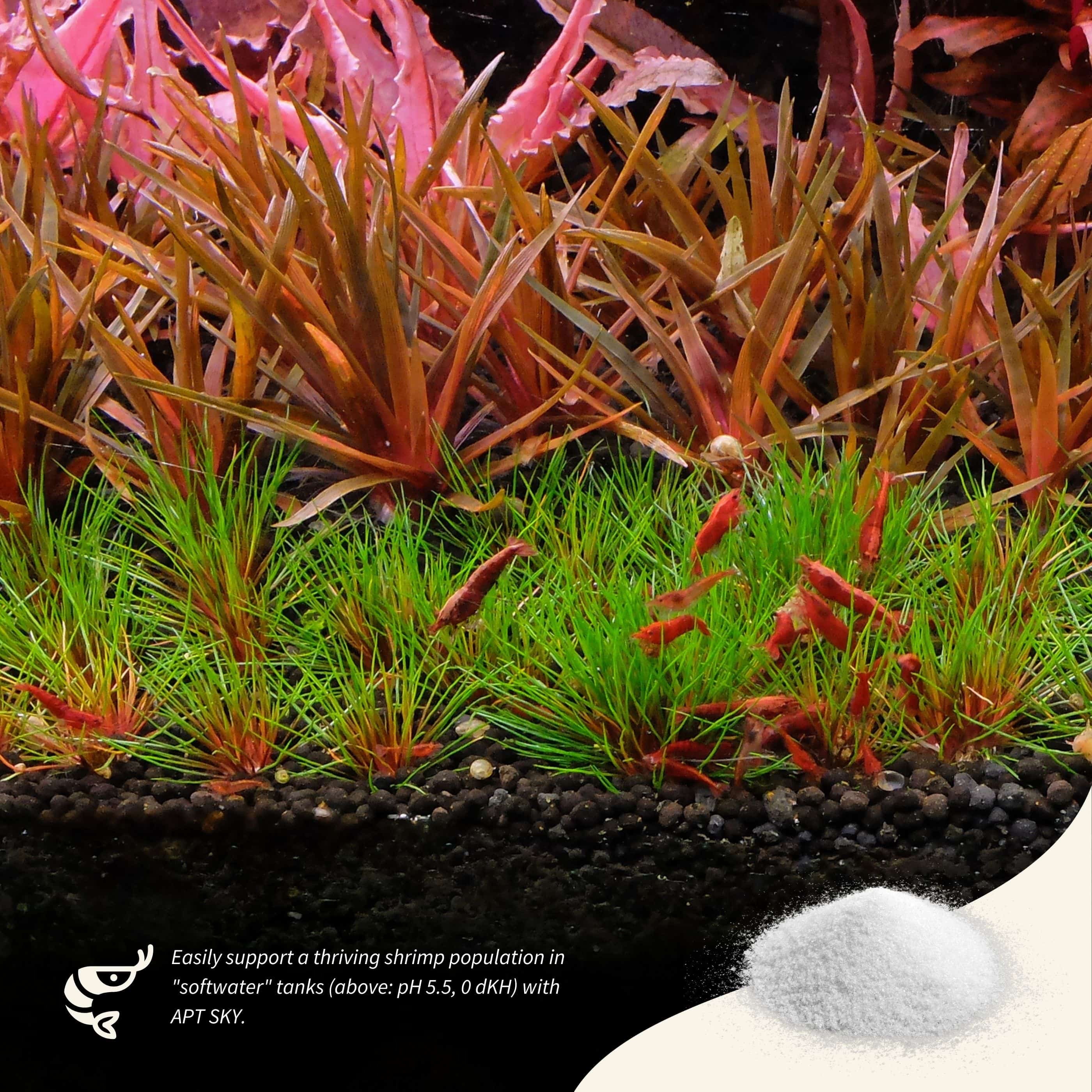
Neocaridina davidi tolerate a wide range: pH 5 to 8, GH 3 to 15 dGH, KH 0 to 12 dKH, TDS 50 to 400 ppm, temperature 21 to 26°C (70 to 78°F). Stability matters far more than hitting any single number on a test strip.
-
Give the tank biological maturity before stocking, usually 4 to 6 weeks after planting an aquasoil setup, not day one.
-
The single most common killer is osmotic shock during transfer, driven by a KH mismatch between the shrimp's source water and yours. It is not copper, CO2 or fertiliser.
-
A 5-gallon (about 19 litres) tank is a workable floor, but a larger volume buffers the temperature and parameter swings that harm a colony.
-
In a mature planted tank they feed themselves, grazing biofilm, soft algae and organic detritus. They carry a low bioload and breed readily once conditions are stable.
-
Cherry, Sakura, Fire Red, Painted Fire Red and blue morphs like Blue Dream are all one species. Grades and colour morphs differ in coverage and intensity, not in care.
What Is a Cherry Shrimp (Neocaridina davidi)?
Neocaridina davidi is a small freshwater shrimp from streams in Taiwan and southern China, and the most widely kept member of its genus in the aquarium hobby. Adults reach around 3 to 4 cm, roughly an inch to an inch and a half, with females typically larger and rounder-bodied than males. The wild form is a drab brownish-green. Every red, yellow, blue, chocolate and black cherry shrimp in the trade descends from that same wild type, selectively bred over decades for colour.
The commercial names are colour grades and colour morphs of a single species, not different species:
-
Cherry: the entry level, patchy red on a translucent body, with plenty of transparent gaps.
-
Sakura: heavier, more consistent red coverage.
-
Fire Red: near-solid red across the body.
-
Painted Fire Red: opaque red with red legs and rostrum, the top grade.
Some sellers use letter grades (A, S, SS, or "Grade AA") in place of these names, but the principle is identical: higher grades carry more solid, opaque red and fewer transparent patches. Blue lines like Blue Dream and Blue Velvet, Neon Yellow, and chocolate morphs are the same story in a different pigment. Grade describes coverage, not care: a Grade AA red and a plain cherry are equally hardy and beginner-friendly.
One point folks miss: colour is partly affected by stress. A beautiful, deeply coloured shrimp can arrive washed-out and semi-transparent after the stress of shipping, then regain its red over a week or two once it settles into stable water.
All grades and morphs interbreed freely, which is why mixing them dilutes colour over generations: offspring drift back toward the muddy wild type. We'd recommend keeping one colour line per tank if color retention matters to you.

Cherry Shrimp Lifespan, Breeding and Maturity
Lifespan sits at roughly 1 to 2 years. Sexual maturity arrives early, around 4 to 6 weeks (about 30 days), while full adult size and peak colour develop over the following month or two, so a shrimplet is breeding well before it is fully grown. Unlike Amano shrimp, Neocaridina have no larval stage. After mating, a female carries 20 to 30 developing eggs under her abdomen (she is then "berried") for 2 to 3 weeks, and the young drop as miniature adults straight into the tank. That direct development, paired with early maturity and a fast growth rate, is why a starter group of ten in a stable tank becomes a colony of hundreds within a year.
What Water Parameters Do Cherry Shrimp Need?
You will read online that Neocaridina need a narrow window: GH 6 to 9, KH 2 to 4, pH 7.0 to 7.5, temperature 72 to 76°F. That advice is not wrong, but it is much stricter than the shrimp themselves require. Cherry shrimp have been documented thriving and breeding across a far wider range:
-
pH: 5 to 8
-
GH: 3 to 15 dGH
-
KH: 0 to 12 dKH
-
TDS: 50 to 400 ppm
-
Temperature: 21 to 26°C (70 to 78°F)
The critical word is stability. A colony bred in soft, low-KH water at pH 6.0 and a colony bred in hard, alkaline water at pH 8.0 are both healthy, but you cannot move an individual from one to the other without heavy losses. Adapt your husbandry to your tap water rather than chasing a forum-approved target. If your tap sits at 10 dGH and 6 dKH, keep hardwater-adapted Neocaridina from a local breeder and stop fighting the chemistry. Stable water parameters beat "ideal" ones every time.
Temperature sets the pace. Warmer water speeds the whole life cycle: shrimp grow faster, breed more often, and die younger. Cooler water gives you larger, longer-lived shrimp and a slower colony growth rate. Neither is wrong; pick the trade-off that suits your tank.
How Long Should a Tank Cycle Before Adding Cherry Shrimp?
Adding shrimp to a freshly planted tank on day one is not advisable. A newly set-up planted aquarium goes through weeks of instability: aquasoil leaches ammonia, the microbial community in the filter and substrate is still assembling, plants are melting and regrowing, and water changes are large and frequent. Every one of those conditions is exactly what stresses shrimp.
Wait until the tank is biologically mature before you stock your first shrimp. In practice that means:
-
Ammonia and nitrite read zero consistently, not just once.
-
Plants show new, algae-free growth, not just old leaves hanging on.
-
Water stays clear between water changes, with no persistent cloudiness or oily surface film.
-
You are no longer making large, parameter-shifting water changes.
For most aquasoil setups, that is around 4 to 6 weeks after planting. Inert substrates can be faster, because there is no ammonia leach, but you still need to build the microbial base. A fading diatom bloom and visible biofilm appearing on the hardscape are good positive signals: that biofilm is exactly the food source the shrimp will graze when they arrive.

Why Do New Cherry Shrimp Die a Few Days After Being Added?
This is the single most common failure mode, and it is almost always osmotic shock. A shrimp bred in 1 dKH water and dropped into a 10 dKH tank does not die immediately. It looks fine for a few hours, forages, even eats. Then over the next 3 to 7 days the colony dwindles to nothing. Folks blame the tank, the fertiliser, the CO2, the food. It was the transfer.
Osmotic shock is driven by the alkalinity difference between the shrimp's source water and your tank, measured by KH. A gap of 3 dKH or more is stressful to Neocaridina and potentially fatal to more sensitive species like Caridina, and the symptoms show up days later, not on the day. When your shrimp arrive, the stress of shipping stacks on top of whatever mismatch is waiting in your tank, which is why losses so often start mid-week rather than on arrival day.
Two ways to avoid it:
-
Buy from a breeder whose parameters, especially KH, sit within 2 dKH of your tank. Ask before you buy.
-
If parameters differ, drip-acclimate slowly over several hours, ideally longer than the usual one-hour hobby recommendation. You are letting the shrimp's osmoregulation catch up to the new alkalinity, not just equalising temperature.
CO2 injection creates a separate concern that most people misread. CO2 drops pH by up to a full point over the photoperiod, but it does not change GH or KH. The shrimp do not care about the pH swing itself; they care about the underlying hardness. Adding shrimp when CO2 is switched off, so they enter at the higher, non-CO2 pH, is a free precaution.
Do Cherry Shrimp Need a Special Diet?
No. In a mature planted tank, they feed themselves. Neocaridina are biofilm grazers first and detritivores second. They spend most of their time picking at the invisible microbial film that coats every surface: leaves, wood, rocks, filter intakes, substrate. That biofilm is a complete food, and it is why a mature planted tank is a self-restocking food source that supports a shrimp colony almost indefinitely without supplemental feeding.
Supplemental food speeds up breeding and colour development but is not required for survival. If you feed:
-
Once every 2 to 3 days, not daily. Uneaten shrimp food fouls water fast, and disproportionately so in small tanks.
-
Small portions, what they can clear in 2 to 3 hours.
-
Vary between algae-based pellets, blanched vegetables and occasional protein. A monotonous diet dulls colour over time.
Two nutrients matter for a breeding colony: calcium, for shell formation and the moult that precedes every reproductive cycle, and protein, which females draw on to develop eggs. Shrimp recover much of their calcium by eating their own moulted shells, which is why you never remove a shed exoskeleton from the tank. A shell drifting in the current is not waste; it is next week's shell, and part of what keeps the next moult healthy.
Does Copper in Fertiliser Kill Shrimp?
This is the most persistent myth in shrimp keeping. You will read that cherry shrimp are highly sensitive to copper contamination. That is true in a narrow, important sense. The gap between a trace micronutrient and a poison is concentration, the way a 1.5-volt battery and a mains socket are both "electricity."
Shrimp have copper-based blood. Their oxygen-transport protein, haemocyanin, uses copper the way our haemoglobin uses iron. Copper is not merely tolerable to shrimp; it is essential, obtained from their diet and, in trace amounts, from the water column. A shrimp in copper-free water is a shrimp with a nutritional deficiency.
The fear comes from copper as a fish medication, where therapeutic doses run orders of magnitude higher than anything in a planted-tank fertiliser. Commercial planted-tank fertilisers, APT included, carry copper in tiny chelated amounts calibrated for plant uptake, far below toxic levels even if overdosed, and tested long-term in tanks holding breeding populations of Neocaridina and the far more delicate Caridina. Where copper does become a contamination problem is elsewhere: overdosed copper-based medications, poorly formulated DIY trace mixes, or old copper plumbing leaching into tap water. Your fertiliser bottle is not the culprit.
"Poor water conditions" is the other half of that warning, and it is worth taking seriously, but water quality is not captured by an ammonia/nitrite/nitrate test alone. A tank can read zero across the board and still carry a load of dissolved organic waste that quietly stresses shrimp. That is what a mature tank and consistent water changes manage, and why the numbers on a test kit are a floor, not the whole picture.
The parallel myth is that CO2 injection kills shrimp. Cherry shrimp breed heavily in CO2-injected tanks that swing more than a full pH point daily, because CO2 moves pH, not GH or KH, and it is the hardness the shrimp regulate against, not the pH number. Keep GH and KH stable and the daily swing is a non-event.
Can Cherry Shrimp Live With Fish?
Yes, with two caveats. Cherry shrimp are peaceful, best kept in a group, and adults are safe with most small, non-aggressive community fish: tetras, rasboras, otocinclus, corydoras, honey gouramis and pygmy cories all coexist with them fine. The second caveat: baby shrimp are food to almost anything with a mouth big enough. Even fish that ignore adults will pick off shrimplets one by one.
That vulnerability cuts both ways. In a community or fry-rearing tank it is a feature: a healthy, over-producing colony is a steady source of natural, protein-rich live food for fish fry. But if a self-sustaining shrimp colony is the goal, choosing the right tank mates is only half of it; the tank also needs dense cover: moss walls, floating plants, tangled roots, small crevices in the hardscape. Shrimplets survive by hiding for the first few weeks until they outgrow the smallest predator mouths. A sparsely planted tank with fish keeps the count static: adults survive, babies do not, and the colony flatlines.
If maximum colony growth is the goal, run a shrimp-only tank. If gentle algae grazing and aesthetic value are the goal, a peaceful, heavily planted community tank works well; just don't expect an explosion.
Fish to Avoid With Cherry Shrimp
Some fish hunt adult shrimp, not just the shrimplets. Avoid angelfish, most cichlids, larger gouramis, most barbs and loaches. With any of these in the tank, expect the shrimp to be treated as food rather than tank mates.

Do Cherry Shrimp Help Keep a Planted Tank Clean?
Yes, within limits. Cherry shrimp are not a cleanup crew that will fix a struggling tank, but in a healthy one they are very helpful. They carry a low bioload, far less waste than an equivalent mass of fish, and spend their day grazing soft algae and shredding organic debris, uneaten food and shed leaves into finer particles.
They do not run the nitrogen cycle; nitrifying bacteria do that. What they do is feed it, breaking waste into forms the microbial community processes faster. The reward is gentle soft-algae control and quicker nutrient turnover for almost no added load.
How Do Cherry Shrimp (Neocaridina davidi) Fit Into a Planted Tank Setup?
The optimised planted tank and the optimised shrimp aquarium are the same tank. Both want:
-
Stable water chemistry, with no large, sudden shifts.
-
Mature filtration with plenty of biological surface area.
-
Adequate flow and surface agitation for oxygenation.
-
A biologically active substrate, such as aquasoil, that traps organic debris and hosts microbial communities.
-
Living, growing plants that produce oxygen and consume ammonia directly.
Five gallons (about 19 litres) is a sensible floor, but bigger is easier: a larger volume swings less in temperature and chemistry, and stability is the whole game.
The things that trigger algae are the same things that harm shrimp: unstable CO2, ammonia spikes, uncycled tanks, dying plant mass. Fix the plants and you have fixed most of the shrimp husbandry at the same time. This is why experienced growers who understand tank stability tend to have thriving colonies almost as a side effect, and why beginners who obsess over shrimp-specific parameters while ignoring plant health end up with slow, mysterious losses.
Filtration and Sponge Filters
A sponge filter is the shrimp-keeper's default. It doubles as biofilm-covered grazing surface, and its intake cannot swallow shrimplets. On a canister-filtered high-tech tank, fit a mesh or pre-filter sponge over the intake for the same reason. Whatever the filter, the goal is the same: keep the tank mature and well-oxygenated.
Low-Tech vs High-Tech Cherry Shrimp Tanks
A low-tech tank (mosses, ferns, low-light stems, no CO2) is close to maintenance-free once established. Pruning is rare, disturbance is minimal, and shrimp thrive because the environment barely changes week to week. This is the classic breeding layout for anyone who cares more about colony numbers than aquascape.
A high-tech tank (CO2, strong lighting, comprehensive fertilisation) is more work, but Neocaridina handle it comfortably. You get a faster plant growth rate, more dramatic scapes, and shrimp browsing a wider range of microhabitats. The trade-off is maintaining stability under a more demanding regime.
On water changes, the standard shrimp advice (small and frequent, 10 to 20 percent) is aimed at avoiding parameter swings, and that approach is right even where the rule is too rigid. What harms a colony is a mismatch between tank water and replacement water (a KH swing), not the volume you change. Match your new water to the tank (same temperature, same hardness; remineralised if you run reverse osmosis, RO) and even a large change is safe. Leave it unmatched and even a small one stresses them. The volume you need depends on the setup, not a fixed percentage: a low-tech, high-plant-mass shrimp tank produces little organic waste and can coast on roughly 30 percent every 2 to 4 weeks, while a high-tech, high-light tank generates far more algae-triggering waste and does better on larger, more frequent changes, always with matched water. That is Water Change The 2Hr Way applied to a shrimp tank: consistency and matching over a magic number.
For sensitive species like Caridina and Sulawesi, low-tech is often the safer start. For Neocaridina, either works. If you are new to both plants and shrimp, start low-tech and get one system stable before adding the complexity of the other. For the parameter mechanics behind all of this, see The 2Hr Aquarist guides on pH, KH, GH and TDS, on transferring livestock, and on tank cycling and biological maturity.

Share:
Fish Tank to Planted Tank: What Actually Changes?
What makes a low tech planted tank setup actually work?