

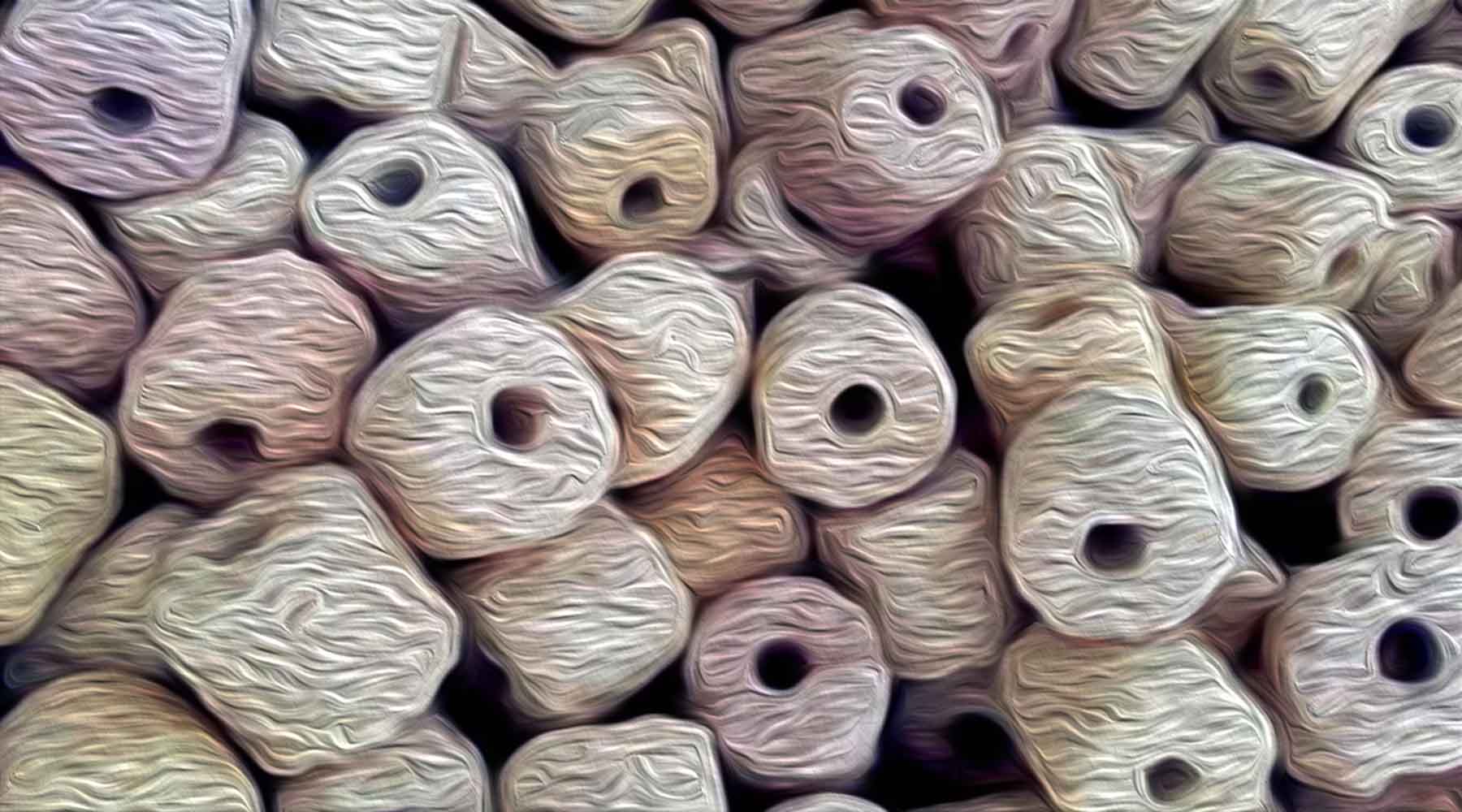
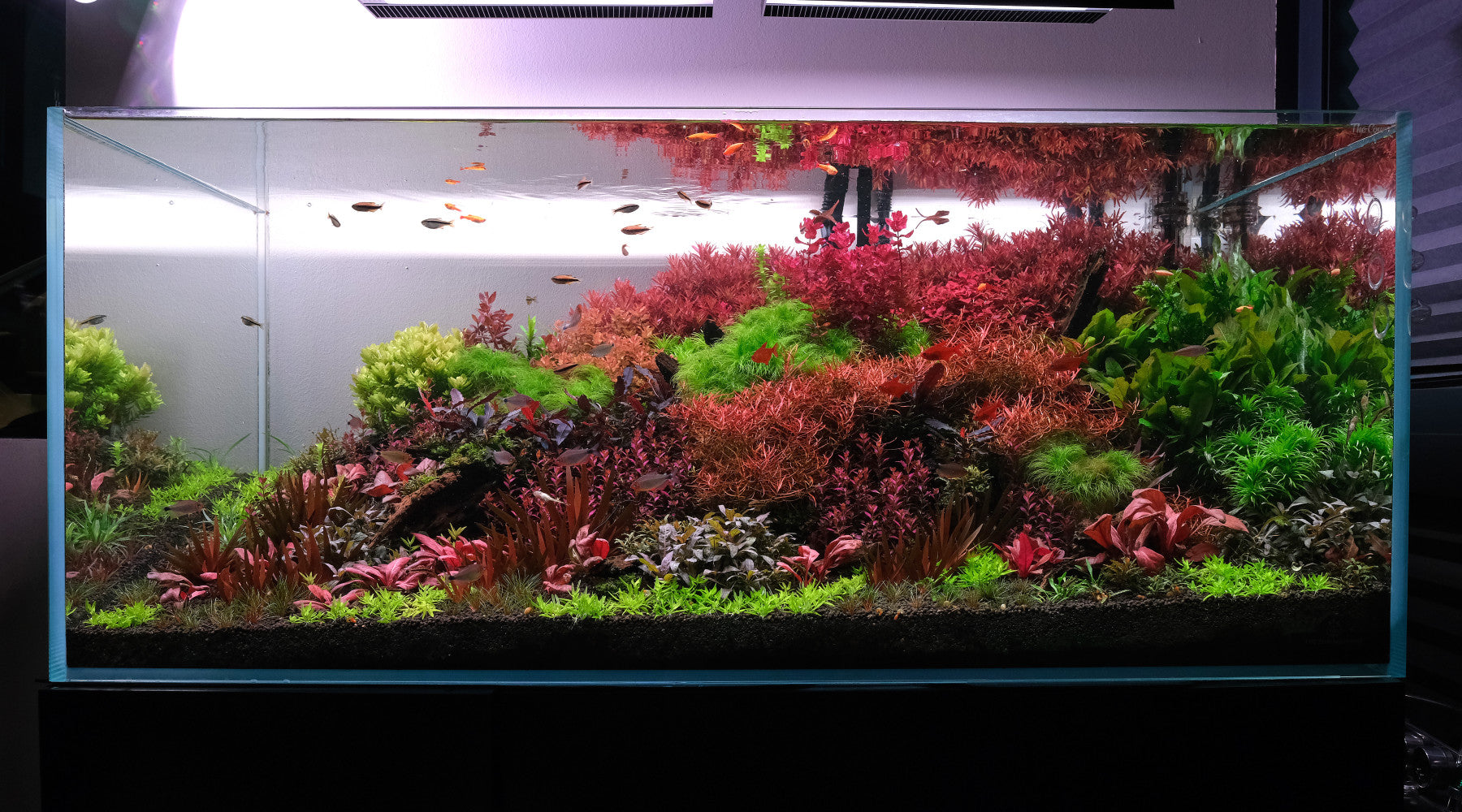
Plain filter foam does nearly everything the expensive media does. The choice that actually changes outcomes is how much media you run, not which brand it is. Sponge is cheap, effective and needs servicing; ceramic never fully clogs but catches less, and its surface-area claims do not survive contact with a running filter. Every tank in the 2Hr Aquarist gallery runs 100% sponge.
- 30ppi foam is the default if you run a single media. 20-30ppi works where the filter is oversized for the tank, which is what we do.
- Above 40ppi captures the finest particles but clogs fast enough to need a pre-filter in front of it.
- The media needed for ammonia oxidation alone is surprisingly small. The media needed to polish water to a low bacteria count is considerably more.
- Surface-area claims are marketing. Fine pores clog with biofilm within weeks, and water flow barely penetrates the interior of ceramic media.
- Anaerobic nitrate-reducing cores are unproven. Plants do the job measurably: a well planted CO2 injected tank drops nitrate 5 to 8ppm in 24 hours.
- Buy an oversized filter and enough media to fill it. Spend the rest of the budget on equipment that changes results.
Why have a filter?
Most bacteria adhere to surfaces rather than the water column. A filter therefore acts as a safe habitat for bacterial colonisation. While free floating bacteria exists, the majority of microbes prefer to attach to surfaces where they form bio-films. Such bio-films protect the microbial life within and also provides a conducive micro-climate for them to function. Filters thus work by providing large surface areas for microbial communities to build bio-film. Most microbes also require oxygen to carry out their activities. Water flow brings both oxygen and food to microbial communities and is essential when thinking about filter media.
The action of bacteria in oxidising ammonia is oxygen dependent (aerobic). Having a ton of surface area but no flow isn't efficient for aerobic ammonia oxidising activity and this is the main criticism of ceramic media types. On the other hand, ammonia oxidising microbes are very efficient, and even a small amount of filter media can process significant amounts of ammonia.
While the ammonia oxidation cycle takes the prime spot in aquarium filtration, it is not the only function that filtration provides. Water quality is not just tied to ammonia readings. Good water quality in aquariums is closely linked to having low pathogenic microbial count in the water column, and this is in turn is closely linked to having healthy populations of heterotrophic microbes that feed on and control populations of free floating microbes. It takes a lot more filter media surface to cultivate such populations of heterotrophic microbes, compared to the amount of media required to just complete ammonia cycling. This is the reason why many hobbyists have "perfect parameters" but still suffer regularly from fish health issues associated with poor water quality - because they have enough media to complete ammonia cycling, but not necessarily enough media to maintain high water quality. That failure mode, and what else stresses fish in a tank that tests clean, is covered in why perfect parameters do not guarantee healthy fish.
From a hobbyist point of view, microbial interactions are invisible to the human eye but manifest in other observable symptoms in the aquarium. Cloudy water, or bad smelling aquariums almost always signify poor microbial balance in the aquarium and a lack of heterotrophic bacteria - these are aquariums that can benefit from more filtration.
Crystal clear water, and absence of foul odours are both signs of an aquarium that has adequate filtration.

Sponges vs ceramic/hard media for filters
Sponge media: cheap, effective, needs servicing
Sponge media contains a large amount of air space that can trap detritus and subsequently provide surfaces for bacteria bio-film to form.
Filter sponges differ in mainly in rigidity (cheaply made ones would compress over time), and pore spacing. Large pore spacing is less easily clogged but may not capture fine suspended particles easily. Small pore spacing sponges capture small particulate matter well but is more easily clogged. The main reason for using different types of filter sponges is that placing coarse filter sponges before fine filter sponges allow the coarse sponge to capture larger sized particulate matter which would otherwise clog the fine filter sponge quickly.
Sponges below 30 ppi (pores per inch) are less efficient at mechanical filtration and capturing fine suspended solids. They are good for capturing large particulate matter such as uneaten fish food, plant detritus, broken leaves and thus act as pre-filters for finer filter sponges. Sponges above 40 ppi (such as fine filter floss) are very good at capturing small particles; those nearly invisible to the naked eye - but these sponges clog more easily and require more regular servicing - or they should be placed after a pre-filter. If using only 1 type of filter sponge, then choosing a sponge around 30 ppi will generally work well. Coarser than that, 20 to 30 ppi, still works provided the filter is oversized relative to the tank: the extra total media compensates for the wider pore spacing. That is the combination we run ourselves, and it is why our own figure looks coarser than the general recommendation.
Fine filter floss collapses over time; these tend to need to be replaced rather than rinsed out. Unless you replace them regularly, they can clog pretty easily. However, their fine structure captures small particles the best.
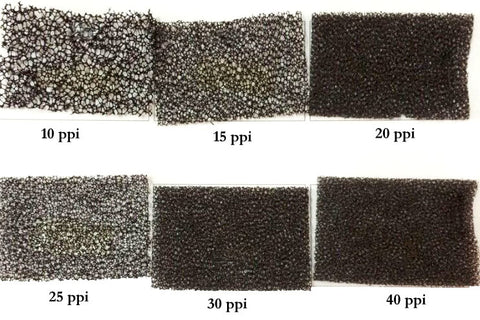
The pore spacing within foam also means that water flow can reach all areas efficiently - as long as the pores do not get clogged. The main advantages of foam media is that they are cheap and very effective. The only downside is that sponge media can get clogged easily if larger sized detritus is allowed to reach fine pored media.
Ceramic media: never clogs, and the surface-area claims do not hold up
Bio-filter media such as ceramic, sintered glass or expanded clay are designed with high surface area to provide ample space for microbial colonisation. The main advantage of ceramic media is that it does not collapse and does not get clogged easily due to the large pore spaces between ceramic pieces.
While ceramic media is sold with plenty of advertising claims such as having a huge amount of surface area available for microbial colonization, actual usage in practical examples do not show any significant advantage over cheaper media such as sponges. Fine pore spaces is very quickly clogged by fine particles and bio-films, so having a huge number of such pore spaces that are immediately evened out by a surface of bio-film gives no competitive advantage. Additionally, water flow passes the surface of ceramic media, but does not penetrate far into the media itself. Breaking apart ceramic media also shows little internal bio-film formation in deeper layers of the ceramic media.
Some brands will boast that they have 1000 times the surface area of basic filter sponges. Whilst this claim may be true in theory, the real world performance of high-end filter media is often not significantly better than using cheap, boring, ordinary filter foam. Similarly, having a lot of surface area that does not have good access to water flow and oxygen will not achieve much in terms of ammonia oxidation. Bacterial biofilm and organic waste clog the fine pores of high-end media that claim to have very large porous surfaces. Biofilm and organic matter also add colonisation surfaces to coarser media that may not have as much theoretical surface area.
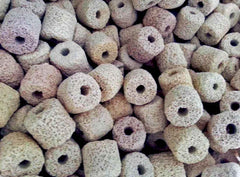
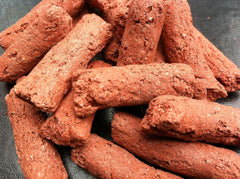
Some bio-media advertises having anaerobic internal portions that can reduce nitrates in the water column through anaerobic bacteria action taking place in the core. Biohome and Seachem Matrix are the best known examples. Water flow is necessary to deliver nitrates for the process, yet needs to be slow enough to prevent the core from being aerobic. Is this even possible has not been proven, and there is no good data on the actual claims made on such media. This is contrasted against plants which do uptake nitrates significantly in a measurable way. A well planted CO2 injected aquarium can reduce nitrates by 5 to 8ppm in a 24 hour window.
So what should you actually buy?

At 2hr Aquarist we mostly use Oase Biomasters for filters and we use 100% sponge media (30 - 20ppi foam) inside. It is a simple setup that works well to polish water to high clarity. The slight over-sized filters vs tank size means that there is plenty of media. This is by far the most important decision when thinking about filtration - do you have enough media to polish water to high clarity without the usage of additional additives such as Purigen.
Aquarists can use more ceramic media if you are lazy on maintenance as they do not clog as easily as sponges. However, there is no magic media that provides a significant edge and aquarists should spend their money on other pieces of more impactful equipment instead.
For the order to stack it in, see filter media layout and sequence. For the biology underneath - what the microbes need, and why biological maturity matters more than a zero ammonia reading - see tank cycling and biological maturity. A new filter also has to be seeded before it can do any of this: how to cycle a planted tank.



Share:
Tank cycling and biological maturity in planted aquariums
Should You Cycle a Planted Tank Before Planting? The Dark Start Method